Indian contributions to math
C. K. Raju,
Visiting Professor, IIT Mandi
Created: 2025-09-26 Fri 14:01
Introduction
- The Bollywood film पूरब और पश्चिम spread the narrative
- that India’s contribution to mathematics was zero,
- as in its famous song जब ज़ीरो दिया मेरे भारत ने…
- But this is a WRONG narrative.
- Actually, India contributed a LOT more
- Europeans learnt much mathematics from India
- including
- arithmetic,
- algebra,
- trigonometry,
- calculus, and
- probability and statistics.
Key point
- Indian gaṇita was SUPERIOR
- European math was inferior
- but Europe misunderstood and transformed Indian ganita, such as calculus, to math
- Some important consequences of the fact that gạnita ≠ math are in different ways of teaching
- arithmetic in primary school(1-5)
- geometry in 6th to 9th
- trigonometry (10th)
- calculus (in XI and XII).
Arithmetic
- Indian arithmetic which used place value
- was far superior to Greco-Roman (pebble) arithmetic
- Q. Can you write 1888 in Roman numerals?
- Note: addition with Greco-Roman pebble arithmetic very inefficient
- 89 + 79 requires 18 operations instead of 5
- Multiplication very very inefficient
- to do \(89×79\) we must add 89 to itself 79 times or (\(18 × 79\) operations)/
- Thus Indian arithmetic was very efficient ad superior
- Arabs understood the superiority of Indian arithmetic, and
Arabs quickly adopted Indian arithmetic
- al Khwarizmi wrote Hisab al Hind in 9th c.
- (hence word algorithm from his Latin name Algorithmus)
Europeans learnt from Arabs in Spain, and Africa
- some 2 centuries later
- via Gerbert (pope Sylvester II), Toledo translations (Adelard of Bath), Fibonacci.
But Europeans were duffers
- They took some 900 years to grasp primary school arithmetic.
Gerbert
- Gerbert realized that Indian place value system could be used to represent large numbers
- he got an 27 column abacus constructed with apices
- but fail to understand that the use of an abacus kills the efficiency of place value arithmetic
Fibonacci
- a Florentine trader understood the efficiency of Indian arithmetic
- hence its great usefulness for commerce
- Alas, he failed to understand negative numbers (like al Khwarizmi).
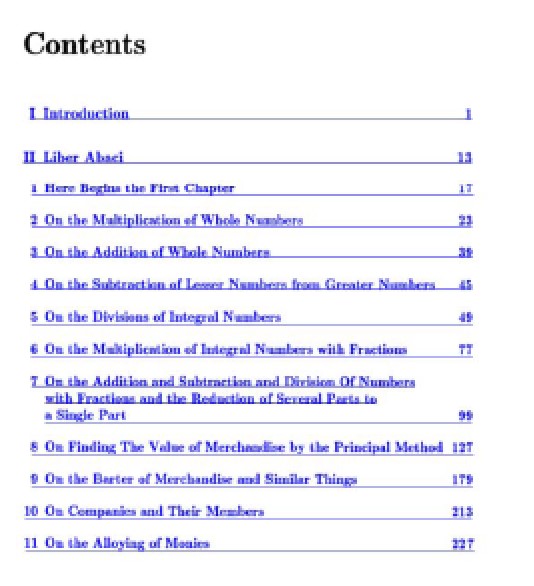
- Compare Fibonacci Liber Abaci toc with Mahavira's toc
Europeans failed to understand zero
Suspicion of zero
- Adding zero at the end can inflate a contract
- (not possible with Roman numerals: only III can be added at the end)
- Hence Florence passed a law against zero in 1299.
This sort of foolishness went on till end 19th c.
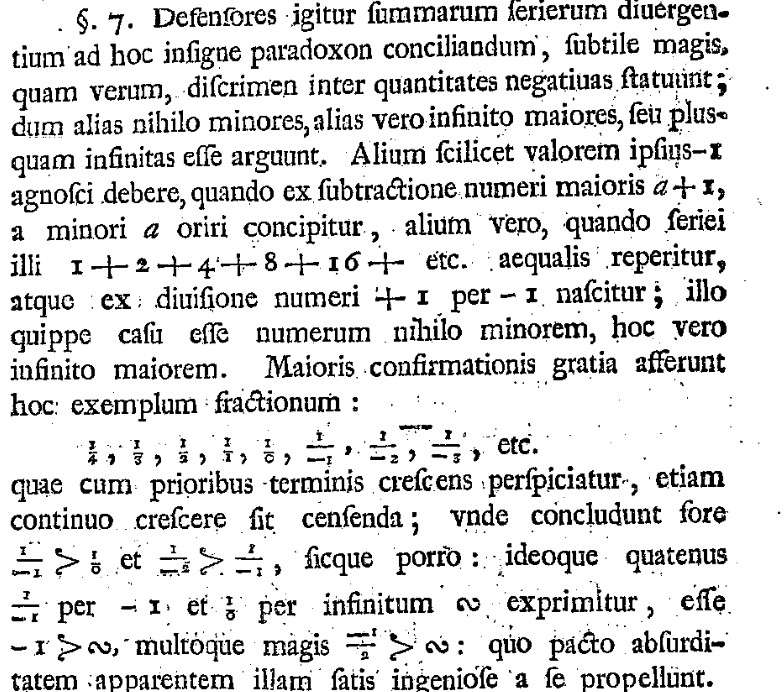
Euler: two kinds of \(-1\)?
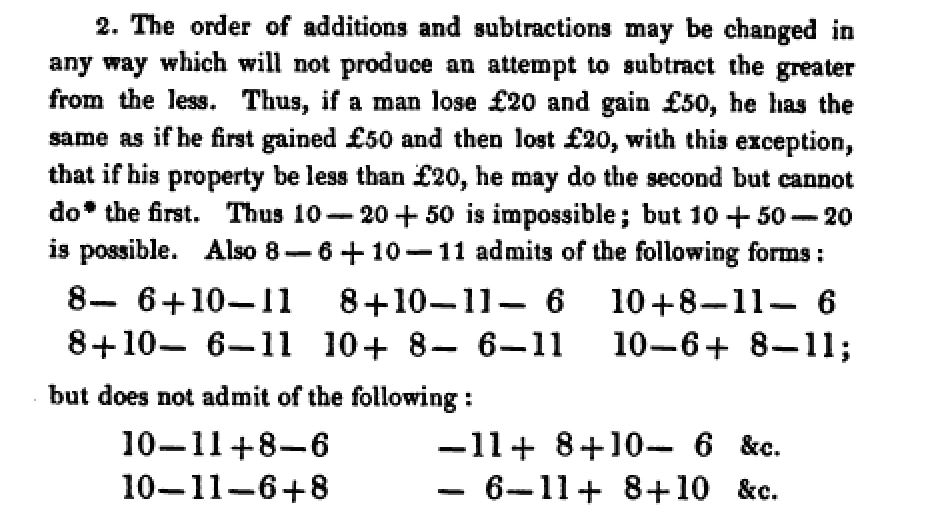
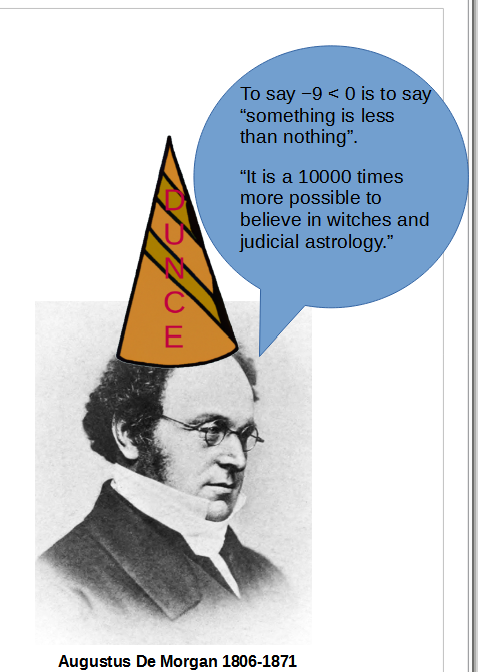
Augustus De Morgan: Dunce
But modern-day Indians but even more foolish
- in 1835 before de Morgan,
- Macaulay said the West is immeasurably superior in math and science
- we believed him in change our entire education system especially STEM
- now we can change it back
- School teachers and students have no power to change
- Neta-s and babu-s do not know mathematics
- foreign experts will not allow a change.
Toledo translations ca. 1125
- Written as consonantal skeleton "jb" (without nukta-s) like "pls" in SMS.
- Misread by Mozharab/Jew 12th c. Toledo mass translators as common word "jaib" = जेब = pocket.😊
- but we are convinced that we must ape the superior West
- Hence, you still use that translation mistake "sine"
- Word "trigonometry" involves a conceptual error: it is about circles not triangles.
- Hence my pre-test question what is \(\sin 92^∘\)? (In a right-angled triangle there cannot be any angle of \(92^∘\).)
Evidence of theft
- In 1834 Whish pointed out the similarity
- of Gregory, Newton, and Leibniz infinite series
- with series for arctan, sine series, and series for π in various Indian texts
- This remained suppressed for some 175 years.
Key point is that Indian calculus was different
Real numbers taught in class IX text
- but NOT easy
- Hence California cancelled the calculus
- E.g. my challenge to axiomatically prove 1+1=2 in real numbers
- from first principles without assuming any theorem of axiomatic set theory.
What difference does it make to school teaching
Probability and Statistics
Mahabharata (Sabha parva)
- Shakuni wins the dice game by deceit
- Hence, there was an idea of a "fair (or unbiased) game".
Mahabharata (Van parva 72)
- Story of Nala and Damayanti
- Their separation. Disguised Nala takes a job as a charioteer with Rituparna, king of Ayodhya.
- Damayanti announces swayamvara (widow remarriage).
Counting the fruits on a tree by sampling
- Nala and Rituprana dash to Vidarbha.
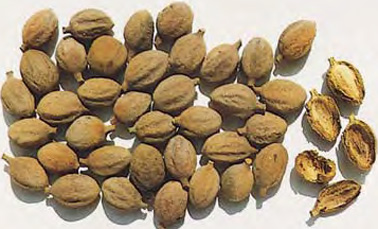
- Stop on the way near a Vibhitaka tree (mentioned in the aksa sukta)
- the five-sided fruit of which was used in game of dice.
- Rituparna shows off his knowledge of ganita, by counting the 2095 fruits on the tree.
Conclusions
- Much mathematics originated in India
- Many aspects (rajju ganita, calculus etc.) better than Western math
- but we can't easily teach it in schools
- Because we are still colonised.