Eclipses

Solar eclipses

When does an eclipse occur?

  • This can happen only when the sun, moon and earth are very nearly in a straight line.
  • This does NOT happen at every full moon (purnima) or new moon (amavasya).
  • Why not?

  • Because, the plane of the lunar orbit around the earth
  • is at an angle to the plane in which the sun appears to revolve around the earth (Ecliptic). - The angle is about \(5^∘ 7' 47.9''\).

  • Therefore, an eclipse does not happen at every amavasya,
  • but can take place only when both sun and moon are near one of the moon's NODES:
  • these are the two points at which the orbit of the moon intersects the ecliptic.

  • the ecliptic is the plane in which the earth revolves around the sun
  • or the sun is seen to revolve around the earth.
  • Indeed, the name ecliptic comes from this fact known from ancient times that
  • eclipses are possible only when the sun and moon are near the nodes.

Rahu and Ketu

  • there are two nodes: an ascending node, and a descending node.
  • these are called Rahu and Ketu in Indian tradition.

Science or superstition?

  • Rahu and Ketu our declared superstitions by numerous colonized historians (such as Romila Thapar).
  • Journalists repeat this,
  • without the foggiest idea about the scientific meanings of these terms, Rahu and Ketu in India
  • or of the theory of eclipses, how eclipses are scientifically predicted,
  • or how this was actually done in India for thousands of years.

Scientific temper or Colonial temper

Origin of science

  • the Surya Siddhant pre-dates the Bible
  • and its superstitious God's-anger theory of eclipses
  • but no colonial historians are today has admitted that the West was wallowing in superstition about eclipses
  • when Indians had scientific theory.

The round earth: gola

  • Eclipses are not the only example.
  • an understanding of eclipses presupposes an understanding of the nature and positions of the sun, the moon, and the earth
  • Indians knew the earth was round, its very name is bhugola
  • they knew earth stands support-less in space

Radius of earth

  • Indians inferred the earth was round from the fact that far-off trees cannot be seen
  • this fact was used to calculate the radius of the earth
  • but the Bible says the earth is flat, and that tall trees can be seen from the four corners of the earth

Why will colonized not admit early Indian knowledge of science?

Types of solar eclipses

  • Three types of solar eclipses: total, annular and partial
  • A total solar eclipse is possible because of the strange fact unique to the earth
  • that the apparent diameters of the sun and the moon are the same.

Annular eclipse

  • But the apparent diameter of the moon varies with its distance from the earth.
  • This is what happens in the case of an annular solar eclipse
  • when the apparent diameter of the moon is a bit smaller than that of the sun,
  • because the moon is further away.

Type depends upon observer

  • The classification of an eclipse depends also on the position of the observer:
  • e.g. some observers may see a total eclipse while others see it as a partial eclipse.

Theory of total solar eclipse

  • Will consider only the theory of a total solar eclipse;
  • the other cases are similar.

Objects not geometrical points

  • Sun, the moon, and the earth must be nearly in a straight line for an eclipse,
  • this does NOT mean that the centers of the three bodies must be in a straight line.
  • The sun, the moon and the earth are bulky real objects,
  • not imagined geometrical points with no size.
  • Eclipse may happen even when the centers are not in a straight line.

Spheres and discs

  • Though sun, moon, etc are spheres, a sphere from a distance looks like a circular disk.
  • An extraordinary fact unique to the earth’s moon and the sun is this
  • though the sun is 400 times bigger than the moon, it is also 400 times distant.
  • Therefore, on looking at the sky one gets the impression that the sun and the moon are the same size.

Artificially designed?

  • Hence a total solar eclipse can take place.
  • This can happen only on the earth (not on any other planet in the solar system)
  • almost as if it were an artificially designed system to ensure that
  • its inhabitants learn astronomy.
  • However, this is not shown in the diagram.

Geometry of a solar eclipse

  • Here, the sun, moon, and the earth are represented as circular discs, with centers at S, M, E respectively.
  • AB is a line tangential to both the sun and the earth.
  • The moon, rotating clockwise, is in a position
  • where its disc just touches the line AB at the point C.

Referring to figure 1,

  • we see that if the angle MES,
  • the angular separation between the sun and the moon as seen from the earth, becomes any smaller,
  • some part of the sun will be eclipsed as seen from some part of the earth.

Eclipse limits

  • We can write MES as the sum of three angles
  • MES = MEC + CEA + AES
  • Now ECB is the external angle to the triangle EAC,
  • ∴ it is the sum of the angles CEA and EAB.

ECB = CEA + EAB

Eclipse limits (continued)

CEA = ECB - EAB

MES = MEC + AES + ECB – EAB (1)

  • The first two angles on the RHS are the apparent semi diameters of the sun and moon, as viewed from the earth,
  • which is around \(0.54^∘\) or \(32’\).

Horizontal parallax

  • The last two angles are the semi diameter of the earth as viewed from the moon and the sun.
  • These are also called the horizontal parallax.
  • the parallax of an object is the change in its angular position (direction)
  • when seen from two different points.

Parallax from a moving train

  • The further away an object the smaller its parallax.
  • therefore when seen from a train
  • far-off objects seem to move with the train
  • while nearby objects get left behind

Parallax of sun or moon

  • is defined as the difference in its direction
  • (a) as seen by an observer on the surface of the earth, and
  • (b) from the earth's center.
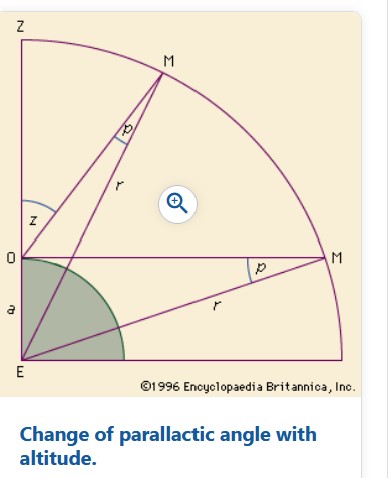
  • That parallax varies with the altitude of the sun or moon.

Horizontal parallax

  • If \(z\) is the angle from the Zenith,
  • and \(p\) is the parallax,
  • and \(a\) is the semi diameter of the earth,
  • we can solve the triangle EMO.

  • \(\frac{\sin p} {a} = \frac{\sin (π -z)}{r}\)
  • or \(\sin p = \frac{a}{r} \sin z\)
  • the horizontal parallax is when \(z = 90^\circ\), so that
  • \(\sin p = \frac{a}{r}\)

  • As can be seen from the figure the horizontal paralax
  • is also the angular semi diameter of the earth as seen from the moon.
  • Its value (as measured by measuring horizontal parallax) is \(57′02.6″\).
  • Likewise, the solar parallax is \(8.797″\) .

  • Putting these values in equation 1
  • gives \(32’ + 57’ = 1^∘ 29’\).
  • This is only a rough value because the distances of the sun and moon from the earth are constantly varying.
  • Actual value varies between \(1^∘ 14’\) and \(1^∘ 38’\).

Ecliptic limits

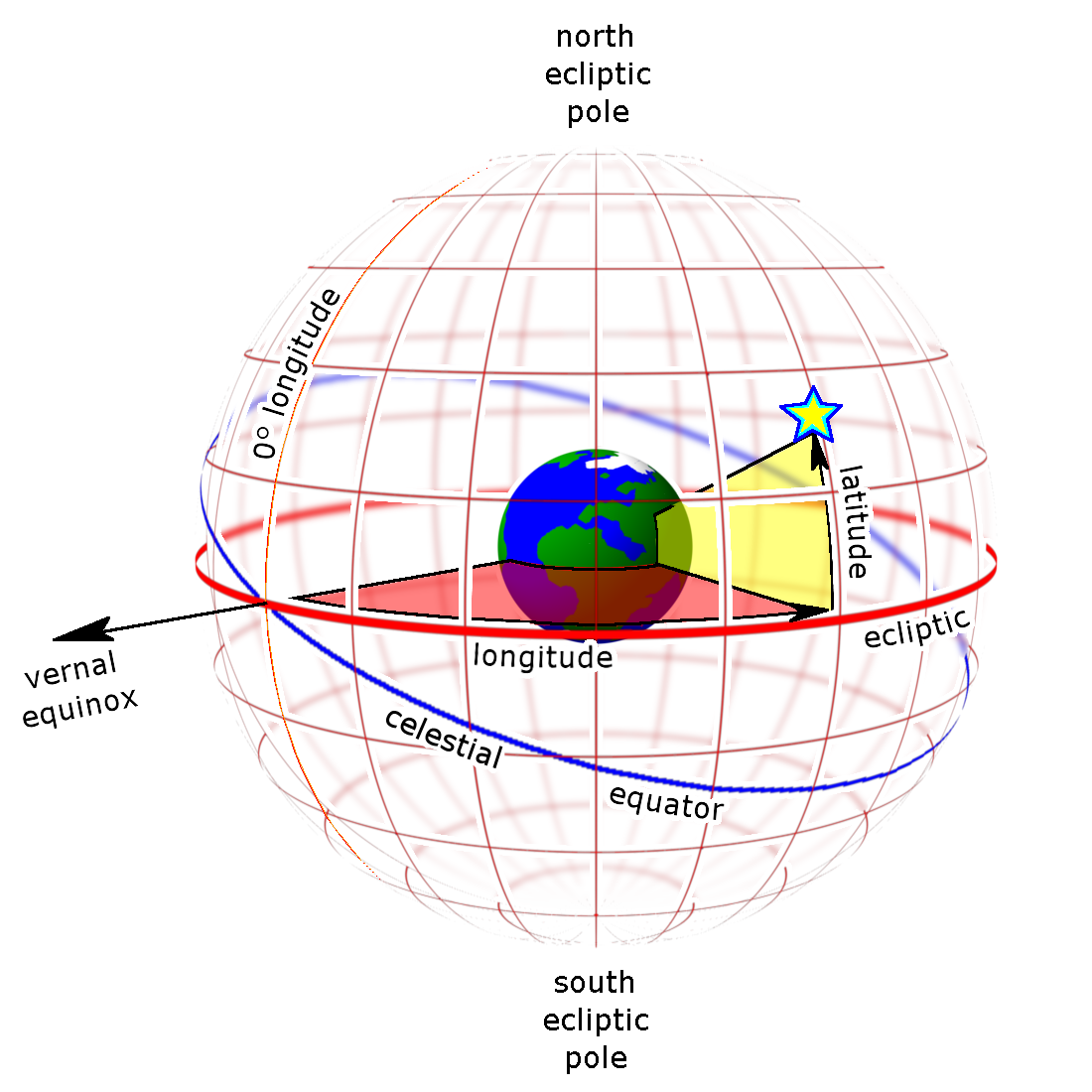
  • When the sun and moon are in conjunction they have the same (ecliptic) longitude,
  • Therefore the angle MES is just the moon's (ecliptic) latitude.
  • Therefore, if the latitude diffference of the sun and new moon is less than \(1^∘ 38’\) there may be an eclipse of the sun,
  • and if it is less than \(1^∘ 14’\) there must be one.

-These are called the ecliptic limits.

When will and eclipse occur

  • Next let us calculate when the sun is close enough to a node to enable an eclipse.

A spherical triangle

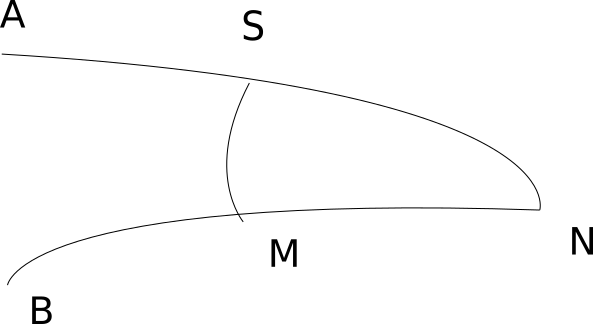
  • In the figure AN represents the sun’s trajectory on the ecliptic
  • This is a great circle (badly drawn) on the celestial sphere.
  • BN represents the moon’s trajectory, another great circle.
  • Finally we draw a secondary SM to the ecliptic:
  • i.e., a great circle passing through the poles of the ecliptic plane.

  • These three great circles make a spherical triangle SMN.
  • This is a right-angled spherical triangle
  • because the secondary will intersect the ecliptic at right angles
  • (it is in a plane perpendicular to the ecliptic).

Data to solve the spherical triangle

  • The angle SNM is the angle between the plane of the lunar orbit and the ecliptic, namely \(5^∘ 7' 47.9'\).
  • Since SM is a secondary to the ecliptic, the angle at S is a right angle.
  • SM represents the angle between the sun and the moon near the node N,
  • for which we have obtained the ecliptic limits above.

Solving the spherical triangle

  • We can solve this right spherical triangle given that we know
  • (1) one side making the right angle and
  • (2) the angle opposite it.

Trigonometric identities for spherical trigonometry

Napier's mnemonics

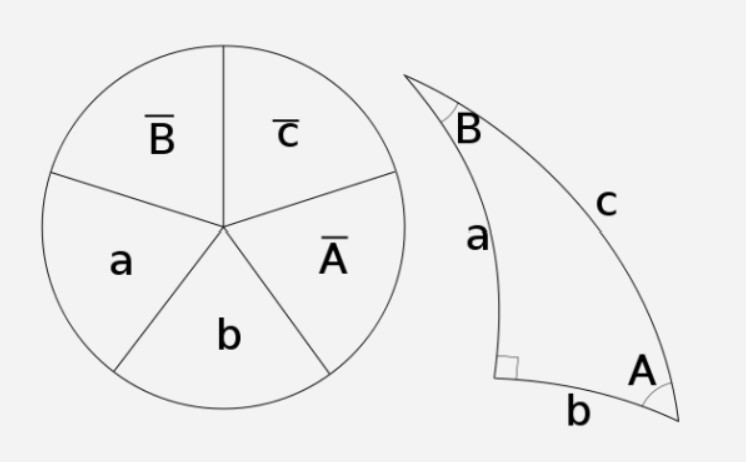
  • SIN-TAAD rule: in Napier’s circle, the sine of any term (called "middle part"), equals the product of the tangents of the adjacent parts.
  • SIN-COOP rule: the sine of any term equals the product of the cosines of the "opposite" parts in Napier’s circle.

  • In this case we know a = SM, one of the arms of the right angle at S,
  • we know the angle A = N opposite it.
  • We have to find b = SN the other arm of the right angle.
  • So, we apply the SIN-TAAD rule to b as the "middle term",
  • whose adjacent parts in Napier’s circle are a and Ā.

  • We can calculate using the figure of \(1^∘ 29’\) we obtained earlier
  • \(\sin b = \tan (1 29/60) \tan (84.856) = 0.02589 * 11.10999\) giving \(b = 16.72\)
  • That is a solar eclipse may be expected when the sun is within \(17^∘\) of a node.

Date of a solar eclipse

  • Since the sun moves about \(1^∘\) along the ecliptic each day
  • (since it covers \(360^∘\) in one year)
  • we look for a date in a 34-day window
  • around the node.

Step 1.

  • We need is the ecliptic longitude of a lunar node (Rahu) in that year (the other note is 180 degrees)away
  • This can be obtained from the NASA horizons interface with the moon as the target body and ecliptic coordinates.
  • or use a Python program such as py-ephem or skyfields
  • Since the node is on the ecliptic by definition its ecliptic latitude is 0.

  • Note that a mode is not exactly fixed but moves by about 19.355 degrees per year westwards (retrograde motion)
  • or about 1.5 degrees per month or one rotation in 18.6 years

Step 2.

  • Find the date of the spring (vernal) equinox in that year.
  • One can use pyephem for this. See ephem-utils.py.
  • (Available functions: previoussolstice(), nextsolstice(), previousequinox(), nextequinox(), previousvernalequinox(), nextvernalequinox().)

  • At this date (vernal equiniox) the ecliptic longitude of the sun is zero.
  • Since the sun goes round the ecliptic at nearly 1 degree per day,
  • the ecliptic longitude of the node gives us the approximate number of days in which the sun will arrive at that node since equinox.
  • A 34 day window around that date is the eclipse season for that node.
  • And similarly for the other node, six months or 180 degrees later.

Step 3.

  • In this 34 day window find the exact time(s) of 1 or 2 amavasya-s.
  • Then find the exact latitude of the moon at those times, and check to see
  • if the conditions for an eclipse are satisfied, i.e., it is within the ecliptic limits.

Step 4:

  • Can also find the place from where it can be seen by looking at
  • the closest point on earth (sub-lunar point for the moon) at that time.

An example calculation

  • Thus, for 2021 we have:

Equinox: March 20, 2021/3/20 09:37:27

  • Times of passage of the moon through nodes (from table or lunar orbit + coord-convert.py:
  • Apr 16 05:53 04h39.6m +22°09.1' 71:26:24.8 -0:00:06.7
  • May 13 10:29 04h36.4m +22°02.9' 70:41:30.6 -0:00:03.4

  • March 20 to May 20 is only 61 days.
  • So, the eclipse season is roughly June. we need at least one more month.
  • Jun 09 16:42 A 04h36.8m +22°03.7' 70:47:07.7 -0:00:03.1 (note departure from mean motion)

  • If we quickly examine the phases of the moon from https://stardate.org/nightsky/moon,
  • or use ephem-utils.py
  • we see that June 09/10 is also an amavasya. Pyephem gives 2021/6/10 10:52:37 as the exact date-time.
  • The time difference from the equinox is 82.05 days.

  • If we examine the coordinates of the sun and the moon at the time of the new moon we get
  • Moon: 79:47:05.9 0:49:38.1
  • Sun: 79:47:05.8 -0:00:07.0 (sun latitude should be 0)
  • So, the difference of latitude is \(49’45’’\) or less than 1 degree.
  • Therefore, a solar eclipse must occur around 2021/6/10 10:52:37.

Lunar eclipse

  • While solar eclipses are more frequent
  • they are visible from only a small region, because the moon is small and its shadow is smaller.
  • But while lunar eclipses are relatively less frequent,
  • a lunar eclipse is visible over half the world where it is night.

  • Therefore, in a given location it is more common to observe lunar eclipses
  • than to observe solar eclipses.

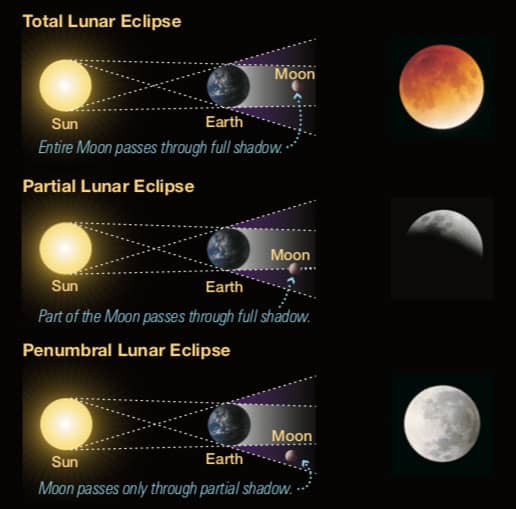
Types of lunar eclipses

Geometry of a lunar eclipse

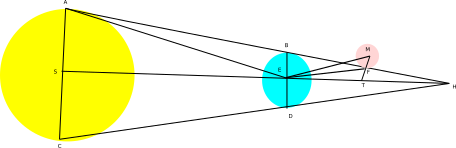
  • Let S, E, M denote the centers of the sun the earth and the moon respectively,
  • assuming that both the sun and the moon are near the lunar nodes So that they are all nearly in one plane.
  • As shown in the diagram, the moon is just about to enter the shadow of the earth,
  • and will do so if the angle MET reduces any further.

Now

  • MET = MEF + FET
  • here, MEF is the apparent semi diameter of the moon as seen from Earth.
  • Now, angle BFE is the external angle to the triangle EHF.
  • Therefore, BFE = FET + FHE.
  • That is,

FET = BFE - FHE.

  • Now, AES is the external angle to the triangle AEH.
  • Therefore,

AES = FHE + BAE,

  • or

FHE = AES - BAE.

  • Here, AES is the apparent semi diameter of the sun as seen from the earth.
  • FET = BFE - AES + BAE,
  • or

MET = MEF + BFE + BAE - AES

Here

  • F is the apparent semi diameter of the moon as seen from Earth, \(0.54^∘\) or \(32’\)
  • BFE is the parallax of the moon \(57′02.6″\) as before.
  • BAE is the parallax of the sun, \(8.797″\). as before
  • AES is the apparent semi diameter of the sun as seen from the earth, \(0.54^∘\) or \(32’\)
  • Thus, the limits for a lunar eclipse have been established in terms of known and measurable quantities.

  • This comes out to about \(58’\).
  • But in actual practice in this varies from about \(50’\) to \(1^∘ 4’\).
  • With this data we apply the previous analysis: - the angle A = angle N = \(5^∘ 7' 47.9''\) = angle between lunar orbital plane and the ecliptic,
  • the angle \(a = 58’\) or according to the limits above.

  • Thus,

\(\sin b = \tan (58/60) \tan (84.856)\)
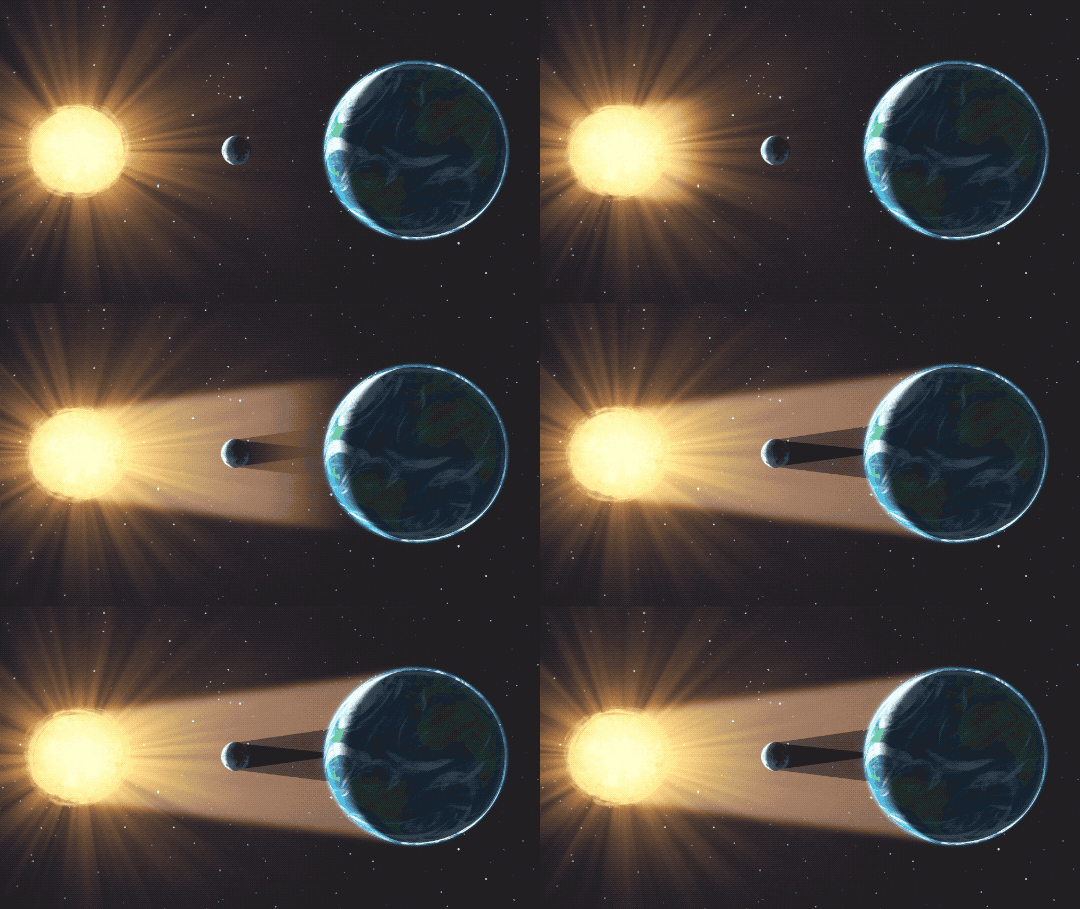
  • which gives \(= 10.80^∘\)
  • Since even twice this period is less than a lunation, no full moon may occur,
  • it is possible for the sun to pass through a node without there being a lunar eclipse.