The Epistemic Test
CKR
Created: 2025-08-26 Tue 14:58
Difficulty with Understanding
- Just as Vasco and other Europeans had great difficulties with the kamāl,
- so also Europeans had great difficulty in understanding the stolen Indian calculus.
- In fact, these difficulties started much earlier
- with difficulties with algebra, arithmetic, and trigonometry
- all of which Europeans learnt from India.
Epistemic test-1 Algebra
- Word "Algebra" from "al Jabr waal muqabala"
- the title of a book by al Khwarizmi
- who partly translated 7th c. Brahmagupta's unexpressed arithmetic (अव्यक्त गणित)of polynomials
- and linear and quadratic equations
- found in BrāhmaSphuṭaSiddhānta.
Greek difficulties with square roots
Deaf roots
- In Indian शुल्ब सूत्र √2 = DIAGONAL (कर्ण) of unit square
- = root of square (मूल, Arabic जड़)
- But word कर्ण also means ear (=कान), as in warrior कर्ण in Mahabharata.
- Hence bad कर्ण mistranslated as bad ear = deaf! 😊.
Conceptual error
- As we will see later, this involves not only a translation mistake
- but also a serious conceptual error.
– The Indian algorithm of extracting square roots
- involves a non-terminating process for, say, √2.
- How are such nonterminating algorithms to be understood? This is an issue at the core of calculus.
Epistemic test-2: trigonometry
Toledo translations ca. 1125
- in the late 11th century the Muslim-ruled taifa of Toledo in Spain
- a part of the earlier Umayyad khilafat of Qurtuba (Cordoba)
- fell to invading Christian pre-Crusaders.
- From Sanskrit term for it ardh-jyā
- (half-chord) or जीवा
- rendered in Arabic as jībā (no v sound in Arabic).
- Written as consonantal skeleton "jb" (without nukta-s) like "pls" in SMS.
- Misread by Mozharab/Jew 12th c. Toledo mass translators
- as common word "jaib" = जेब = pocket.😊
- translated as sinus.
- Sine is taught as part of trigonometry
- Word "trigonometry" involves a conceptual error: it is about circles not triangles.
- Hence my pre-test question: what is \(\sin 92^∘\)?
- (In a right-angled triangle there cannot be any angle of \(92^∘\).)
Epistemic test-3: Arithmetic
Early Greeks and Romans were BACKWARD in arithmetic
- Names of small numbers similar in Greek, Latin, Persian and Sanskrit
- obvious e.g. सप्त (September), अष्ट (October), नव (November), दश (December)
- More details
But NO large numbers in Greek and Latin
- Greek and Latin numbers stopped at a myriad (10000).
- Though this is a puny number,
- in the English language
- it still connotes an infinitely large number!😀
But Sanskrit numbers go on
Greeks learnt Indian number-names
- But Persians too stopped at a myriad
- ="beavan" in Avesta (Ervad Rooyinton P. Peer, personal communication 25 July 2021)
- Same small numbers BUT no large numbers = Greeks learnt from Indians via Iran
- but learnt little.
Primitive pebble arithmetic
- WHY did Greek and Roman arithmetic lack large numbers?
- there was a STRUCTURAL reason.
- Bcoz Roman/early Greek arithmetic was PRIMITIVE, done using pebbles
- and a counting board (called an abacus) as depicted in the Dara (Darius) Vase $-4$th c. CE.
The Roman calculus 😜
- The Latin word "calx" means "pebble" or "gravel stone"
- calculi are thus little stones (used as counters)
- In Greek the pebbles were called psḗphoi and
- the word for "to calculate" is psēphizein (literally, "to pebble")🤣
- Note: In early Greek, the letters used above are the initial letters of
- pente(ΠΕΝΤΕ), deca (ΔΕΚΑ), hecaton (HECATON), xilioi(ΧΙΛΙΟΙ), mypio (ΜΥΡΙΟΙ).
- Hence, described as acrophonic by a Roman historian Herodian of Syria (+3rd c.) until which time they were clearly in use.
- In the early Greek system of writing (till +6th c. CE), only CAPITAL letters were used as in this +4th c. Greek Bible.
Beware
- Western history-cheaters confound it with Minuscule developed in late Byzantine Greek (Turkey) mid-9th c.
- Hence, very wrong to attribute 9th c. knowledge to early Greeks like Archimedes.
- (Greek) Attic numerals used from earliest Greeks times.
- Attic is a dialect of Greek in which donor lists and amounts were written on stone tablets in Athens from about the −5th c. CE.
- So, this system of "Attic numerals" prevailed in Greece from about −5th c. CE to +3rd c. CE (the time of Herodian).
- i.e., until Roman conquest of Greeks.
- This should be clearly separated from
later Byzantine Greek texts.
Both Roman and early Greek
- are adapted to this pebble arithmetic ( गणित)😀
- or coin-counter arithmetic; e.g. XVII=10+5+1+1.
- This already tells you WHY Graeco-Roman arithmetic was limited to small numbers.
- 10000 pebbles is a lot of pebbles!)😀
Indians used the superior place-value system
Important note on zero
- Place value system needs a place-holder: e.g. write 603. What will you put in 2nd place?
- Place holder was zero as in Aryabhata's "ख द्वि नवके" = two nines of zeros (for 18 places).
- Hence, zero existed in India since place value arithmetic, i.e., Vedic times
- contrary to foolish western claims of its later origins.
- But let us return to the main topic.
India had extensive trade with Roman empire
- but Romans could not say what a myriad myriad (\(10^5 \times 10^5 = 10^{10}\) = 10 billion is.
- Surprising that Romans never learnt arithmetic from India!
- or how to represent large numbers.
- Moral: Ignorant people (duffers?) take much time to understand their ignorance!
- Note: Should I say White Europeans were an inferior RACE (as they did about us)? But I am NOT doing that right now.
Interim summary
- Graeco-Roman arithmetic was backward because it was PEBBLE ARITHMETIC
- Hence could not represent large numbers
- as Indian arithmetic with place value easily did from Vedic times.
- Cartoon summary.
Backward pebble arithmetic persisted in Christian Europe
- Backward Roman and Greek arithmetic
- continued into Christian Europe (later called "Holy Roman Empire")
- To begin with it continued for 1500 years after Dara, until 10th c.
The learned but foolish pope
- Then, a very learned Christian European, Gerbert (Pope Sylvester II, died 1002)
- finally understood the backwardness of Roman-Christian arithmetic.
- Wow! Took 1500 years!😀
Gerbert imported Indian arithmetic
- thus admitting the inferiority of Roman Christian arithmetic,
- he imported Indian arithmetic from Muslim Cordoba (Umayyad Khilafat)
- This was not an easy step,
- because the church hated Muslims
- and fought a long religious war with them
- (pre-Crusades from mid-11th c., and Crusades from end-11th to 16th c.)
Indian arithmetic reached Cordoba
- via 9th c. al Khwarizmi of Baghdad (Abbasid Khilafat)
- who wrote a book Hisab al Hind
- But Gerbert called this arithmetic "Arabic numerals". 😀
Two terms: "Arabic" and "numerals"
- "Arabic" wrong, but excusable since Gerbert got it from Arabs.
- "Numerals" a major blunder by Gerbert
- as if what had changed was only the way of writing numbers
- when what changed was the whole way of doing arithmetic.
Gerbert's apices
- Apices were Gerbert's striking innovation!😀
- That is, instead of having, say, 7 pebbles,
- he had one pebble with the number 7 written on it,
- using Arabic notation, in 976 CE.
Gerbert's achievement
- Large numbers could at long last be
- written in Roman-Christian arithmetic
- by copying the Indian place value system.
- Note: place-value system existed elsewhere (e.g. among Maya) but Europeans learnt it from India via Muslims.
Gerbert's blunder
- He made an abacus for Indian arithmetic.
- bcoz he wrongly assumed that all arithmetic needs an abacus.
- This blunder came naturally to Gerbert
- for he had written a book on the abacus
- BUT abacus subverts the EFFICIENT PROCESS ("algorithms")in Indian arithmetic
- by which large numbers are generated.
- Abacus an inferior and inefficient way to do arithmetic compared to algorithms.
- Let us see why.
- (Note: "algorithm" from al Khwarizmi's Latin name Algorithmus or Algorismus.)
Inefficient Graeco-Roman pebble arithmetic-1: Writing numbers
- Challenge: can you write तल्ल्क्षण (\(10^{53}\)) in Roman numerals?
- Term billion not standardised even in my college days!
- English billion = million million, American billion = 1000 million (America won.)
- Cartoon summary.
Inefficient Graeco-Roman pebble arithmetic-2: Addition
- Q1. Can you do \(89 \times 89\) in Roman arithmetic?
- Q2. Can you even do 89+89 in Roman arithmetics.
- Note: NOT allowed to convert to decimals, do sum, and convert back. Do it as Romans did.
- Let us answer Q.2 first.
Addition in Graeco-Roman pebble arithmetic
- Step 1: write out LXXXIX in its full form: LXXXVIIII.
- Step 2: Use counters (coins) for each of L, X, V, I (and C)
- Step 3. Pool together all counters used for LXXXVIIII and LXXXVIIII.
- Step 4: Simplify
- Step 4.1: 8 I = 1 V and 3 I. (Operation: remove 5 I’s replace by 1 V)
- Step 4.2: 3 V's = 1 X and 1 V. (Remove 2 V replace by X)
- Step 4.3: 7 X's = 1 L and 2 X (Remove 5 X, replace by 1 L)
- Step 4.4: 3 L's = 1 C and 1 L (Remove 2 L, replace by 1 C)
Final result (Whew!)
- What is left: 1 C, 1 L, 2 X, 1 V and 3 I,
- namely CLXXVIII or 178.
- If we count removal and replacement as one operation each
- we need a total of 6+3+6+3 = 18 operations.
Inefficient Graeco-Roman pebble arithmetic-3: Multiplication
- Now to Q. 1. Do \(89 \times 89\) as Romans did.
- Roman multiplication = repeated addition, hence even more inefficient.
- So you must add 89 to itself 89 times
- needs at LEAST \(18 \times 89 = 1602\) operations
- (ignoring intermediate large numbers which will hence need more operations)
In contrast usual (school) algorithm for
- \(89 \times 89\) needs just 8 operations
- So, Graeco-Roman arithmetic was at least 200 TIMES more inefficient and time consuming
- compare to Indian arithmetic
- Western historians NEVER told you that.
- Why not?
Bcoz it is a major issue
- Q. If early Greek pebble arithmetic was so inferior
- how could the early Greeks have done any science?
- They did not, but West won't admit it: will stand current history of science on its head.
- hence, also, the colonized monkey won't accept it for he FEARS commonsense.
Fibonacci's foolishness
- It took another 2 centuries for Europeans to grasp
- that there was more to Indian arithmetic than the ability to represent large numbers.
- A Florentine merchant understood its efficiency gave a competitive advantage in commerce.
Florence
- was among the richest city states in Europe
- Because Florentines traded with rich Muslims, in Africa
Fibonacci grew up partly in Africa
- in a city he called Bugia which means "lie" 😀 in Italian per Google.
- Perhaps the Algerian port city of Béjaïa.
- In Africa he studied Indian arithmetic through
- al Khwarizmi's Hisab al Hind
Liber Abaci
- In 1202 he published Liber Abaci on Indian arithmetic
- In it he repeatedly speaks of "the art of the nine Indian figures" (p.15),
- on "the recognition of the nine Indian figures and how all numbers are written with them" (p. 16) etc.
- Never uses the word "Arabic" for them.
- Anyway, we need a term to compare "Hindu-Arabic" with
- so I will use the term "Roman-Christian pebble arithmetic".
Fibonacci's 13th c. book is a dumbed down version of
- 9th c. Mahavira's Ganita Sara Sangraha
- Note: Mahavira was a Jain, hence naturally emphasized commercial applications (not astronomy)
- in which Fibonacci was most interested.
- Compare Mahavira's table of contents with Fibonacci's
Why is Fibonacci a dumbed down version?
- Note how square-roots and cube roots
- at the beginning of all Indian ganita texts
- are postponed to the end in Fibonacci's book.
- since these problems were beyond Roman-Christian pebble arithmetic.
- Topics in Mahavira, such as permutations and combination, area of an ellipse are completely missing.
Fibonacci's blunder
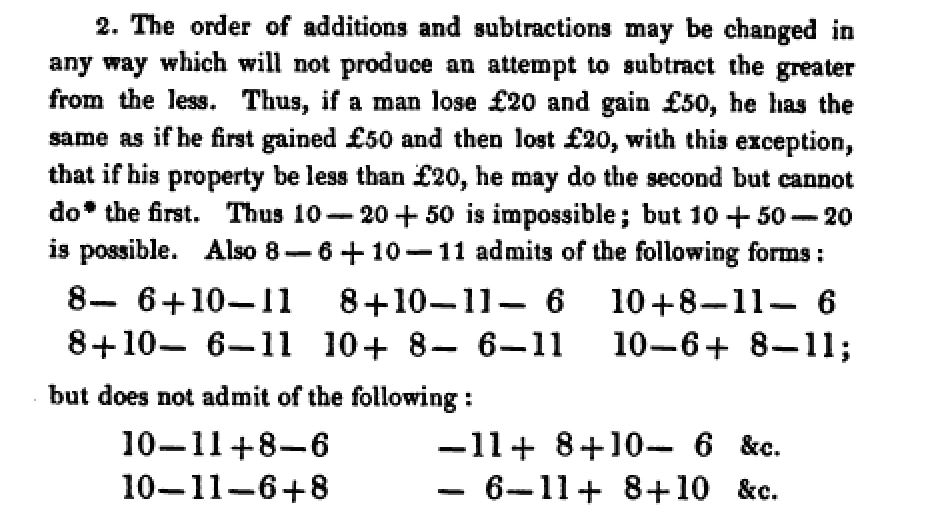
- Most importantly Fibonacci did not fully understand subtraction
- Hence, NEGATIVE numbers are missing in Fibonacci.
- Mahavira's TOC mentions positive and negative numbers
- Fibonacci's TOC says that only a SMALLER number can be subtracted from a LARGER number.😀
Fibonacci's blunder was natural
- in Roman-Christian pebble arithmetic
- subtraction means removing pebbles from a given bunch of pebbles
- so, one cannot remove more pebbles than are there!
- There are no negative pebbles.
Whose blunder?
- One can discuss whose blunder this was.
- Fibonacci went by al Khwarizmi (not Mahavira, directly)
- al Khwarizmi did not accept negative numbers!
- But it was nevertheless a natural blunder for Fibonacci and numerous Europeans after him.
Zero as nothing = "no pebble"
- Zero glorified by Bollywood, Manoj Kumar, Purab Paschim.
- Actually, because of Fibonacci "Arabic" "numerals" (=Indian arithmetic) spread in Florence, Venice etc. (not beyond)
- BUT, to understand negative numbers one must also understand zero.
- Alas, accustomed to their paradigm of primitive Roman-Christian pebble arithmetic
- many other Florentine merchants failed to understand both place-value and zero.
Roman-Christian numerals are "additive"
- This is the first point to understand
- X represents 10 pebbles and I represents one pebble (or coin)
- Therefore, XXII means 10+10+1+1=22
On this system, Florentines understood as "nothing"
- or "no pebble"
- exactly as in Gerbert's apices.
- This is one possible meaning of zero.
- However, on the place-value system this is not the ONLY meaning of zero.
Recall Aryabhata and his खद्विनवके
- or "2 nines of zeros"
- as 18 placeholders for numbers up to \(10^{18}\)
- 000000000 000000000
- A blank entry leaves only the symbol 0.
But, this is not the only possible meaning of 0
- on Indian arithmetic numbers are leftists 😀
- अन्कानाम वामतो गति:
- the places are filled from right to left.
- Therefore, a 0 at the beginning of a number does mean nothing: 011 = 11.
But this is NOT true for 0 at the end or in middle of a number
- 110 ≠ 11 ≠ 101 😀
- This sort of thing also happens for the position of a word in an English sentence
- as in of the change of meaning from the position of the word "only"
- in the following sentence
"He said that he loves her"
- "ONLY he said that he loves her" (0111111)
- "He ONLY said that he loves her" (1011111)
- "He said ONLY that he loves her" (1101111)
- "He said that ONLY he loves her" (1110111)
- "He said that he ONLY loves her" (1111011)
- "He said that he loves ONLY her" (1111101)
That is, 0 means nothing ONLY at the beginning of a number 😀
Florentine law against zero
- Hence, Florence in 1299/1300 passed a law
- that any financial contract written in "Arabic numerals"
- Should also be written in words.
- We still follow that practice in writing cheques.
Interim summary
- In Indian place value arithmetic zero has a double role
- as (1)the number 0, and (2) as a placeholder
- Therefore, the meaning of zero changes with its position.
- This confused people accustomed to Roman Christian arithmetic.
- Cartoon summary
Confusion about negative numbers in modern times
- Thus, West was backward in elementary arithmetic
- from early Greek and Roman times until 10th c.
- Then, Europeans imported Indian arithmetic ("Arabic numerals")
- but had great difficulty in understanding it.
Did Europeans overcome their difficulty with arithmetic by 13th c?
- No! Their confusion about negative numbers etc. persisted until 20th c.
- Whole story too long to tell here
- Will give just two examples.
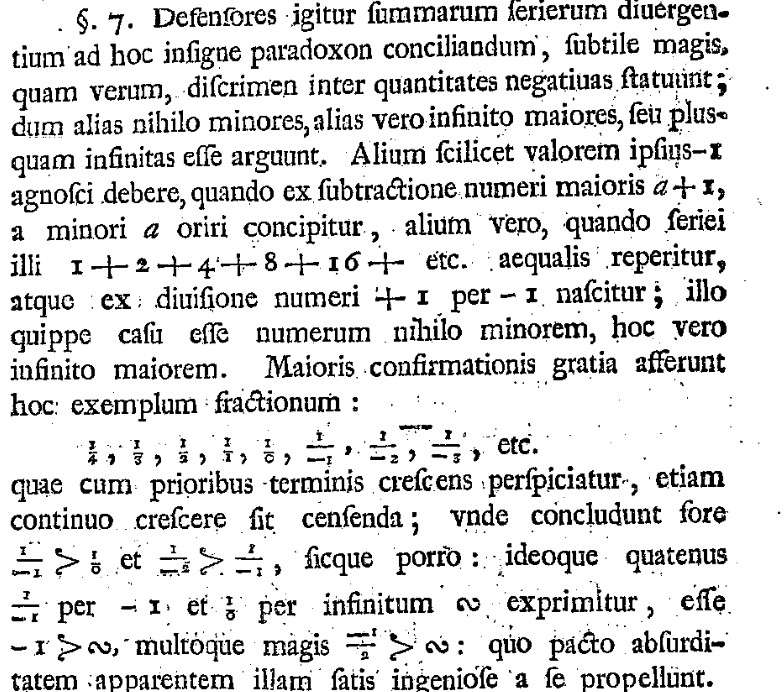
Euler: two kinds of \(-1\)?
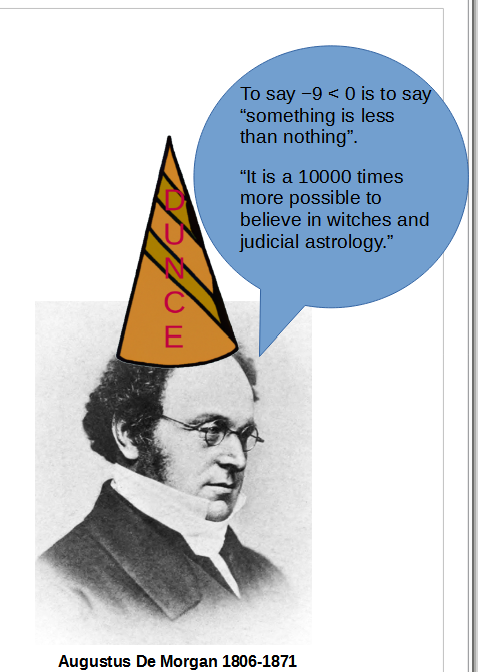
Augustus De Morgan: Dunce
Summary
- West was backward in math (elementary arithmetic) from early Greek and Roman times.
- Took 2000 years to understand their inferiority
- then started importing Indian arithmetic 10th c. on
- foolishly called it "Arabic" numerals then or "Hindu-Arabic numerals" today
Summary (contd.)
- But took very long to understand its fundamental differences from Roman Christian pebble arithmetic
- such as place-value, it's efficiency, use of large numbers, zero, negative numbers.
- Those who learnt school arithmetic from us, how can they claim to be superior in math?
- The colonizer left but his lies remain in your mind!
Epilogue: fractions and the Roman Christian calendar (astronomy)
- Bad arithmetic leads to bad science.
- Roman-Christian arithmetic which lacked fractions
- hence led to the shoddy Roman-Christian calendar
- which we accept as our national calendar today.
But the Roman calendar was equally lousy
- The Julian calendar was made by Egyptians,
- hence after the Roman conquest of Egypt)
- needed a corrective year of 445 days! 😀
- Romans laughably didn't even grasp the Egyptian prescription
- that every 4th year must be a leap year.
Augustus Caesar
- For 20 years Romans kept making every 3rd year a leap year 😀
- Then Augustus Caesar corrected it, hence got the month August named after himself,
- and got it increased to 31 days.
So, Roman calendar based on vanity of Roman emperors, Julius, Augustus
- NOT scientific
- Hence, months have varying durations 28, 29, 30, 31 days.
- Nothing to do with any observed motion of the moon. (Word MONTH derives from moon.)
- But we think it is "scientific temper" to adopt this unscientific calendar,
- not the Indian calendar in which every month has EXACTLY 30 tithi-s.
Later it became the official Christian calendar
- First Council of Nicaea (ca. 325 CE) adopted this as the official Christian calendar
- to fix a common date of Easter, to bring about unity among Christians in the Roman Empire.
- So, it can accurately be called the Roman-Christian calendar.
- Gregorian reform of 1582 done by a Pope since this miserable calendar was failing badly for centuries.
All of our colonized historians use this calendar
- they give dates using the terms AD and BC
- so that belief in Christ (as our Lord) is asserted in every date
- though historicity of Jesus is very doubtful.
- The colonized think imitating the West (long dominated by the church) is secular!😀
- Hence, also, our only two secular festivals Independence Day and Republic day
- are defined only on the Roman-Christian calendar
- though that term is never used.
But scientific Indian calendar
- is called Hindu calendar
- although it is clearly used also by Buddhists, Jains, Sikhs
Critical point
- Roman-Christian calendar is bad because of bad Roman-Christian arithmetic
- which lacks fractions
- hence could not depict the (tropical or sidereal) year accurately
- and could not calculate the "synodic" month
- still determined by religious authority of a synod or priest.
Egyptians HAD unit fractions
- as in the famous "Eye of Horus fraction"
- but inferior Graeco-Roman arithmetic had no way to depict general fractions
- Can't write \(\frac{4}{5}\) as \(\frac{IV}{V}\) (then cancel the V?! 😀)
- Hence used the primitive system of leap years.
Christoph Clavius, author of the Gregorian reform
- introduced Indian fractions (direct from India) as practical mathematics in the Jesuit syllabus in ca. 1576
- but due to widespread ignorance of fractions in Roman-Christian Europe then
- the Gregorian calendar continues to use the primitive system of leap years.
Calendar still inferior and unscientific
- Consequently it does not get the tropical year right from year to year
- but only on a thousand year average.
- The Gregorian calendar is still bad an unscientific
- but, for us, aping the West means being superior!
Key point: ALL these cases
- of arithmetic, algebra, trigonometry
- involved various degrees of conceptual incomprehension
- by Europeans while copying from Indians
- but we have declared the duffer as "superior"
- and are playing "follow the leader".