Created: 2025-09-05 Fri 11:47

Busting Macaulay:
(1) The epistemic test,
(2) the theft of calculus by “Christian discovery”, and
(3) the myths and superstitions in the present-day teaching and practice of axiomatic math

C. K. Raju, Visiting Professor, IIT Mandi

Introduction: Macaulay

Macaulay

Padres and church, NOT Macaulay

  • Obviously, the very same colonial/church education spread also in the French, Dutch, Spanish, and Portuguese's colonies
  • where Macaulay never reached.
  • That is, church education was globalized (not limited to India) by padres, NOT Macaulay.
  • So, declaring "Macaulay" as the CAUSE of colonial education shows extreme lack of शत्रु बोध.

Doctrine of supremacy and false history

  • Well known that padres and church totally transformed Christianity in the 4th c.
  • after the padres grabbed power and started ruling the Roman empire.
  • They modified and weaponised Christian dogmas (doctrine of sin, eternal damnation, etc.) into instruments of power.
  • Or the genocidal religious doctrine of Christian discovery that any land (such as Americas, Australia)
  • or knowledge (e.g. calculus)
  • is "owned" by the first Christian to "discover" it, REGARDLESS of prior knowledge (or occupancy, see cited US Supreme Court judgment)
  • so that most land in the world came to be owned by Christians.
  • That is also how Newton "discovered" calculus
  • exactly like Vasco "discovered" India or Columbus "discovered" Americas
  • regardless of earlier occupants of India or Americas.
  • And eventually all science was claimed to originate with "Christians and friends".

Theft of calculus

How to explain the stark similarity?

  • between the EARLIER Indian infinite series
  • and the LATER infinite series today attributed to, Gregory, Newton, and Leibniz?

Onus of proof

  • On current academic norms, onus of proof,
  • to prove "independent rediscovery" is on those who came later
  • especially when they are habitual criminals: thieves and dacoits
  • who have stolen 3 whole continents and committed the most massive genocides known to humanity.

The double coincidence

  • The West also needs to prove that
  • the simultaneous discoveries by several people in Europe were independent of each other
  • Roman Catholics Cavalieri, Pascal, Fermat, …
  • Anglican Gregory (who brought Indian calculus from Padua)
  • to Protestants Newton, Leibniz who eventually claimed credit .
  • Nevertheless, though the onus of proof is on West, I anyway provided proof of theft.
  • That is, Newton did not actually discover calculus: he STOLE it.
  • Theft is a criminal offence.
  • based on the standard of current CRIMINAL law ("proof beyond reasonable doubt")
  • (as distinct from the usual standard in history/civil law of "balance of probabilities").
  • Though such a high standard of proof was never before or after used in history.
  • Contrary to usual Wikipedia lies, I DID provide ample evidence.

Initial evidence for theft of calculus

  • As in a murder case, I pointed out
  • (1) opportunity,
  • (2) motivation,
  • (3) circumstantial evidence, and
  • (4) documentary evidence.

Opportunity

  • Vasco fled from Kozhikode to Kochi to escape the wrath of the Samudri (Zamorin)
  • The first Roman Catholic mission (1501) in Kochi and later school and Jesuit college
  • not only taught the local Syrian Christians
  • but used them as informants to gather and translate Indian math, and astronomy texts available near Kochi.
  • So, there was contact, and ample opportunity for Europeans to steal Indian texts starting 16th c.
  • These Indian texts were mass-translated to Latin
  • mimicking the Toledo model (1125 CE) of mass translating Arabic texts.

Motivation: Navigational problems specific to backward Europeans

  • Why translate these texts? To solve the specifically European navigational problems of determining (at sea)
    • Loxodromes
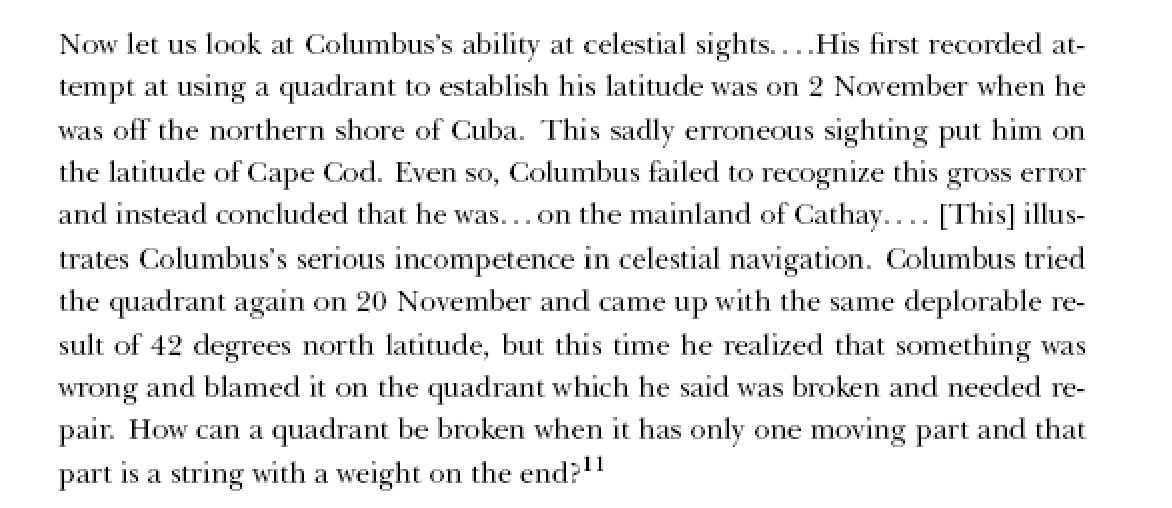
    • Latitude
    • Longitude
  • All of which required accurate trigonometric values.

Loxodromes

  • Problem: 16th c. European navigators FOOLISHLY thought moving in a fixed direction,
  • e.g. set by compass or stellar rhumb line,
  • would move them in a straight line.
  • But on the curved earth (in non-cardinal directions) it results in a logarithmic spiral
  • = loxodrome (loxos = curved, dromos = line)
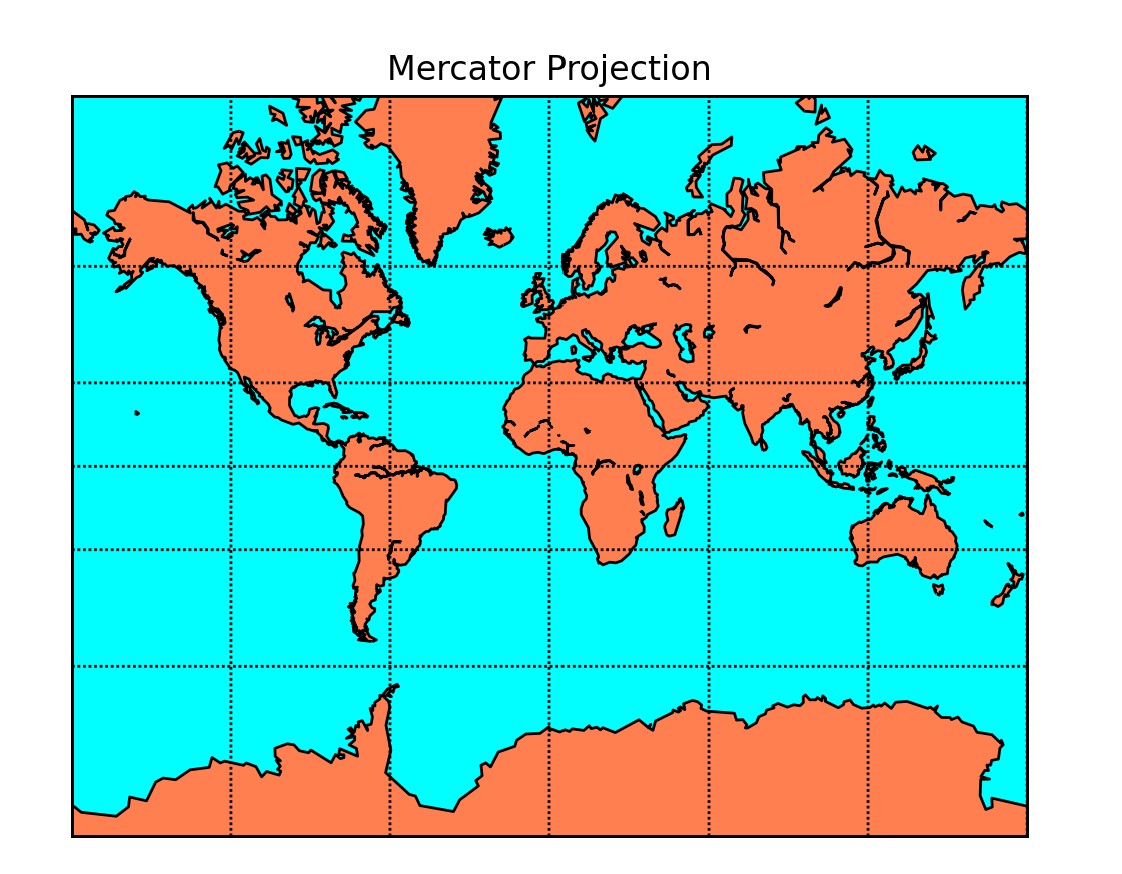
  • The Mercator chart uses a conformal map which maps loxodromes to straight lines
  • but bloats areas at high latitudes
  • e.g. Greenland seems larger than Africa which is actually some 14 times larger;
  • area scale factor is \(\sec²φ\) which goes to infinity near poles and is 1 for the equator.

Latitude

Longitude

  • For navigation in the Indian ocean (in recent centuries) it could be easily determined
  • by measuring the angular elevation of the pole star
  • as done by the navigator (Mualim Kanak) who brought Vasco from Melinde to Calicut.
  • Longitude could also be determined by one of the several Indian techniques
  • by solving a longitude triangle (Laghu Bhaskariya 1.32, p. 11).
  • But this required an accurate knowledge of the radius of the earth
  • not known to Europeans then.
  • Bhaskara I (7th c.) also points out that using the "Pythagorean" proposition to solve the plane triangle is
  • described as a gross method since it neglected the curvature of the earth
  • according to भटस्य शिष्या: (Bhaskara 1, Mahabhaskariya, 2.5)

Crude European method of heaving the log

  • Of course, they still needed accurate trigonometric values to solve even the plane sailing triangle
  • from course angle and distance travelled.
  • Naturally, they grabbed knowledge from every available source.
  • There is ample circumstantial evidence they did so.

Circumstantial evidence

  • Aryabhata's recursive method = "Euler" method (will cover this in detail, later)
  • Nilkantha's planetary model= Tychonic model (see my book on Indian calendar) (Tycho as Royal astronomer to the "Holy Roman empire" was a natural recipient of stolen Indian texts)
  • Madhava's sine values = Clavius' trigonometric values (which were an interpolated version)
  • Brahmagupta-Vateshvar(="Stirling's") formula

Documentary evidence

  • Primary sources [Ricci's letter. (Ricci was Clavius' favourite student and biographer.)
  • He was naturally searching for Indian calendrical texts in Kochi
  • since this was right before the Gregorian calendar reform of 1582
  • authored by Clavius whose favorite he was.
  • But in those days of the Inquisition
  • it was impossible for the padres to admit that the reform of the Christian RELIGIOUS calendar was based on superior HERETICAL knowledge.
  • (Note it was the Christian religious calendar,
  • officially adopted at the first Nicene council to fix the date of Easter
  • NOT the Julian calendar).
  • As usual the chief padre, the pope, lied about the 1582 calendar reform telling the story that it was
  • based on the "Alfonsine tables" from centuries ago
  • and due to one Alyosisus Lilius a shadowy figure trained as a physician (not astronomer).
  • But the story "established" that the knowledge had a valid Christian lineage.
  • Why, then, was Ricci searching for knowledge of the calendar among heretics?😄
  • Anyway, Wikipedia says I provided no evidence in my book
  • so just go with that blind belief.😆

Epistemic test

  • This is important because if Newton's fluxions and
  • Dedekind's axiomatic real numbers
  • do not incorporate a correct understanding of calculus
  • then today calculus has to be taught differently as I am currently doing in IIT, Mandi

Example of epistemic test from arithmetic

Early Greeks and Romans were BACKWARD in arithmetic

  • Names of small numbers similar in Greek, Latin, Persian and Sanskrit
  • obvious e.g. सप्त (September), अष्ट (October), नव (November), दश (December)
  • More details

But NO large numbers in Greek and Latin

  • Greek and Latin numbers stopped at a myriad (10000).
  • Though this is a puny number,
  • in the English language
  • it still connotes an infinitely large number!😀

But Sanskrit numbers go on

  • till a trillion (परार्ध, \(10^{12}\)) in the Yajurveda 17.2
  • and तल्लक्षण (\(10^{53}\)) and परमाणुरजःप्रवेशानुगता (\(10^{108}\) in Lalitavistara sutta [Life of Buddha] chp.12).
  • (Buddha was asked to name numbers after 100 crores,
  • Greeks, Romans would have flunked.😀)

Greeks learnt Indian number-names

  • But Persians too stopped at a myriad
  • ="beavan" in Avesta (Ervad Rooyinton P. Peer, personal communication 25 July 2021)
  • Same small numbers BUT no large numbers = Greeks learnt from Indians via Iran
  • but learnt little.

Primitive pebble arithmetic

Gerbert's apices

  • Apices were Gerbert's striking innovation!😀
  • That is, instead of having, say, 7 pebbles,
  • he had one pebble with the number 7 written on it,
  • using Arabic notation, in 976 CE.

Fibonacci's blunder

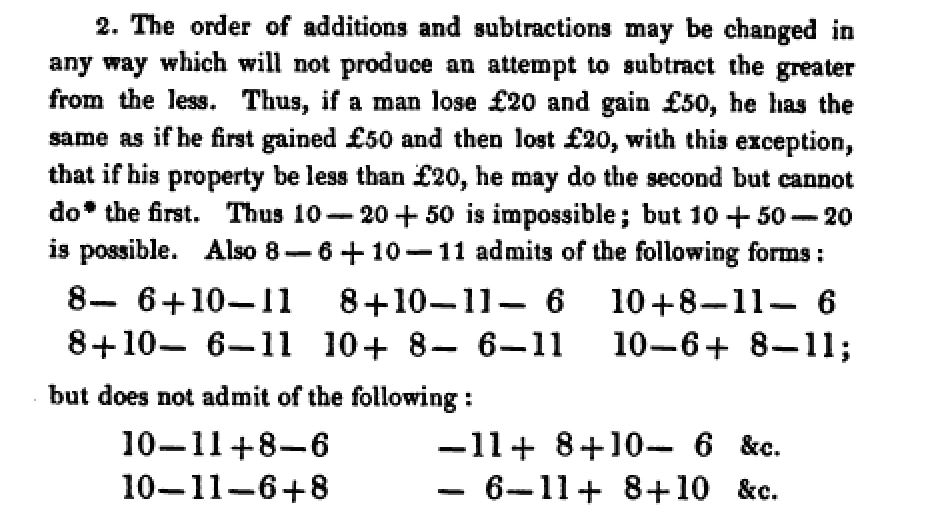
  • Most importantly Fibonacci did not fully understand subtraction
  • Hence, NEGATIVE numbers are missing in Fibonacci.
  • Mahavira's TOC mentions positive and negative numbers
  • Fibonacci's TOC says that only a SMALLER number can be subtracted from a LARGER number.😀

Confusion about negative numbers in modern times

  • Thus, West was backward in elementary arithmetic
  • from early Greek and Roman times until 10th c.
  • Then, Europeans imported Indian arithmetic ("Arabic numerals")
  • but had great difficulty in understanding it.

Did Europeans overcome their difficulty with arithmetic by 13th c?

  • No! Their confusion about negative numbers etc. persisted until 20th c.
  • Whole story too long to tell here
  • Will give just two examples.

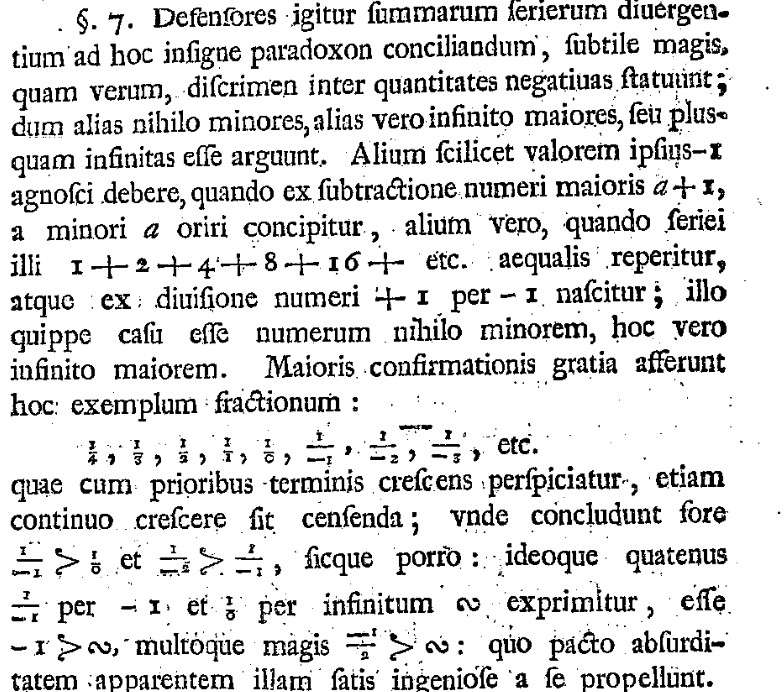
Euler: two kinds of \(-1\)?

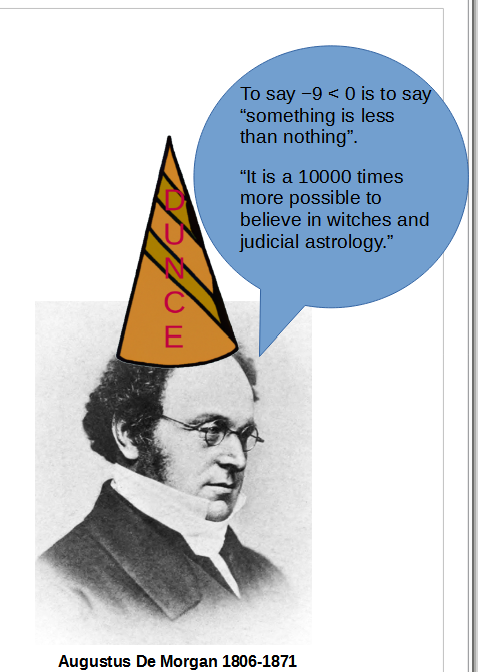
Augustus De Morgan: Dunce

To support theft of calculus

Not sole case of Institutuional complicity with serial plagiarists

  • These buffoons wrote in an article in Race and Class (DOI: 10.1177/0306396804043866)
  • that floating-point numbers (IEEE standard 754 of 1985)
  • were used by "Kerala mathematicians"
  • to derive infinite series.

Back to Newton and Leibniz

  • Leibniz accused Newton of stealing his "discovery"
  • and complained to the Royal Society.
  • Today people say both "discovered" calculus independently (How?)
  • In response to Leibniz, Newton as President of the Royal Society appointed a committee
  • which he himself headed to investigate the charge against himself.
  • He wrote the report exonerating himself,
  • published it and also anonymously published a review of it.
  • In this he called Leibniz the "second inventor"
  • since Leibniz did not understand how to sum the infinite series he claimed
  • adding that "second inventors have no rights".
  • So, by his own standard, how does Newton as "second discoverer", have any right to claim calculus
  • or even Madhava's sine series?
  • As Newton himself rightly says, even dividing the credit for calculus would be an act of injustice.

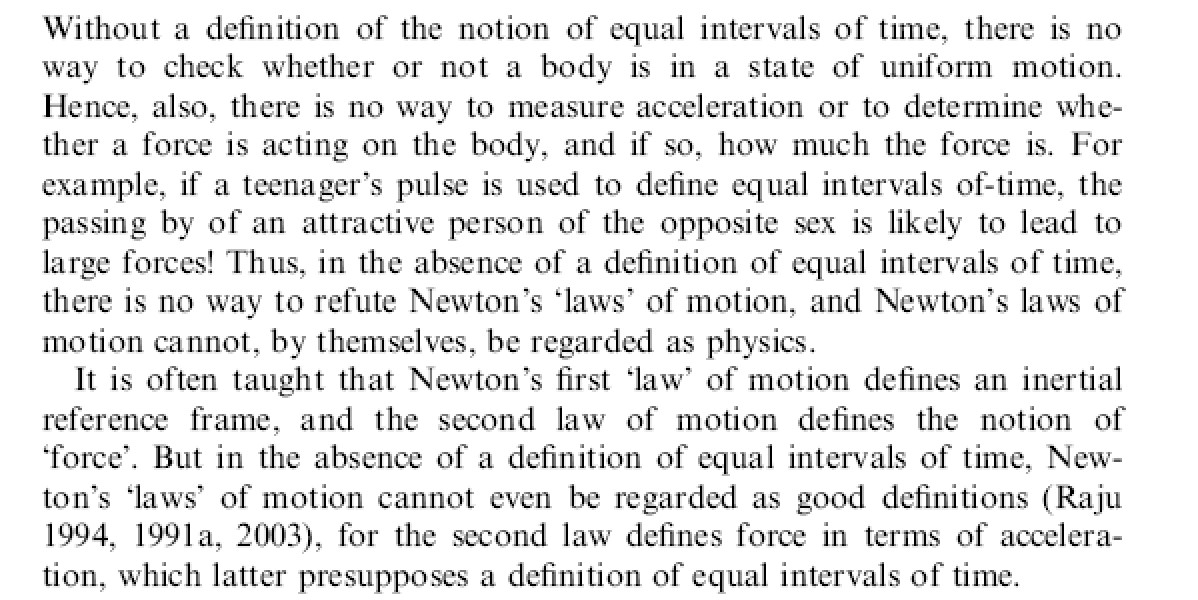
Conceptual Problems in Newtonian Physics (skip physics)

  • Newton’s laws of motion and gravitation are metaphysical individually
  • Take Newton's first "law" of motion:
  • "in the absence of external forces the body stays in its state of rest or uniform motion in a straight line".
  • What is meant by "uniform" motion?
  • Uniform motion supposedly means the "body" (= point mass) covers equal distances in equal times.
  • Set aside equal distances.
  • What is meant by equal times?
  • To measure it a clock is needed.
  • But which clock to use? Your heartbeats or mine?

Barrow's definition

But Newton overturned it

  • as also the "law" of gravitation.
  • Newton’s belief in “mathematical time” was theological
  • Only by combining both laws we get refutability
  • e.g., Newtonian ballistic trajectories are elliptic while Galilean are parabolic

Relativity and the Fall of Newtonian Physics

  • These conceptual flaws—not experiments—led to the downfall of Newtonian physics.
  • Electrodynamics brought in waves which travel at \(c\) the speed of light
  • How would \(c\) and Maxwell's equations change if the reference frame was moving?

Berkeley's critique

  • Berkeley was a bishop, a padre, and defender of the church
  • The fear was that after Newton's death his venomous writings against the padres might leak out.

Newton's Religious Hostility

  • Newton, though a fanatic Christian,
  • was totally anti-church for the way the post-Nicene corrupted Christian beliefs for power.
  • His writings were suppressed;
  • an appraiser from the Royal Society called them "foul papers related to church matters, unfit to be published".
  • Newton called (post-Nicene) Christian priests "spiritual fornicators"
  • "the most evil sorts of men ever to have inhabited the earth"
  • His 7-volume history of the church is suppressed to this day.
  • Hence, Berkeley's discourse was against an "Infidel mathematician"

Our concern

  • Newton's "fluxions" are today abandoned as utterly confused.
  • Berkeley criticized Newton's lack of understanding,
  • of what he called the theory of fluxions, = derivatives = tiny particles of "flowing" time
  • stating science must involve genuine comprehension.

Berkeley quote (skip)

  • And. . . there be other Fluxions, which Fluxions of Fluxions are called second Fluxions.
  • And the Fluxions of these second Fluxions are called third Fluxions: and so on,
  • fourth, fifth, sixth, &c. ad infinitum.

Berkeley quote (contd)

  • Now as our Sense is strained and puzzled with the perception of Objects extremely minute,
  • even so the Imagination, which Faculty derives from Sense, is very much strained and puzzled
  • to frame clear Ideas of the least Particles of time,
  • or the least Increments generated therein. . .

Berkeley quote (Contd)

  • And it seems. . . to. . . exceed, if I mistake not, all Humane Understanding.
  • The further the Mind analyseth and pursueth these fugitive Ideas, the more it is lost and bewildered;
  • the Objects, at first fleeting and minute, soon vanishing out of sight.
  • Certainly in any Sense a second or third Fluxion seems an obscure Mystery….
  • the nascent Augment of a nascent Augment, i.e. of a thing which hath no Magnitude:
  • Take it in which light you please, the clear Conception of it will…be found impossible.

Berkeley's other argument

  • He pointed out that the fluxions/infinitesimals could neither be finite quantities
  • (for that would destroy the purported perfection of the mathematical theory),
  • nor could they be infinitely small quantities
  • (since they could then be neglected without fear of error),
  • nor could they even be zero (for

all the derivations would then fail).

  • Finally, he pointed out that mathematicians of his time
  • were unable to pin down the nature of infinitesimals
  • which always disappeared from the final

result.

This led to Berkeley's famous polemic

  • "And what are these same evanescent Increments?
  • They are neither finite Quantities

nor Quantities infinitely small,

  • nor yet nothing.
  • May we not call them the

Ghosts of departed Quantities?"

  • Irrespective of Berkeley’s political motivation to pull down Newton
  • (due to Newton's hostility to the church and padres)
  • and irrespective of his polemics,
  • Berkeley's arguments are valid.
  • He is careful to point out that he is not challenging Newton’s scientific conclusions,
  • but only his understanding.
  • He explains in detail how one can arrive at a right result in a wrong way,
  • through a double mistake each of which cancels the other.
  • Berkeley's point was that such a process,
  • lacking understanding, cannot be called science:
  • "For Science it cannot be called, when you proceed blindfold, and arrive at the Truth not knowing how or by what means."

Berkeley's Valid Critique

  • So, despite Berkeley, despite political motives, and polemics,
  • correctly argued that Newton's calculus lacked conceptual clarity.

Jurin’s feeble response

Newton's conceptually confused notion of flowing time

  • led to the failure of Newtonian physics,
  • and its replacement by relativity.
  • we go into this very briefly (more details in my book Time: Towards a Consistent Theory.

Newton’s Character and Ethics

Theological Origins of belief in “Laws of Nature”

However, not only Berkeley

  • This proves two things.
  • Newton did not understand calculus
  • all the practical consequences of Newtonian physics (before Dedekind) were obtained without the use of real numbers.
  • Basically, Europeans failed to understand two aspect of Indian calculus
  • the notion of infinitesimal
  • how to sum an infinite series

Lacunae in Real-analysis defn of derivative

  • The college calculus, or the notion of derivative as defined in real analysis
  • does not work for all of physics
  • e.g., it does not work for shock waves
  • where discontinuity may arise
  • so that the differential equations of physics become meaningless on that definition.

– A similar problem arises in the context of renormalization in quantum field theory.

  • This shows that the existing understanding of calculus is still not good enough for all current physics.

The solution to this problem in my PhD thesis

Later, I abandoned non-standard analysis

  • realizing that the only thing needed was
  • what is today called non-Archimedean arithmetic (in an ordered field)
  • which has infinitesimals and infinities.
  • Brahmagupta's polynomial arithmetic (अव्यक्त गणित = Bhaskara's बीज गणित) is naturally non-Archimedean).
  • Note that this is better than using hyperreal numbers
  • which makes calculus "easy" AFTER making its beginning impossibly complicated.

Myths and superstitions of axiomatic math

  • Of course there is no Euclid either and no takers for my "Euclid" challenge prize (video, presentation, book)
  • I teach children that teaching brazen lies about math is essential to teaching Western/padreist math.

Superstition about superiority of axiomatic proof

  • Children today are taught that axiomatic proofs are superior
  • in this way of doing math axiomatically (Western ethnomath) has been globalized.

Difference between axiomatic math and ganita

  • Gaṇita accepts empirical proof= प्रत्यक्ष प्रमाण
  • accepted by all schools of Indian thought,
  • as stated e.g. in the Nyaya sutra 2.

Empirical PROHIBITED in math

  • People find this hard to believe.
  • But stated in any stock text on mathematical logic (e.g. Mendelson, introduction to mathematical logic, page 34)
  • i.e., A mathematical proof is a sequence of statements in which each statement is either an axiom, or is derived from preceding statements by some rule of reasoning
  • (e.g.,modus ponens 1. \(A \Rightarrow B\), 2. \(A\), ∴ 3. \(B\).)

Also stated in class IX NCERT text(p. 301)

  • "each statement in a [mathematical] proof has to be established using only logic…Beware of being deceived by what you see …!"
  • i.e., math allows only अनुमान NOT प्रत्यक्ष.
  • This text is compulsory reading for all (math compulsory up to class X),
  • if you didn't read it, it is your problem!

A question

  • If math is done for science and technology which accepts empirical
  • why does rejection of empirical make math better?
  • Does make it better for theology
  • as in Aquinas angel theorem
  • from his summa Theologica
  • Axiomatic proof was first used by the Crusading Christian theology of reason
  • since it can be used to prove any nonsense proposition whatsoever by anyone authorized to lay down the axioms.
  • As such, believe in its superiority ("infallibility") is a foolish superstition
  • much more foolish than racism.
  • This superstitions benefits axiomatic mathematicians
  • and hurts the nation.