Proof of theft of calculus from India
Created: 2025-08-25 Mon 11:57
1. Opportunity
- was there contact between India and Europe then?
- "Was there contact?"
- This is the first question that one asks when two students turn in identical answer sheets.
1.1. Of course there was extensive contact
- between Europe and India
- starting from 1498 after Vasco da Gama arrived in India.
2. The story of Vasco and the "discovery" of India
2.1. Europeans had long had contact with Africa,
- especially Algeria and Morocco which were very rich countries then,
- while Europe was poor.
2.2. Florence etc. became the (culturally, financially) richest part of Europe
- by 12th c.
- because of their trade with rich Africa.
2.3. Portuguese Creepy navigation
- However it was only in the mid-15th century that
- Portugal became rich enough and adventurous enough to start exploring
- how to creep along the coastline of Africa
- and reach what is called sub-Saharan Africa.
2.4. In 1441 Europeans finally learnt
- how to sail past Cape Bojadour and the Sahara desert
- by staying far enough away from the coastline
- to avoid the strong winds and currents.
2.5. This contact with sub-Saharan Africa brought in the first African captives to Europe
- The papal bulls (fatwas) Dum Diversas (1452)
- and the bull Romanus pontifex (1455) were formulated in this context
- As we will see, this "Doctrine of Christian discovery" has an
- important bearing also on the claim that some Christians discovered calculus
- like "Vasco discovered India".
2.6. More creepy navigation
- By 1488 Bartolomeu Diaz had used this "creep-along-the-coast navigation"
- to sail to the Cape of Good Hope
- In 1498 Vasco sailed round the Cape and up the
- Eastern African coast to Malindi near Mombasa.
2.7. The navigator and the pilot
- Malindi was part of the Africa which had traditional sea trade with India
- across thousands of years.
- He was told that more creepy navigation would take him right back to the Arabs he sought to avoid 😆
- and that to reach the land of spices he had to cross the ocean.
2.8. Navigator and pilot (contd,)
- Alas Vasco didn't know how to cross the "uncharted" ocean!
- But an Indian fleet reached Malindi
- and Vasco hired a person (Mualim Kanak=Malemo Cana)
- to guide him across the ocean to India.
2.9. Navigator and pilot (contd.)
- I was taught in school that Vasco "discovered" India (like Columbus discovered America).
- I naively asked "where were Indians living before India was discovered?"
- I added, "what about the Mahabharata battle and the Kurukshetra near Delhi mentioned in the 1st sloka of the Bhagvad Gita?" धर्मक्षेत्रे कुरुक्षेत्रे…
- The teacher responded that Indians lived right here even before India was discovered.😄
- So, what exactly did Vasco "discover"?
2.10. Navigator and pilot (contd)
- Some colonised people try to save the story
- They now say Vasco "discovered" the sea route to India.
- Certainly that is false since Vasco hired a person to take him across the Indian ocean from AFrica.
- on a sea route known for thousands of years, even to the Romans.
- The term "discovery" has a special technical meaning in Christian god-gyan(=theology=theos+logos) in this context
- and that special meaning of "discovery" applies also to "discovery" of calculus by Europeans.
2.11. Navigator and pilot (contd.)
- The term "discovery" is not the only word which has a strange new meaning
- Vasco records he hired a "pilot" at Malindi to help him cross the ocean.
- Now a pilot is one who guides a ship near the land, where their may be unknown hidden obstacles, known only to a local person.
- A navigator is one who guides a ship across the open sea.
- Mualim (=wayfinder") Kanak was the one who navigated the ship across the open Indian ocean from Malindi to Calicut (Khozikhode)
- Vasco was the one who was doing creepy navigation sticking close to the shoreline from Lisbon to Malindi.
- So, who was the navigator and who was the pilot?&#x;
- Moral: don't trust even a single word of history told by Europeans. They were backward, not "superior".
2.12. How the pilot told the distance by his teeth
- The instrument is used to measure angles, by blocking off the angle by varying the distance of the board from the eye.
- This was used to measure the angular elevation of the pole star (kau) = the approximate latitude.
- While measuring, the string is held between the teeth
- teeth are called kau in the Arabic-Malayalam language used by the Mapila sailing community of Kerala (so the Kanak was from Kerala).
- The pole star is also called kau!
- Navigator said he was telling the latitude by kau (=pole star)
- But Vasco recorded "the pilot was telling the distance by his teeth".🤣
- As we will see, terms such as zero and "sine" have a similar history.
2.13. Graduating a harmonic scale in inches
- The knots on the string tied to the kamal are NOT equidistant
- but are in harmonic progression, like the holes in a flute
- i.e. the inverses of the distances between two knots are in arithmetic progression.
- Alas, Vasco understood only linear scales, not harmonic one's.
- So he took back a copy of the kamāl saying he would get it "graduated in inches"🤣
- impossible sine it is a harmonic scale.
- This is just a very simple example of the stupidity that Westerners displayed in grasping Indian concepts
2.14. 2-scale principle for harmonic scales
- Further, the kamal has two pieces which work together for greater accuracy as in the Vernier caliper.
- Did any European understand that the 2-scale principle "Vernier principle" can be applied to harmonic scales?
- No, but by 19th c. British were ruling India. and James Prinsep (a mint assistant) made gross racist remarks about the kamal
- But Prinsep lacked the brains to understand the 2-scsle principle (Vernier principle) applied to harmonic scales
- which gives the kamal a very high accuracy
- as I first explained in my book (but ignored).
- (Is the case of calculus similar? Did Europeans likewise fail to understand Indian calculus?)
- Drunk in their racist sense of supremacy Prinsep et al did not have the commonsense to ask in over 150 years
- how Lakshadweep islanders navigated for centuries to small islands
- without an accurate navigational instrument.
- Instead they introduced colonial education to teach their "superior" method of navigation.
- (Like they teach a "superior" understanding of calculus today?)
- Hope you are getting the analogy,
- Q. is the story of the "discovery" of the calculus similar to the story of the discovery of India by Vasco?
2.15. Colonial education for islanders
- To move on with Vasco's story, since Christian/colonial education was not popular in Sunni Muslim Lakshadweep islands
- British govt. commissioned a text in Malayalam, Nāvik Shāstram, to make it attractive.
- Text introduced in schools of the largest island called Amini in 1939.
- to teach Brit techniques of navigation to islanders
- based on the sextant (kamān) and declination tables of the sun.
- (we will see why declination tables are needed).
2.16. Effect on accuracy
- The kaman had an accuracy of about 1°, less than the accuracy of the kamal (10')
- Also, kamān (made of steel) could not be locally manufactured and had to be got from Mumbai
- Students indoctrinated into the "superior" navigation quickly forgot all about the kamāl.
- I toured ALL the Lakshadweep islands in 1998 and not a single person could explain its functioning
- which I reconstructed.
- (Like the Indian understanding of calculus, which we all forgot.)
2.17. Noorie tables
- The students were now indoctrinated to use the kamān with "Noorie tables".
- What are these "Noorie tables"?
- These "Noorie tables" were found in the "rahmani" ("log book") of Kunhi Kunhi Koya
- as part of a 5 million dollar project of the INSA to study indigenous navigation.
- In 1998, the findings of this project were to be presented
- at an Indo-Portuguese meeting on the 500th anniversary of Vasco's arrival in India.
- No one in the big project team could figure out what these "Noorie tables" were
- (remember the haunting song Noorie…?)
- Hence, I was roped in for this purpose, to go to the Lakshadweep islands and solve the mystery.
- I solved the mystery within a couple of days of arriving at Kavaratti
- through a serendipitous visit to the library at Kavaratti.
- There, in the navigation section, I found a book by Capt. James Norrie
- giving the same tables as tables of declination of the sun.
- The value of the solar declination is needed to determine latitude at sea in daytime
- from observation of the solar altitude at noon.
- I checked that the book had been issued to Kunhi Kunhi
- and carried away the accession card as proof.
- So a colonised method of navigation was being passed off as indigenous knowledge.
2.18. Vasco's imaginary Armada
- To complete Vasco's story we also need to understand the European trick of using systematic lies as a source of soft power.
- As Vasco approached Calicut he was fearful he would be attacked and killed.
- So he sent Malemo Kana ahead to meet the Samudri (Zamorin)
- with instructions to lie to him that a huge armada was following him.
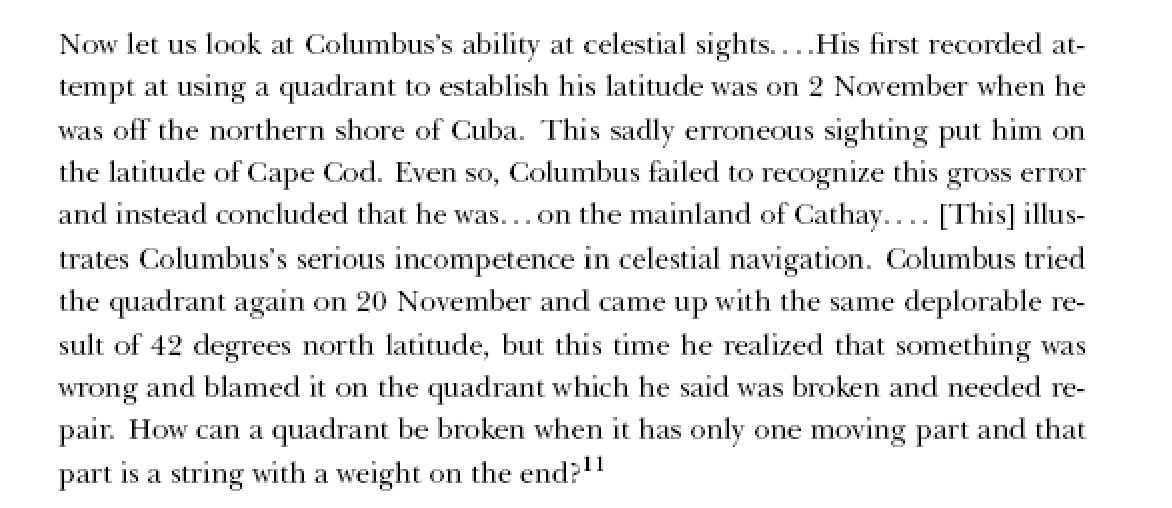
2.19. Columbus's broken instrument
2.20. How Vasco fled to Kochi
- To complete the story, we need to tell how Vasco arrived in Kochi
- where there were numerous manuscripts in astronomy and mathematics containing the Indian infinite series.
- The official Portuguese excuse for traveling to India was to trade
- So, when Vasco arrived in Kochi this Samudri gave him a "factory" a place where he could store his goods
- as he gave to every Arab trader.
- Vasco left a few men at the factory and went back to Europe to return a year later.
- But the Portuguese goods were mere worthless baubles
- at which the Arab traders familiar with Portugal and Spain laughed
- The Portuguese left in Calicut were so poor they had no money to trade.
- So they tried their usual tricks: telling lies and claiming the goods of others.
- Arab traders accustomed to a higher level of honsety were enraged and burnt the Portugueses factory to the ground.
- Vasco on his return realized that his bluff of being traders had been called.
- So, to reveal his "military might" he fired a cannon at the unarmed trading vessels in the harbour.
- But a cannon is more of a symbolic weapon
- which had greatly impressed Europeans after the fall of the Eastern Roman Empire and the thick walls of Constantinople in 1452.
- Vasco realized he had no defenses against the Calicut navy and fled.
- European historians talk of cannon firing but never explain that (or why) Vasco fled from Calicut to Kochi.
- His Gujarati advisor (also assigned by the Zamorin)to save his own life advised Vasco to flee to Kochi
- since the raja of Kochi was hostile to Calicut
- and so he would get protection there.
- Accordingly Vasco fled to Kochi.
- Two important things happened in Kochi.
- First, the Raja of Kochi did offer protection (the enemy of my enemy is my friend)
- and even allowed Vasco to build a small (one room) fort (Fort Emmanuel)
- with a small symbolic cannon on top pointing in a fixed direction, hence easily evaded.
- Second, and more importantly, Vasco found the Syrian Christians in and near Kochi.
- It was part of his mission to try to team up with other Cristian's (Prester John) to win the Crusades.
- To convert them he set up the first Roman Catholic mission in Kochi in 1501.
- As we will see, it was through the Syrian Christians that
- the Portuguese got detailed knowledge of a variety of Indian texts available in and near Kochi.
- Some written by people who had the same patron, as the Portuguese, in the Raja of Kochi.
- So, quite clearly, Europeans had ample opportunity to obtain those Indian texts.
2.21. Moral to remember
- (1) Europeans were poor
- (2) They were habitual liars
- (3) They didn't know navigation but it was a matter of life and death for them.
- (4) The padres systematically lied about the knowledge they stole, which is the basis of Wester/colonial education.