Mathematics in Ancient India and its Contemporary Value:
It makes math so easy, so why don't we teach it?

C. K. Raju
Indian Institute of Advanced Study
Rashtrapati Nivas, Shimla

Preliminaries

Opi mou syndrome

  • The Opi mou story.

Moral:

A child

  • believes the first story he is told

– (does not ask for evidence, believes any silly story), and

  • then resists change.

E.g.

  • Most people acquire their religious beliefs in childhood,
  • and not because they compare various religions and choose what is best.

Hence, education moulds the mind

  • especially early education.

But what education do we have?

Colonial education

  • which was 100% church education when it came.
  • (No secular education in Britain until 1871.)
  • Mission schools obvious

But ALL early Western universities (Oxford, Cambridge, Paris,…)

  • were set up by papal bulls
  • and totally controlled by the church.

Higher education offered a sarkari job

  • but also made missionary schools (and clones) important as the entry point
  • We happily poisoned the minds of our children in the hope of a sarkari job.

Church education was designed to benefit the church not us, as we foolishly assume (even today in the latest NEP 2019),

  • Church a political entity, tied to the state for 1700 years
  • (and the colonial state)

Church power is soft power, based on propaganda: a web of systematic lies.

Hence, colonial education stuffed us with THOUSANDS of FALSE stories to make us accept colonial rule.

  • Stories NOT just about Christian god, but

Church propaganda spread stories

  • about your inferiority
  • and Western superiority.

Widespread feeling of inferiority among colonised due to this church propaganda.

It taught you to blindly trust Western authority

  • Oxford, Cambridge, Wikipedia.
  • and blindly imitate them.

We accepted all this uncritically

  • and refuse to change today.

Do not caricature. I am NOT arguing for blind rejection of the West

-Be critical, choose what is best.

I am arguing against

  • blind acceptance; we never critically examined colonial education.
  • Resistance to change; and today regard any critical examination or change as heresy

This talk about Opi Mou syndrome in colonial math education.

  • and how it makes math difficult
  • Before coming to math, let us take an easy example.

E.g. bad calendar

  • Colonial elducation taught us the Gregorian calendar ("superior"?)
  • Most people know their date of birth only on the Gregorian calendar.

Hurts our vital interests

  • Gregorian calendar has no rainy season unlike our traditional calendar
  • This hurts a vital economic interest (our economy depends on monsoon driven agriculture).
  • "Delayed monsoon phenomenon" documented since 2004

For more details, see Youtube video:

  • "Tale of two calendars" (Google)

Gregorian calendar is an unscientific calendar

  • months wrong (unequal, 28,28, 30, 31 days, unlike pancang)
  • year wrong (still wrong even after Gregorian reform, unlike traditional Indian calendar)

But we cannot change it today,

  • Not for our economic self-interest,
  • not for science

Why not?

  • because colonial education taught us only imitation, "नक़ल परमो धर्म:",
  • and to hang on to bad choices, by giving excuses. (Opi mou syndrome)

Two points:

  • (1) The Gregorian calendar is a RELIGIOUS (Christian) calendar

– with every date you are forced to recite core Christian superstitions, AD and BC.

(2) The Gregorian calendar errs just because Westerners (Greeks, Romans, Europeans) were bad at elementary math,

  • no good way to represent fractions with Roman numerals.

How do you write \(\frac {2}{7}\) in Roman numerals?

  • Greek/Roman arithmetic system (abacus) inferior.
  • Europeans could not easily SAY the exact length of the (tropical) year.
  • Hence, Gregorian reform stated it using a complex system of leap years

Gregorian year =

\[ 365 + \frac {1} {4} - \frac {1} {100} + \frac {1}{1000} \]

  • Confused everyone in the year 2000
  • gets the duration right only on a 1000 year average. (Equinox NOT always on same day.)

Hence, Europeans repeatedly imported Indian arithmetic, just because their own math was inferior, and Indian math was superior.

  • But today we imitate them.

(Opi Mou story 2): "Contribution of ancient India to math was zero."

  • Story found even in "patriotic" films: Manoj Kumar in पूरब और पश्चिम.
  • Just a patronising concession.

We don't see the joke:

  • M. S. Huzurbazaar: "contribution of modern India to math is also zero".

Pseudo patriotism? Big pride little knowledge

  • We are proud for the WRONG reasons
  • we talk big but invested ZERO in studying our ancient history.
  • Never understood how the coloniser manipulated it to manipulate our behviour.

Not a single universitydepartment of history and philosophy of science in the country.

  • I have been asking UGC to start one since 2001
  • when UGC introduced 16 university departments of astrology.
  • Won't do it, because colonial education founded on a false history of science which would be exposed.

Corrected story: Zero NOT the sole or main contribution of ancient India to math.

MOST present-day school mathematics first went from India to Europe. That includes

  • Arithmetic
  • Algebra
  • Trigonometry
  • Calculus
  • Probability and statistics

E.g. Indian arithmetic went to Arabs (9th c.)

  • al Khwarizmi ("Algorithmus") of Baghdad wrote Hisab al Hind
  • Spread to Muslim Europe (Umayyad Khilafat) Cordoba, and Africa.

Christian Europe repeatedly imported efficient Indian arithmetic

  • Round 1, via Arabs (Gerbert,10th c., via Cordoba)
  • Round 2, via Africa (Fibonacci, Liber Abaci, 13th c.)
  • Round 3, direct from Cochin (Clavius, Arithmetica Practica, 16th c.)

That is, Christian Europe repeatedly imported SUPERIOR Indian arithmetic across 600 years. Why? Not for zero, but because

  • Efficient arithmetic needed for commerce and navigation
  • two key sources of wealth.

But today's talk not about transmission, so will just give references.

For transmission of trigonometry and calculus from India to Europe, see my book

Or see the Youtube video of my MIT (Cambridge) talk

For probability and statistics, see my article (Google for online version)

  • "Probability in ancient India" in Handbook of the Philosophy of Statistics, Elsevier, 2012.

West remained backward in math until end 18th c., e.g.

  • Bad Julian calendar persisted. (Protestants accepted the Gregorian reform only in 1752, Russia after revolution, 1918)
  • Bad navigation technique. (European navigational problem persisted until end 18th c.)
  • (Just because Europeans ignorant of math needed to measure the earth, as Indians and al Mamun did.)

Details in Cultural Foundations of Mathematics.

Yet, by early 19th c. we accepted Western "superiority" in math and science

  • Ram Mohun Roy wrote to Amherst (1823)asking for Western education.
  • Macaulay 1835 boasted of "immeasurable superiority (of the West) in science".
  • (Used a false history of science. Science needs GOOD math.)

Opi mou syndrome in resulting (colonial) math education

  • To understand it we need to understand two things.

(1) Colonial education was church education

(2) In the West, math was tied to religious belief, since Plato:

  • (very word "mathematics" from mathesis = learning = recollecting past lives of the soul.) (Go to primary source: Plato, Meno, NOT tricky Wikipedia.)
  • Western math tied to church dogmas about "reason" since the Crusades.

– (Will explain shortly)

Euclid and Jesus: How and why the church changed mathematics and Christianity across two religious wars

In contrast, Indian gaṇita was always practical.

  • ( "Raju's non-equation" 😜 )

    gaṇita \(\neq\) (formal) mathematics.

  • We teach formal math today, not gaṇita.

Why is math difficult?

  • Common answers

– bad teachers

– bad teaching methods

– bad students.

My answer: bad math.

  • we teach the WRONG math: Western (formal, semi religious) math
  • which came with colonial education
  • not the Indian (normal) math which went from India to Europe.

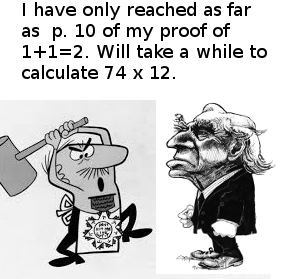
Common (Opi Mou) story 3. Math is universal; isn't 1+1=2 always?

-NO (We may have 1+1=0, or 1+1=1; used millions of times in a computer chip. )

And WHY is 1+1=2?

Does anyone here understand anything on that page?

(If not, you don't know why 1+1=2, but you know the Opi Mou story that math is universal!)

Clearly, Russell added nil to practical knowledge,

  • You manage your daily groceries without knowing one sentence of Russell's proof.

How did Russell do his groceries?

But obviously Russell made 1+1=2 so difficult that almost no one understands it.

Cape Town challenge:

  • Challenge issued to mathematicians in University of Cape Town:
  • Prove 1+1=2 in formal"real" numbers from first principles (without assuming theorems of set theory).

1+1=2 is too hard.

Simpler example. we teach geometry according to a text ("Euclid") used by the church to teach reasoning to its priest, NOT geometry according to the शुल्ब सूत्र.

  • We are very proud of the शुल्ब सूत्र-s, but have no use for them!
  • You probably know neither text
  • but still you "know" the story that "math is universal"
  • If so, we could just as well teach either.

To the contrary, our current NCERT text for class 9 repeats the stock church propaganda.

  • Indian (and ALL non-Western) mathematics was inferior, since practical
  • Greek mathematics was superior since it used "reason".

This is a tricky church claim for three reasons.

Tricky Reason 1: The concerned "Greeks" such as "Euclid" never existed.

  • E.g. my prize of Rs 2 lakhs for primary evidence about "Euclid".
  • Unclaimed since 2010. See video: "Goodbye Euclid!"

and "Is science Western in Origin"

Easy to impute any intentions to a non-existent person.

NCERT response:

  • Indian children MUST believe everything stated in Western texts.
  • No need to cross-check facts from primary sources.
  • That is what our government wants.

Response of NCERT math head

Our fault too, if we don't check facts in school text:

  • Our attitude: No problem what nonsense you teach, just make sure our children pass so they can get a job in future.

Tricky Reason 2: word "reason" involves church doublespeak

  • most people take reason to mean NORMAL reasoning (reason PLUS facts)
  • but formal math PROHIBITS facts
  • formal reason = reason MINUS facts.

Why?

  • The church accepted reason as part of Christianity during the Crusades
  • (to convert Muslims who were militarily too strong, and rejected the Bible as corrupted)
  • But church rejected facts since facts contradict church dogmas.

E.g. Thomas Aquinas reasoned about how many angels can fit on a pin.

  • He started by assuming angels occupy no space.

Such an assumption is called an axiom

  • Axioms (= postulates) are assumptions, NOT uncontested truths, as even our class 9 text explains.

However, as in the above case, axioms CANNOT be empirically tested.

  • Most axioms are pure metaphysics or fantasy.

E.g. Class 6 text explains: geometric points are invisible.

  • Hence, a line consisting of points is invisible.
  • Class 9 text postulates: a unique (invisible) line connects any two (invisible) points.

How do you test it? You can't. You must have faith.

Church glorified rejection of facts and acceptance of faith. or fantasy.

  • Formal math = faith-based math
  • Normal math (ganita) = fact-based math.

Our school texts today still delcare axiom-based reasoning to be "superior",

  • and deduction to be infallible.
  • (People believe mathematical theorems are infallible truths.)

Actually,

  • Axioms/assumptions are fallible (if empirically meaningful: Lokayata on wolf's footprints)
  • Therems based on faulty axioms are false.

Not even relative truth

  • Reasoning itself is fallible: any complex proof (e.g. four-color theorem) or calculation may involve mistakes.

Senses fallible,

  • but mind errs MORE easily than senses
  • E.g. game of chess: every human ALWAYS makes a mistake, hence ALWAYS loses to a machine.

Check my Durban article "Decolonising math", on my blog.

Note: Use of facts does NOT exclude reasoning:

  • Aryabhata deduced that the earth is round
  • from the FACT that far off objects cannot be seen
  • (and the horizon is round).

Tricky Reason 3: Greeks NEVER used reason without facts. Only the post-Crusade church did.

  • Claim about Greeks blatant falsehood (hides church connection).
  • Read the actual book "Euclid's" Elements. (Don't go by the story about it.)
  • It has axioms, but NO axiomatic proofs.

The original Elements uses empirical proofs.

  • Proof of theorem 4 (Side-angle-Side theorem, SAS) is empirical (by superposition)
  • Proof of "Pythagorean theorem" depends on prop. 4.
  • (Hence, no different from Indian proof; only very prolix.)

Today we teach SAS POSTULATE, not theorem.

  • David Hilbert's cover-up of the "Euclid" myth

However, this creates a major problem.

  • Original proof of SAS by superposition (putting one triangle on top of another).
  • Prohibiting superposition leads to SYNTHETIC geometry: length cannot be measured.
  • Length measurement also done by superposition: you put a ruler on top of a visible line segment.

Today we teach BOTH: 😄

  • (Hilbert's) synthetic geometry
  • AND empirical, metric compass-box geometry!

Lenth measurement both allowed and disallowed:

  • allowed for practical purposes
  • disallowed theoretically.

  • Students and teachers and text-book writers never told about this total lack of coherence.
  • And don't notice.

This is the kind of rubbish that we teach as the first lesson in "superior" axiomatic geometry.

What is the alternative?

Cannot leave question of alternative math to the government:

A school text on "Rajju ganita" is available

  • String geometry in the sulba sutra-s was also used in Africa.

A string can measure a curved line

  • no instrument in a compass box can.
  • Makes concepts like angle and \(\pi\) easy to understand.
  • E.g. how do you build a protractor to measure an angle?

Subtle differences: e.g. Manava sulba sutra 10.10 uses square ROOTS to state "Pythagorean theorem"

  • accepts that \(\sqrt 2\) is inexact.
  • (Foolish religious belief that the "Pythagorean theorem" is ever exact anywhere in the real world.)

Practical advantage: children can measure latitutde, longitude, height of a tree, mountain, size of the earth etc.

Teaching experiments carried out in Nasik, Chamrajnagar, Indore.

Calculus

Changing school syllabus difficult.

  • Decided by the ignorant

Easy to change university syllabus: some knowledgeable people around

Calculus in India developed differently:

  • no fantasies about infinity, such as real numbers or
  • the exact sum of an infinite series such as the infinite series for \(\pi\).

"Leibniz series", found in India 300 years before Leibniz

  • taken from India by Cochin-based Jesuits
  • and attributed to Leibniz on the genocidal Doctrine of Christian Discovery.

This metaphysics set aside for ALL practical applications of calculus

  • e.g. rocket trajectories calculated on a computer,
  • which uses floating point numbers, not real numbers.

Hence, rejecting real numbers and limits does not affect any practical application of calculus.

Calculus first developed in India with Aryabhata of Patna

  • who invented "Euler's" method (simple arithmetic rule of 3) to calculate 24 sine DIFFEREMNCES.
  • resulting in sine values precise to the first sexagesimal minute (about 5 decimal places).
  • This method refined over next thousand years (especially by his disciples in Kerala).

My course on "Calculus without limits" teaches calculus that way.

  • Makes calculus easy and
  • hence enables students to solve harder problems
  • omitted in current calculus courses (e.g. correct time period of a simple pendulum)

Correct time period is NOT \[T=2\pi\sqrt{\frac{l}{g}}.\]

  • Requires separate lecture to explain alol advantages.
  • But see the tutorial sheet (p1, p2) for the course as taught in SGT university.