The Funny History of Arithmetic How “superior” Europeans blundered for 900 years to learn elementary Indian arithmetic (“Arabic numerals”)
C. K. Raju
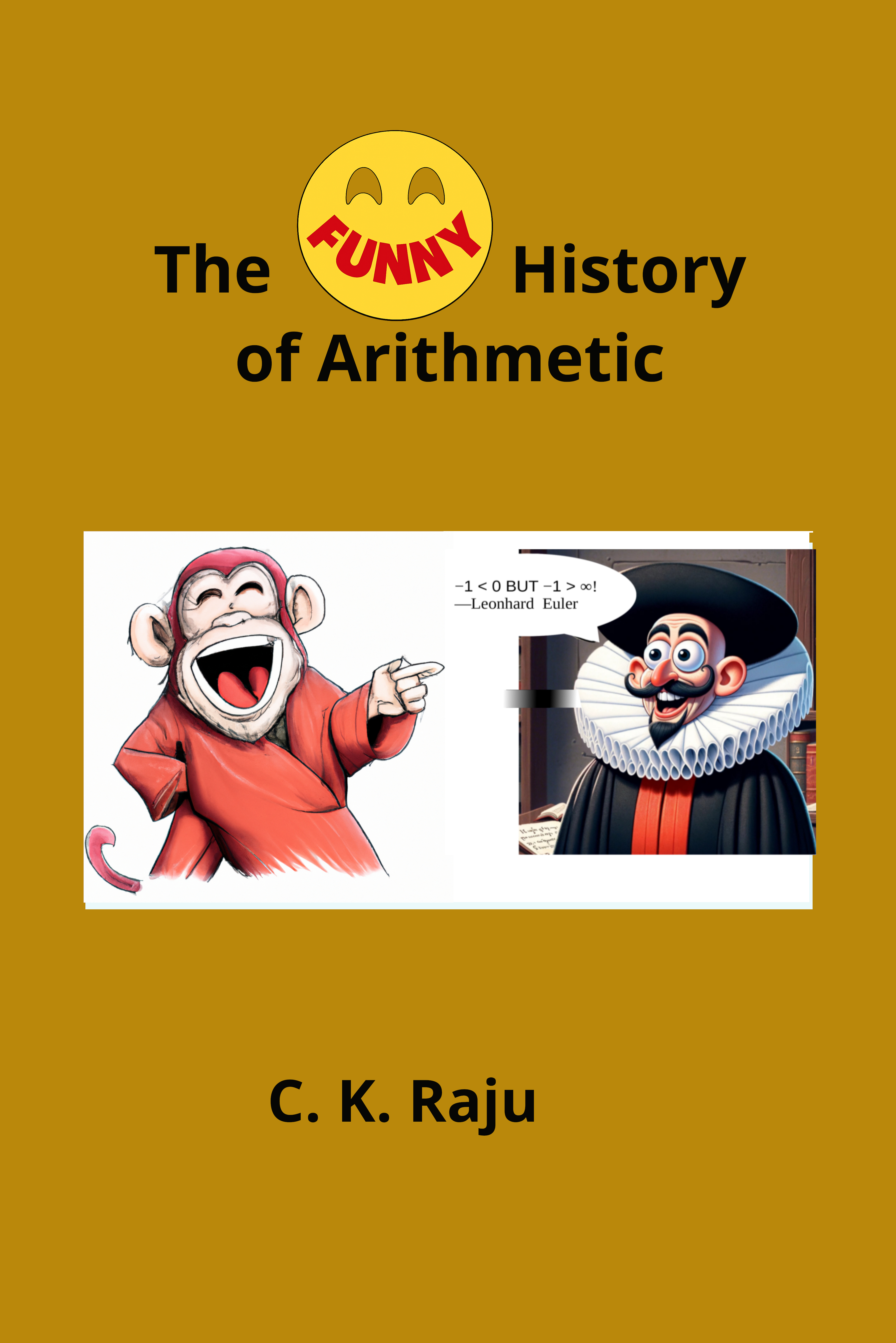 From the backpage
Arithmetic is the beginning of mathematics, and arithmetic begins with counting. To count, one must first name numbers. Early Greeks and Romans aped Sanskrit names for small number, but the largest number they named was a myriad, puny compared to giant numbers like parardha and tallakshana found in ancient India. This difference is inexplicable on the Aryan conquest fantasized to explain away the similarity. This book explains why early Greeks were inferior even in their abacus-based pebble arithmetic, contrary to their incessant false glorification by school texts, Wikipedia and chatbots, etc.
To overcome this chronic European inferiority in arithmetic, a 10th c. pre-Crusading pope imported “Arabic numerals”, also called “algorismus” after the Latin name of the 9th c. al-Khwarizmi, who wrote Hisab al Hind (Indian Arithmetic). The pope wanted Christians too to write large numbers, to catch up with their Muslim neighbours, who had learnt it from India.
But the other sophisticated features of Indian arithmetic—place-value, efficient algorithms, zero, negative numbers, and fractions—continued to puzzle and elude Europeans for another 900 years, until the end of the 19th c. Why? Because of hubris, due to their destructive religious superstition of their own supremacy. This book tells the funny story of how Europeans so comically applied this superstition, for centuries, to assert the superiority of their primitive pebble arithmetic, with hilarious consequences.
The laughter shatters Macaulay’s boast of the “immeasurable superiority” of Whites/West, in math and science. Read this book to learn how to bust that racist and colonial self-glorification through false history, and how to counter that psychological attack on the self-esteem of the colonised. This book also outlines how to make math easier and better today.
Preview the book and see contents and detailed index.
To buy, please fill this Google form.
Praise for
C. K. Raju’s earlier books
“Both path-breaking and definitive”—
Martin Bernal
“Raju remains one of the most important contemporary thinkers in the world...brilliant, insightful, ...magnificent work”—
Molefi Asante
“among the best treatments of the history and philosophy of mathematics”—
Ubiratan D’Ambrosio
“highly learned”— Asghar Ali Engineer
“masterly command of primary sources and a delightful sense of wit and humour”—
Kapila Vatsyayana
“magnificent...truly revolutionary”—
Arun Ghosh
“Raju is one of the deepest thinkers of modern times” —
Asad Zaman
“authoritative and written with impeccable clarity” —
G. J. Klir
“an excellent book and I highly recommend it” —
J. F. Woodward
About the author
Professor C. K. Raju holds an MSc in math and a PhD from the Indian Statistical Institute. He taught formal math (real analysis, functional analysis) for many years before abandoning it to play a key role in building India’s first supercomputer. As a Fellow of the Indian Institute of Advanced Study, he wrote Time: Towards a Consistent Theory (Kluwer/Springer, 1994), then The Eleven Pictures of Time: the Physics, Philosophy, and Politics of Time Beliefs (Sage, 2003). As an initial member and later Editorial Fellow of the Project of History of Indian Science, Philosophy and Culture he authored Cultural Foundations of Mathematics: ...the Transmission of Calculus from India to Europe in the 16th c. CE (Pearson Longman, 2007), then Euclid and Jesus: How and why the church changed mathematics and Christianity across two religious wars (Multiversity, Penang, 2012). More details at https://ckraju.net/cv. He is an Honorary Professor, and has been a Visiting Professor at University Sains Malaysia, Indian Institute of Technology, Mandi, etc.
A sequel to the present book will examine how algebra, trigonometry and calculus, also went from India to Europe, and explain his long-standing thesis how the West stole the calculus from India in the 16th c. That intellectual theft, and consequent limited comprehension of calculus by Newton et al., resulted in the current bad colonial teaching of calculus, which impedes a better understanding of science and retards the growth of technology. To correct it, he has been teaching alternative courses in calculus as ganita at IIT etc., string geometry and accelerated place-value arithmetic in schools.
To buy
India: Paperback print book Rs 875/-
Please fill this Google form to pay.
Or just watch a minimal video hereexcerpted from a talk at Sol Plaatje Univ. Kimberley, South Africa.
Brick and mortar stores
Garuda Prakashan (from 1 May 2026) 7/10 Ansari Road Daryaganj Near Jain Cottage Delhi - 110002 +91 7565800228 contact@garudabooks.com