UGC recommendations for teaching IKS: some serious lacunae
C. K. Raju
c.k.raju@ganita.guru
Introduction
I will take up three recommendation
- Vedic mathematics
- Vedic astrology
- "Kerala" calculus
There is widespread confusion regarding traditional knowledge
- To illustrate: E.g. on a recent visit to Australia
- the Indian community invited me speak on Bharatiya ganita
- and the Indian calendar.
Bharatiya ganita?
- Much talk today on Bharatiya gaṇita.
- Is there any other kind of gaṇita?
- Or does the phrase Bharatiya mean that no other nationality should use it?
- It is only for Bharata?
If you say only gaṇita
- You are forced to acknowledge that gaṇita is not the same as math
- for the simple reason that ganita accepts empirical proofs (प्रत्यक्ष प्रमाण)
- as do ALL systems of Indian philosophy, without exception.
Western math prohibits empirical
- When the Euclid book first came to Europe during the Crusades
- and was falsely interpreted as containing axiomatic proofs
- convenient to Christian rational theology invented during the Crusades.
- Christian priests declared axiomatic reasoning without facts,
- and, contrary to science, as a "superior" way of reasoning (convenient to Christian theology).
- We foolishly accept that this is the best way to teach math FOR science and teach it.
- In the language of the current class IX NCERT math text (p. 301)
- "Beware of being deceived by what you SEE"

गणित accepts प्रत्यक्ष प्रमाण
- As stated in in the Nyaya sutra 2
- and elaborated with examples from Indian gaṇita texts in this slide.
- as also explained in my Hawaii’i article of 1999/2001 in Philosophy East and West
- or as explained in this video on the notion of proof in Indian gaṇita
- or in this one in IIAS Shimla on ganita versus math
- and in this one on practical ganita vs religious mathematics.
We must understand the different philosophies of gaṇita and math
- if we intend to teach traditional gaṇita and use it.
- Cannot just keep pretending that acceptance of prtayaksh
- and prohibition of empirical are one and the same thing!!
- when they are diametrically opposite.
But one can’t teach traditional ganita without this discrimination
- between ganita and math
- apparently the UGC objective is to inculcate pride by teaching history
- but not to actually teach gaṇita or to deviate from existing colonised math courses
- because that is the real colonial superstition ("dharam") propagated by colonial education
- ape the West to the point of wearing suits in Delhi summer.

Apparently the UGC wants to promote tradition without
- without any conflict with the other colonial tradition of aping the West.
- this is an impossible proposition
- even promoting Ayurveda brings it in conflict with West.
- This is an open invitation people to make fun of pride in things
- which are de facto rejected as useless today.
- as for example the fear of teaching calculus as gaṇita
- and the fear of even discussing it openly.
Vedic math
- Some universities, such as Harisingh Gaur University, Sagar
- have introduced “Vedic math” in the syllabus.
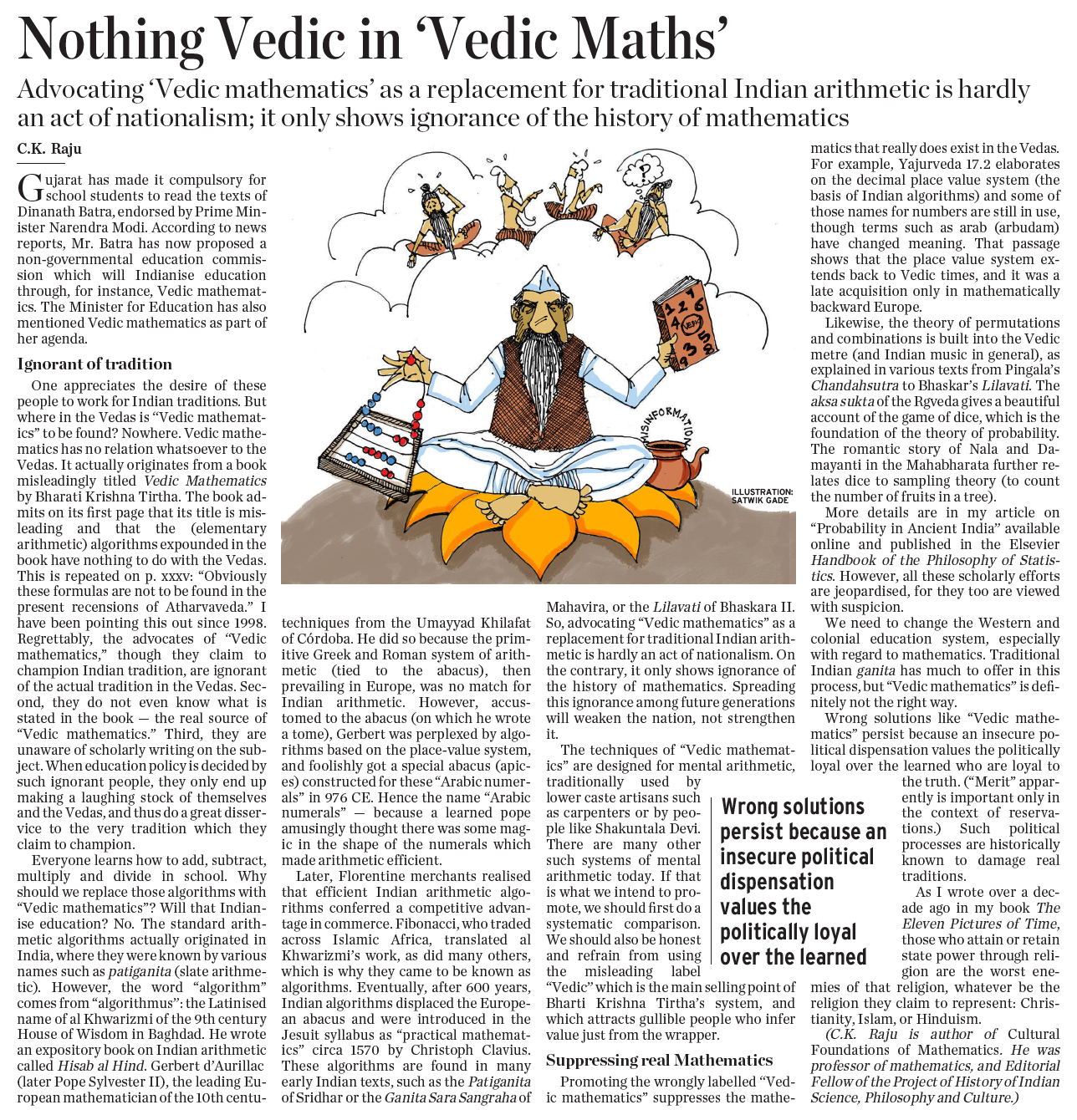
"Vedic math" has NOTHING to do with Veda-s
- Everybody agrees! (Including original "Vedic math" book.)
- As stated on its opening page and on p. xxxv/p. xxix bottom (in newer reprint)
"Obviously these formulae are not to be found in present recensions of Atharvaveda".(emph. added)
My past writings on this issue
- Article in Hindu, and in Jansatta
- Responses to critics on this blog
- esp. admission by Atul Kothari that "Vedic math not found in Veda" is true.

The REAL math found in the Veda
- is better described in this book
- and its great importance is explained in my recent book on Aryan Race Conjecture.
- Also अक्ष सूक्त (ऋग्वेद 10.34), my translation
- in my paper on "Probability in ancient India" in Elesevier Handbook of Philosophy of Statistics.
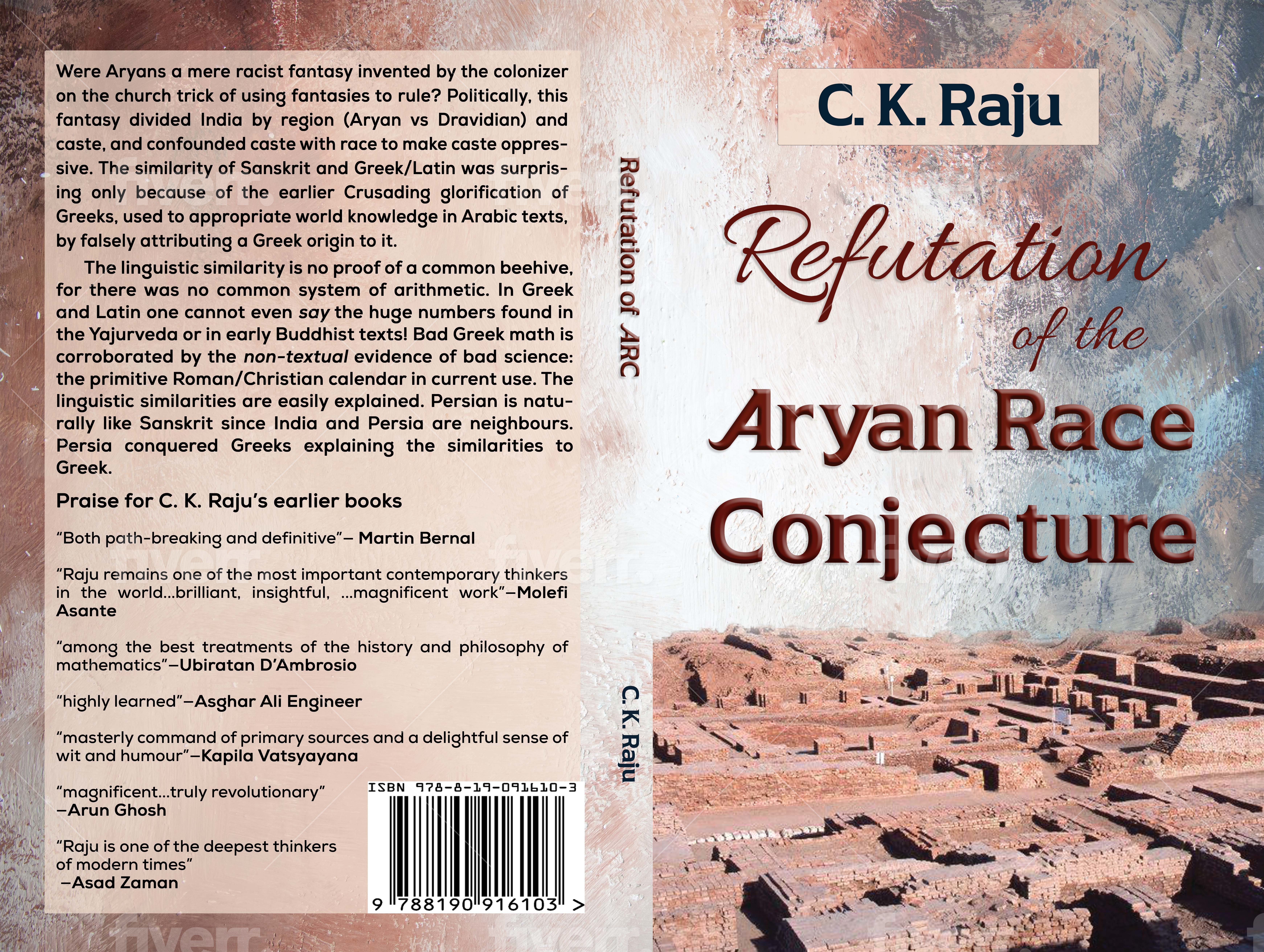
No mention of any of above in "Vedic math" book
- So, real math in Veda-s is NOT "Vedic math"!
- It is authentic traditional Indian gaṇita
- which "Vedic math" seeks to replace.
- To reiterate, Gaṇita NOT a synonym for math: see my Himanjali article "गणित बनाम मैथमेटिक्स".
So, name "Vedic" in "Vedic math" misleading:
- that "Vedic math" has some connection with Veda.
- Using name of Veda to mislead, to sell, demeans the Veda.
- A disservice to Hinduism.
Apologias
- "Vedic in sense that all knowledge is in the Veda"
- ALL knowledge?⁉
- Manual for car repair?
"Ancient" hence "Vedic"?
- (Atul Kothari said that so.)
- WRONG claim. Everything ancient is NOT "Vedic"!
- Lokayata, Buddhists, Jains REJECTED belief in Veda-s or related शब्द प्रमाण.
- Lokayata said that moksha is laughable.

- Lokayata said that authors of the Veda are धूर्त, and that Veda-s are false (अनृत) and contradictory (व्याघात).
- Eng trans. (Cowell) that "three authors of the Veda were buffoons, knaves and demons".
- Calling this "Vedic"!😖
- JUST to justify misguided attempt to sell "Vedic" math, is going too far!

Anyway, no evidence "Vedic math" is ancient 😀
- Our source modern: Bharati Krishna Tirtha.
- Could not explain his sources when asked by K. S. Shukla, ca. 1950.
- "Vedic math" NOT found in ANY traditional Indian math/astronomy text
- from Vedanga Jyotiṣa (\(-1500\) CE) to Yuktibhāṣa (+1500 CE) across 3000 years.
Swami Bharti Krishna Tirtha
- was undoubtedly a patriot and a freedom fighter.
- His intentions were entirely honourable
- (that is not necessarily true of those who promote or oppose Vedic math today)
- But he was ill-informed that he was replacing an imported tradition of arithmetic by an Indian tradition.
- Our duty is to correct him.
Arithmetic as currently taught IS of Indian origin
- which went from India to Europe,
- and was returned as part of colonial education.
- So "Vedic math" wrongly seeks to replaces real Indian gaṇita by using a fake marketing label "Vedic".
"Vedic math" has VERY limited use
- At BEST good for mental calculations in elementary arithmetic for primary school.
- Perhaps for some competitive tests where a calculator is disallowed.
- My point: teach mental arithmetic (many systems) if you want, but at least remove the false label "Vedic".
Any OTHER harm in teaching "Vedic math"?
- Yes! Damages authentic Indian tradition of gaṇita in various ways
- and its REVOLUTIONARY possibilities for future S&T which even Africans understand
- But most Indians don't.

- Colonialism taught us to ape Whites/West,
- and we are easily fooled by one FALSE label "Vedic",
- and related ELEMENTARY mental arithmetic
- (teaching which does NOT threaten West)
- as teaching gaṇita does
Graeco-Roman calculus: Arithmetic revolution
- Greek (and Roman) names for numbers very similar to Persian and Indian (Sanskrit) names.
- West claims this is because “Aryans” invaded India
- drove the indigenous Dravidians to the South
- On this fantasy See how many seat DMK won.
- But NO evidence for Aryans!
- West claims they also created the Veda-s (so much for the label "Vedic").
- This the ultimate insult to Hinduism.
- My simple, decisive answer to this 250-year old fantasy.
- Grace-Roman counting INFERIOR;
- their number names agree with Sanskrit ONLY for small numbers. Why?
- Graeco-Roman number names stopped at the puny myriad (Persian beavan) \(10^4\)
- still means uncountable, and connotes it as in "myriad stars" and other literary quotes


- But Indian names went on to parārdha (=1012) Yajurveda 17.2,
- tallakṣhaṇa (=1053) and beyond (10108, Buddha, Lalita vistara sutta, chp.12)
- so these Aryan/European duffers could not have created the Veda!
But why did no one notice this for 250 years?
- Why did no one point it out that "Aryan"/Greek/Roman knowledge of arithmetic was limnited to small numbers.
- Because we study only our own tradition
- and are afraid to attack the pūrva paksha (opponent’s point of view)
- which is what our tradition demands.
Why were Greeks and Romans backward in math?
- Conquest of Greeks by Persians (Aechemenid conquest after Lydian conquest) is a known fact.
- Hence, early Greeks/Romans knew calculus
- calculus=pebble=psephos: primitive pebble arithmetic = गिट्टी गणित
- Two meanings of word calculus!

- Early Greeks learnt pebble arithmetic from their Persian conquerors
- to pay tax to them (tax collector scene from Darius vase −300 CE)

Large numbers
- Roman numerals designed for pebble arithmetic.
- How do you write 1888 in Roman numerals?
- Pebble arithmetic very inefficient.
- Small number 1888 needs 13 figures MDCCCLXXXVIII not 4
- Indians could write large numbers
- because Indians used efficient place value system.
- that is Graeco-Roman pebble arithmetic is primitive/INEFFICIENT
- compared to sophisticated place-value of Indian gaṇita.
- Large numbers need place value.
- Took smartest of Europeans over 1000 years to understand simple fact.
Transmission to Baghdad
- First Indian arithmetic, because of its fame, went to Arabs.
- al Khwarizmi of Baghdad translated it as Hisab al Hind.
- Came to be known to Europeans as algorismus or algorithms after his Latin name: Algorithms.
- From Baghdad it went on to the Umayyad Khilafat which ruled Spain, Morocco
- Then in the 10th c. a pope (Gerbert) heard of it
- and started learning Indian arithmetic
- from Muslims in Spain and Morocco.
- But FAILED to understand it
- constructed an abacus which destroyed efficiency of Indian ganita.

Fibonacci
- Took another 2 centuries for Christian Europeans to grasp the efficiency of Indian Gaṇita.
- and its use for commerce.
- Then Florentine merchant Fibonacci wrote Liber Abaci (13th c.).
- based on al Khwarizmi's 9th c. Hisab al Hind.
- Both (Fibonacci and al Khwarizmi) gave an over-simplified treatment of Indian gaṇita
- As found in common Indian texts emphasizing commercial uses of gaṇita (instead of astronomy)
- Compare contents of 9th c. Mahavira's गणित सार संग्रह (Gaṇita sāra sangraha),
- with Fibonacci's contents (square/cube roots etc. only in chp. 14)
- Note Fibonacci's chp. 4 on subtraction (only LESSER numbers)

Fibonacci's blunder
- That is, still mired in the paradigm of pebble arithmetic like Gerbert
- Fibonacci blundered: has no negative numbers (like al Khwarizmi)
- because in primitive Graeco-Roman calculus (pebble arithmetic)
- subtraction means removing pebbles from an existing hoard
- and you can't remove more pebbles than there are on the board!

- OF COURSE Fibonacci numbers stolen from India, he made NO original contribution.
- Fibonacci's influence largely limited to Florence and neighbouring states
- since zero (= sifr=cipher) puzzled Europeans] (and Florence passed a law against zero)
- Finally, in 16th c. Gregor Reisz declared victory of algorismus over abacus

- followed by Adam Riese.
- Most importantly Jesuit general Christoph Clavius again imported gaṇita direct from India
- wrote a text on practical mathematics,
- introduced it in the Jesuit syllabus ca. 1575.
- We copied it after colonial education.
Persistent confusion about subtraction and negative numbers


Interim conclusion
- Conclusion: Western math was PERSISTENTLY INFERIOR,
- even in the matter of primary-school arithmetic
- from early Greek times till end of 19th c.
- contrary to colonial tales of Western supremacy.
Phylogeny is ontogeny
- On the principle that “phylogeny is ontogeny”
- these Western difficulties with elementary math are reproduced even in the primary school classroom today.
- Hence, aping the West makes math difficult even in the matter of primary school arithmetic.
- So the decolonial solution is to revert to the original methods of teaching ganita.
- E.g. Assume child has learnt representation of numbers by objects at home.
- START teaching arithmetic with place value, teach large numbers early.
- Teach practical value of arithmetic as in Mahavira Ganita sara sangraha etc.
- Also necessary to discuss difference between philosophy of ganita
- and of Western (axiomatic) math which prohibits the use of empirical in proof
- because of the churchification of mathematics in the West,
- since the Crusades when Euclid first arrived in Europe.
- But useless to talk of such matters to people who don’t know the basic history of arithmetic.
- If interested see my 2nd recent talk in Australia
- Note that the philosophy of axiomatic math enunciated by Christian priests
- Peano’s axioms, formal real numbers
- started by pronouncing their great curse (anathema) in 6th c. on the Hindu notion of soul
- similar to the notion of soul which Plato linked to mathematics as mathesis
- and which was copied by early Christianity of Origen.
- So, follow your colonial dharam, fundamentally against Hinduism
- and keep pushing what your neta-s (Congress or BJP) tell you to do.
Calendar and "Vedic astrology"
- The calendar involves the motion of the sun against the background stars (year, नाक्षत्र वर्ष)
- of the moon (month, चंद्रमास)
- the phases of the moon (tithi, तिथि ≠ civil day = सावन दिन )
- the weekday (वार)
- Because the Greeks were so bad at math
- their calendar involved a year of 375 days
- as the learned Greek Solon
- explained to the Lydian king of Greeks

- Currently you learn the (Gregorian) calendar
- The Julian calendar was adopted as the official Christian calendar in the Roman empire in 325 CE.
- It was later (6th-7th c.) changed to the "Year of the Christian Lord" calendar
- This religious calendar forces you to recite the name of the Christian Lord, AD-BC with every date.
- Then it was earlier called the Julian calendar after Julius Caesar
- who got the Egyptians to make it, after he conquered Egypt.
- The original Roman calendar was so bad the correction needed an intermediate year of 448 day
- because Romans, like early Greeks were bad in math

- The months are unscientific with 28, 29, 30, 31 days
- with no relation to the cycle of the moon
- The year is still described using leap years, since Romans lacked fractions (of pebbles)
- The Gregorian reform of 1582 still used leap years,since fractions were little known in Europe then.
In contrast, the Indian calendar is very scientific
- Every month has exactly 30 tithi-s
- because a tithi is mathematically defined as the time in which the moon moves ahead of the sun by 12° (celestial longitude)
- so purnima to purnima = 360° = 12° × 30.
However, we never refer to that unscientific and religious calendar
- as the Christian calendar
- to hide the fact that our two secular festivals
- Independence day and Republic day are defined ONLY on the Christian calendar.
However, UGC aims to defame the Veda-s
- Therefore, it will also NOT talk of science with regard to the Indian calendar
- instead wants to link the Veda to the pseudoscience of astrology.
- This attempt has been going on for the last 20 years.
- When the UGC first tried to open 16 University departments of Vedic astrology
- At that time a debate was organized between scientists and astrologers
- in India International center by Kapila Vatsyayana
- the late Pushpa Bhargava, Raja Ramanna, and I participated on the side of the scientists.
- I challenged the UGC, in front of the international press, to show me
- a single verse on astrology in the Vedanga Jyotish.
- No one could.
- Vedanga jyotisha defines jyotisha as कालज्ञानं, and कालविधानशास्त्रं.
- It does not have a single sentence on astrology1 or फलित ज्योतिष),
- In fact traditional Indian astronomy texts from Vedanga Jyotish to Yuktibhasha
- (including Varahamihira’s Panchsiddantica,
- across at least 3000 years do NOT have a single sentence on astrology.
- the confusion arises because Jyotish defined in the VJ as timekeeping
- is misread as astrology.
- perhaps this misreading is deliberate.
- Because astrology is a source of money and also superstition
- and the government wants to encourage that
- without contesting Christian superstitions in the calendar.
What to do?
- The correct approach is to avoid making a joke of Indian tradition
- by teaching a pseudo science of astrology,
- and to instead teach the scientific aspects of Indian tradition and the Indian calendar,
- while emphasizing the religious and non-secular aspects of the Gregorian calendar.
- This is being tried out initially in a school in Hyderabad.
Teaching Indian calendar requires rajju ganita

- or a change in geometry teaching
- to measure angles in space, such as the angle between sun and moon
- which are rarely in the sane plane (ecliptic).
- Measuring 3D angles not taught in current school geometry syllabus
- which teaches useless angle measurement only with protractor.
- Rajju ganita also needed to determine local latitude, longitude, size of the earth.
- also never taught in school geometry since colonial education focuses on Euclid
- and teaching the church method of axiomatic proof by prohibiting facts
- falsely read into the Euclid book.
However, big task
- zero support and much opposition from govt
- whether Congress or JP
- Very limited support from private parties.
- So, it may or may not happen.
Kerala calculus
- Again the UGC IKS recommendations speak of “Kerala calculus”.
- Whish’s 1832 article on the Indian calculus mentioned only Kerala texts.
- Good we are now taking cognizance of it AFTER 190 years.
- But that does not mean calculus originated with the Aryabhata school of Kerala,
- which only carried forward the work of Aryabhata.
- This confusion is due to several reasons:
- 1. the focus of the UGC recommendations is only to develop a sense of pride in Indian culture,
- and not to emphasize its current usefulness,
- which directly challenges the West.
- Pride can also be based on false assumptions
- as the cases of Vedic math and Vedic astrology shows.
Calculus stolen by Newton etc.
- How could the West have understood it
- when it too a thousand years to understand elementary arithmetic and negative numbers?
- Fact: West did not understand calculus!
- Newton’s fluxions were not understood
- Hence, Dedekind invented axiomatic reals.
- Now the West claims that is that that is the only way to understand and do calculus.


- Indian calculus as ganita was different did not involve a metaphysics of set theory etc.
- but we know the rule: the West cannot be challenged
- in keeping with our colonial temper!
Does Indian ganita make calculus better/
- 2. If one focuses on the current use-value of IKS,
- the question would immediately arise whether the calculus can be taught better under IKS.
- No one else except for me has actually attempted to teach calculus using IKS.
- The moment one does so it is obvious that Aryabhata’s finite difference technique
- now falsely called (“Euler’s method”) of solving differential (finite difference) equations
-is far better suited than mere infinite series
- without any well explicated criterion of convergence.
- the finite difference technique, first used by Aryabhata, is what is still use for all practical application
- such as sending a man to the moon.
- but we must do our colonial dharam, the most important aspect of it is to please the West.
- 3. Even if the UGC’s unstated objective is solely to inculcate pride minus use value,
- a conflict would nevertheless arise in the glorification of the high caste Brahmins of the “Kerala school”
- over the low-caste Āryabahaṭa a dalit from Bihar,
- though there was no such conflict in the minds of people of the Aryabhata school in Kerala
- who openly acknowledged Aryabhata as their guru.
- which shows that the oppressive form of casteism is post-colonial.
- So, let us call it the Aryabhaṭa calculus.
Ganit vs math again
- 4. Most importantly, there is a clear conflict between the philosophy of ganita
- which accepts empirical proof (prtayaksh pramana)
- and the philosophy of axiomatic mathematics, underlying which prohibits it.
- And axiomatic real numbers regarded as essential to the teaching of calculus, which rejects empirical proof.
How calculus is taught with ganita
- In my recent first (invited) talk at Pacific rim conference in mathematics
- have reiterated the principles underlying my course on calculus without limits.
- taught in 3 countries in 5 universities.
Three principles are
- Finite difference techniques: calculus as solution of differential equations
- Non-Archimeaden (polynomial) arithmetic of Brahmagupta
- which results in calculus without real numbers and without limits
- Zeroism or inexactitude.
- But the colonized are unwilling even to seeriously discuss the differences in a rational way,
- to decide which is better,
- because it exposes the religious (Christian) superstitions,
- underlying the current axiomatic philosophy of mathematics.
- Such a serious discussion would take several days, not 40 mins.
Summary and conclusions
- UGC should modify its recommendations
- to keep in mind the use value of tradition
- and the difference in the philosophies of ganita and math.
- We should teach authentic history and the scientific nature of Indian tradition,
- Tradition understood for its use value is not the monopoly of Bharat
- and could easily be grabbed by others, like Haldi patent.
- So we need to understand that we do not have another 190 as we took in acknowledging Whish.