Contents
Indic knowledge courses
C. K. Raju
Indian Institute of Advanced Study
Rashtrapati Nivas, Shimla
Introduction
Will talk of 3 undergraduate-level courses
- Calculus (and differential equations)
- Statistics
- History and philosophy of science (HPS)
Indic origins
- Calculus is of Indian origin
- as is probability and statistics
- A corrected history AND philosophy of science needs to be taught
- so students are aware of the historical Indian contributions to math and science.
Details of Indic origins: Background reading
- Calculus: My book Cultural Foundations of Mathematics (Pearson Longman, 2007)
- Probability and statistics: Article on "Probability in ancient India" Handbook of Philosophy of Statistics (Elsevier, 2011), pp. 1175–96.
- HPS: Booklet on Is science Western in origin? Multiversity, 2009.


Practical value today
- WHY teach these Indic knowledge courses?
- Just for sentimental value?
- Because our ancestors did it?
- A. NO. I teach them for their PRACTICAL value to students, TODAY.
So, what is wrong with existing courses on calculus and statistics?
- They teach only mechanical application of formulae.
- Students lack conceptual grasp of most elementary concepts such as
- limit, derivative, integral, probability etc.
- (will go into details shortly).
Ganita method
- Teaching math (calculus and statistics) as ganita makes math easy and
- enables students to solve harder problems not covered in usual courses
- and to acquire a solid conceptual grasp.
A note
- These courses were developed and taught in Malaysia, Iran etc.
- for their PRACTICAL advantage, NOT Indic origins
- Many Malaysians have a poor opinion of Indians who first went as poor indentured labourers.
- So, to repeat, they accepted these courses solely for their practical advantage NOT Indic origins.
What is the practical value of the course on history and philosophy of science?
- Western education taught us deshi = inferior and videshi = superior.
- And hence taught us to imitate the West in every way.
- As our school math texts still teach in class IX
- that Indian geometry was inferior and we should imitate "superior" Western geometry.
Believed without checking
- We accepted that claim of Western superiority
- without ever checking it.
- because teaching Western superiority at an early age indoctrinates us.
Consequence: our academic system 100% imitates the West
- And we are frightened of not imitating the West
- e.g. in mathematics,
- without understanding that we taught most core mathematics to the West
- We superstitiously fear that non-imitation may result in some terrible catastrophe.
The course on history and philosophy of science (HPS) teaches that
- This claim of Western superiority is bogus
- that it is based on a false history and bad philosophy of math.
- This poorva paksha needs to be countered BEFORE we boast that we did this and that.
- But we cannot contest it, because there is not a single university department or decent course in HPS in India.
But to understand how false history was used to trick and enslave us
- we need to understand the tricks by which a false history was spread through the education system
- including the trick of declaring a particular philosophy as (normatively) universal
- as used in giving credit to "Pythagoras" for the so-called "Pythagorean theorem".
So the practical advantage of the course is that it will get rid of our sense of inferiority
- it will give us the courage to innovate and get ahead
- as we did before colonialism.
- This is the right way to do it, instead of making wild claims of spacecraft in ancient India
- which make us an object of ridicule.
Or false claims of "Vedic math"
- not found in the Veda-s
- or in any traditional Indian math text across 3000 years
- from Vedanga Jyotisha (-1500) to Yuktibhasha (+1500)
- (And ability to do mental arithmetic is of , engineering or commerce).

Recap
- Teaching math (calculus and statistics) using Indic methodology of ganita
- makes math easy and enables students to solve harder problems not covered in existing courses.
- Teaching history and philosophy of science exposes the false Western history of science
- and the trick of using a bad philosophy.
- and enables us to escape from the resulting sense of racial and cultural inferiority.
Calculus
- Calculus originated in India with आर्यभट (5th c.)
- Developed across a thousand years,
- and was stolen and taken to Europe in 16th c.
- for a solution of the European navigation problem
European navigational problem
- was then the biggest scientific challenge in Europe from 15th to 18th c.
- and many European governments offered large prizes for its solution
- such as the prize offered by the British Board of Longitude set up
- by an act of Parliament in 1711.
Note
- It is आर्यभट NOT आर्यभट्ट
- A common mistake made by people who do not study history of science.
- आर्यभटीय is the name in all original manuscripts.
- Significance?
भट is a dalit name (भट्ट the title of a Brahmin)
- And Aryabhata's followers included the highest caste Namboodiri Brahmins from Kerala
- such as नीलकंठ सोमसुत्वन who wrote a commentary on आर्यभटीय.
- Caste system was quite different in ancient India.
Discovery doctrine
- In the West it was falsely claimed that calculus was "discovered" by Newton and Leibniz
- on the obnoxious "Doctrine of Christian discovery"
- that the first Christian to find something becomes its "discoverer"
- This is the meaning of saying "Vasco da Gama discovered India", or Columbus "discovered" Americas.
But we never study history of science, so are easily fooled
- by false Western history repeated in math texts.
- Will come back to history.
- Let us move on to calculus.
The size of calculus texts
3 years to learn calculus
- At an average of 1 page per day a student will take over 3 years to read these texts!
- And calculus is taught across 3 years: 11th, 12th, and beginning undergrad courses.
- But, at the end what does the student learn?
The difficulty of limits
- Surprisingly little!
- Understanding a simple calculus statement \[\frac{d}{dx} \sin(x) = \cos(x),\]
- needs a definition of \(\frac{d}{dx}\).
- That requires limits.
But limits NOT defined
Indian NCERT class XI text says:
First, we give an intuitive idea of derivative (without actually defining it). Then we give a naive definition of limit and study some algebra of limits3
The formal definition of limits
- On present-day mathematics, the symbol \(\frac{d}{dx}\) is defined for a (real-valued) function (of one real variable) \(f\),
- using another symbol \(\lim_{h \to 0}\).
- \[\frac{df}{dx} = \lim_{h \to 0} \frac{f(x+h) - f(x)}{h}.\]
Definition of derivative (contd)
- \(\lim_{h \to 0}\) is formally defined as follows. \[\lim_{x \to a} g(x) = l\] if and only if \(\forall\: \epsilon > 0, ~\exists\: \delta > 0\) such that \[0 < |x - a| < \epsilon\: \Rightarrow | g(x) - l | < \delta, \quad \forall x \in \mathbb R.\]
The missing element
- The texts of Thomas and Stewart both have a section called "precise definition of limits".
- But the definitions given are not precise.
- They have the ritualistic \(\epsilon\)'s and \(\delta\)'s.
- But are missing one key element: \(\mathbb R\).
The difficulty of defining \(\mathbb R\)
- Formal reals \(\mathbb{R}\) often built using Dedekind cuts.
- Set theory provides a model for formal natural numbers \(\mathbb N\),
- which provide a model for Peano arithmetic.
The difficulty of defining \(\mathbb R\) (contd)
- \(\mathbb N\) can be extended to the integers \(\mathbb Z\).
- This integral domain \(\mathbb Z\) can be embedded in a field of rationals \(\mathbb Q\).
- Finally, \(\mathbb Q\) can be used to construct cuts.
Dedekind cuts
- \(\alpha \subset \mathbb Q\) is called a cut if
- \(\alpha \neq \emptyset\), and \(\alpha \neq \mathbb Q\).
- \(p \in \alpha\) and \(q < p \implies q \in \alpha\)
- \(\not\exists \, m \in \alpha\) such that \(p \leq m\quad \forall p \in \alpha\)
Dedekind cuts (contd)
- Addition (\(+\)), multiplication (\(\cdot\)), and order (\(<\)) among cuts defined in the obvious way.
- May be readily shown that the cuts form an ordered field, viz., \(\mathbb R\).
- Called "cuts" since Dedekind's intuitive idea originated from Elements 1.1.
Elements 1.1: The fish figure

- With W, E as centers and WE as radius two arcs are drawn, and they intersect at N and S.
- Used in India to construct a perpendicular bisector to the EW line and thus determine NS.
Rejection of empirical methods of proof
- Elements, I.1 uses this figure to construct the equilateral triangle WNE on the given segment WE.
- Empirically manifest that the two arcs intersect at a point.
- This appeal to empirical methods of proof was rejected in the West.
Rejection of empirical proofs
- \(\mathbb R\) required for formal proof which prohibits empirical proofs (accepted in ganita).
Historical note
- If real numbers are essential for calculus
- then since Dedekind invented real numbers in 1878
- No one prior to that had any proper understanding of calculus.
- So how did Newton and Leibniz invent calculus without understanding?
Epistemic test
- Lack of understanding is proof that knowledge of calculus was stolen
- How do you prove that a student copies in an exam?
- If he lacks knowledge of what he claims to know
- and cannot explain what has written in his exam paper.
The integral
- What about \(\int f(x) dx\)?
- Integral taught as the anti-derivative, with an unsatisfying constant of integration. \[\text{if}~ \frac{d}{dx} f(x) = g(x) \quad \text{then}\quad \int g(x) dx = f(x) + c\]
Riemann integral
- It is believed that some clarity can be brought about by teaching the Riemann integral obtained as a limit of sums. \[\int_a^b f(x) dx = \lim_{ \mu(P)\to 0} \sum_{i=i}^n {f(t_i) \Delta x_i}\]
- Here the set \(P = \{ x_0, x_1, x_2, \dots x_n \}\) is a partition of the interval \([a, b]\), and \(t_i \in [x_i,\ x_{i-1}]\).
The integral (contd.)
- Once more defining even the elementary Riemann integral requires a definition of the limits.
- hence real numbers.
The difficulty in defining functions
- What is the definition of \(\sin(x)\)?
- Most students think \(\sin(x)\) relates to triangles.
- Do not learn the correct definitions of \(\sin(x)\) etc.
- since the definition of transcendental functions involve infinite series
- and is today believed to require notions of uniform convergence.
What the student takes away
- Calculus texts trick the student into a state of psychological satisfaction of having "understood" matters.
- The trick is to make the concepts and rules seem intuitively plausible
- by appealing to visual (geometric) intuition, or physical intuition etc.
What the student takes away (contd)
- Thus, apart from a bunch of rules, the student carries away the following images: \[\begin{aligned} \text{function} &= \text{graph} \nonumber\\ \text{derivative} &= \text{slope of tangent to graph} \nonumber\\ \text{integral} &= \text{area under the curve.} \nonumber\end{aligned}\]
Belief that visual intuition may deceive
- The student is unable to relate the images to the rules.
- Ironically, the whole point of teaching limits and real numbers is the belief that such visual intuition may be deceptive.
- Recall that Dedekind cuts were motivated by the doubt that the "fish figure" (Elements 1.1) is deceptive.
Need for set theory
- Real numbers are not the end of the story
- whatever way we get real numbers
- as Dedekind cuts or equivalence classes of Cauchy sequences
- set theory is needed for it.
The difficulty of set theory
- The construction of \(\mathbb R\) requires set theory.
- Students are TOLD about set theory but not TAUGHT even the definition of a set.
What the student typically learns about set theory is something as follows.
"A set is a collection of objects"
or
"A set is a well-defined collection of objects"
Russell's paradox
- With such a loose definition it is not possible to escape things like Russell's paradox.
- Let \[R = \left\{x | x \notin x \right\}.\]
- If \(R \in R\) then, by definition, \(R \notin R\) so we have a contradiction.
- On the other hand if \(R \notin R\) then, again by the definition of \(R\), we must have \(R \in R\), which is again a contradiction.
Why Cantorian set theory was rejected
- So either way we have a contradiction.
- From a contradiction any nonsense can be deduced: \[A \wedge \neg A \Rightarrow B\]
- Paradox is supposedly resolved by axiomatic set theory,
- but even among professional mathematicians, few learn axiomatic set theory.
- Most make do with naive set theory.4
Have you understood the difficulties?
- Can go on like this, but if you don't know about formal reals and axiomatic set theory
- you will not understand these problems or further problems like Banach-Tarski paradox
- So, here is a simple challenge problem
- to highlight the difficulties
Cape Town challenge
- Prove 1+1=2 in formal REAL numbers (not integers or natural numbers) AXIOMATICALLY,
- from FIRST PRINCIPLES (in the manner of the 378 page proof of 1+1=2 in cardinals by Russell and Whitehead)
- WITHOUT assuming any result from AXIOMATIC SET THEORY.

Prize of Rs 10 lakhs
- If you can offer a valid answer to my Cape Town challenge by tomorrow.
- Serious offer, hence some caveats.
- Easy to put your name on someone else's written response
- So, you will be expected to publicly explain what you claim to have written.
In Indian calculus all these problems disappear
- Empirical proof accepted
- No limits needed for derivatives only finite differences (e.g. खंड ज्या)
- needed for Aryabhata's method of numerical solution of differential equations
- My study of practical application at C-DAC showed that numerical solution of differential equations
- needed and suffice for ALL major practical applications of calculus.
Integrals
- No need of integrals (e.g. \(\int f(x) dx\) is solution of \(y' = f(x)\))
- On this method, non elementary integrals (e.g. elliptic integrals) as easy as elementary integrals
Sine function
- OED says "sine" derives from Latin sinus from Arabic jaib (जेब = pocket) = fold
- Actually, sine function from India, called jiva
- from jya = chord
- related to CIRCLE NOT triangle.

Sine function (contd)
- Jiva changed to "jiba" in Arabic
- (since Arabic has no v sound)
- written without nukta-s as consonantal skeleton "jb".
- misread as "jaib" by ignorant Toledo translators.
Infinite series
- Infinite series for sine function first derived in India (see my book Cultural Foundations of Mathematics, chp. 3)
- Used to derive sine values in a very precise way.


How was the infinite series summed?
- INFINITE geometric series WAS first summed by Nilakantha (1501)
- (Finite geometric series very old, found in Yajurveda 17.2, "Eye of Horus" fraction in ancient Egypt etc.)
- How was it done WITHOUT real numbers and limits?
Brahmagupta's avyakta ganita
- Brahmagupta's avyakta ganita of polynomials
- was reproduced in al Khwarizmi's al jabr waal muqabala, later became Algebra.
- This polynomial arithmetic is non-Archimedean
- (means there are infinities and infinitesimals, but no unique limits)
Formula for finite sum is extended to infinite sum
- and infinitesimals are discarded on the philosophy of zeroism.
- Further details requires a full course.
Course on calculus without limits has been tried out
- First in 2009 in the Central University of Tibetan Studies, Sarnath
- Then in 2010 with 4 groups of students in the math department of Universiti Sains Malaysia. See report part 1, part 2.
- Then in 2012 in CISSC, Tehran, see poster and group photo,


Course on calculus without limits (contd)
- Then in Ambedkar University Delhi, see poster, and group photo
- And in 2017 in SGT University Delhi, poster and group photo.


Advantages of the Indic calculus course
- Conceptual clarity: no unreal "real" numbers, limits etc. which few understand
- Teaches real life applications (e.g. ballistics with air resistance)
- Teaches non-elementary integrals omitted from calculus courses (e.g. correct theory of simple pendulum using elliptic functions).
- See e.g. tutorial sheet
- Teaches that it is silly to memorise formulae by using MAXIMA (earlier MACYSMA).
Statistics
Indian origins of probability and statistics
General references, see articles in books
- "Probability in Ancient India", Handbook of Philosophy of Statistics, Elsevier, 2012, pp. 1175-96.
- "Probability", Encyclopedia of Non-Western science…, Springer, 2016, pp. 3585–3589.
- Cultural Foundations of Mathematics…transmission of the calculus from India to Europe in the 16th c. CE , Pearson Longman, 2007.

Probability and statistics arose in India as normal math or गणित.
- Probability relates to game of dice.
- The first account of the game of dice is in the RgVeda.
Mahabharata (Sabha parva)
- Shakuni wins the game by deceit
- Hence, there was an idea of a "fair (or unbiased) game".
Mahabharata (Van parva 72)
- Story of Nala and Damayanti
- Their separation. Disguised Nala takes a job as a charioteer with Rituparna, king of Ayodhya.
- Damayanti announces swayamvara (widow remarriage).
Counting the fruits on a tree by sampling
- Nala and Rituparna dash to Vidarbha.
- Stop on the way near a Vibhitaka tree (mentioned in the aksa sukta)
- the five-sided fruit of which was used in game of dice.
- Rituparna shows off his knowledge of ganita, by counting the 2095 fruits on the tree.
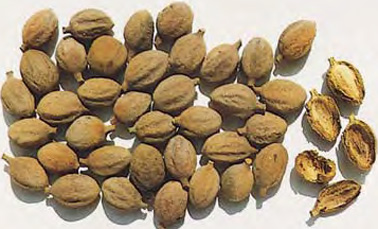
Sampling is the easy way to count
- a large number of fruits in a tree
- as Rituparna explains to Nala
- who tries to check by cutting down the tree and counting.
The theory of permutations and combinations first found in many ancient Indian texts
- from the time of the Jain Bhagwati sutra, Susruta, and Varahamihira etc.
- E.g. in the common school text ("Slate arithmetic") of Sridhara
When Cochin-based Jesuits stole knowledge of calculus they also stole probability from India
- for the sake of their navigational problem.
- Indian texts had verses giving trigonometric values which are very accurate
- needed to determine latitude, longitude, and loxodromes
- Accurate navigation was the biggest scientific challenge in Europe from 15th to 18th c. CE

Binomial coefficients and "Pascal's" triangle
- Binomial coefficients found in Pingala's Chandahsutra
- His commentator 10th c. Halayudha obtains binomial coefficients using 17th c. "Pascal's" triangle
- called Khanda-meru by Bhaskar II.
Pascal was close to Fermat
- whose 1657 challenge problem to European mathematicians remained unsolved until 18th c.
- Was a SOLVED EXERCISE in Bhaskara's Beejaganita (87)
- involving large numbers 226153980 and 1766319049.
Because they stole, Europeans failed to understand calculus and probability until 20th c.
- they eventually turned it into formal math to fit their superstitions about math.
- Most people do not do Lebesgue integral and find probability as a measure is very hard to understand
- especially for management students who need it for marketing surveys etc.
Statistics for AI
- AI based heavily on statistics
- Use without understanding can result in major calamities tomorrow.
Statistics for finance
- Many science and engineering students shift to finance a lucrative line
- This requires solid grounding in statistics, as explained in video of my recent JNU talk
- Failure to understand can result in a huge crash like the sub-prime crisis.
History and philosophy of science
- On my analysis, Macaulay imposed Western/colonial education using a false history of science
- which we never checked.
- We need to check it.

International HPS workshop
- Anchored a week long International workshop in 2012
- to design a new HPS course,
- not taught in Western universities
- but first taught in AlBukhari University Malaysia.
The course was popular
- e.g. see this short video (2 min 30 sec)
- Hence part 2 of the course was developed
- with emphasis on philosophy
- and also taught in AlBukhary University.

Course was localised to India
- As per the original recommendation of the workshop
- the course was to be localised to suit different countries.
- Accordingly, when I taught it in SGT University in 2017
- it was localised, as is clear from the final question paper.
The need to check history using facts from primary sources
- One aspect that the course emphasizes is that
- a whole lot of false history has been systematically created by the church/Western historians
- Because establishing your inferiority is the first step to conversion.
- So, those people who accept that everything indigenous is inferior are already half-converted.
The remedy
- How to check that false history?
- Today, most people google which takes them to Wikipedia.
- But Wikipedia is an UNRELIABLE tertiary source.
- Even standard texts are secondary sources which may be unreliable as the course teaches.
Case of Euclid
- For example, let us go back to the class IX math text
- what is the PRIMARY evidence for Euclid?
- For my 2 lakh reward see the 3-part video Goodbye Euclid! of my lecture at USM.
- But NCERT has no primary evidence; our textbooks mislead.

The need for philosophy
- A second important issue to understand is
- the trick by which a bad philosophy is used to change history.
- Look at Q. 2b in the question paper.
Is "Pythagorean theorem" found in the sulba sutra?
- It is often claimed that it is.
- This ignores the poorva paksha or counter argument in our school text that Indians Egptians etc. had a statement,
- but no deductive proof.
Indians did have proof
- While Indians did have a proof as well
- it involved empirical methods (but also used reasoning)
- There is nothing wrong with proofs which use the empirical
- accepted as the first means of proof by all Indian systems of philosophy
- and by science.

Does prohibiting empirical make a proof superior?
- All of our current math and stat teaching is based on that belief
- which derives from a church superstition that proofs based on axioms and prohibiting facts are infallible.
Why math works
- A common doubt raised by students is that "it works" so why change anything?
- But what works in math is CALCULATION (or ganita) not formal PROOF e.g. rocket trajectories.
- Similarly, the "Pythagorean" proposition in the Manava sulba sutra 10.10 involves calculation (of square roots)
- using a SQUARE of sides \(a\), \(b\), with diagonal \(d\), NOT a right-angled triangle with its hypotenuse.


Indian "Pythagorean" calculation,
- instead of \[d^2 = a^2 + b^2\]
- the Manava sulba sutra$ has \[d = \sqrt {a^2 + b^2}\]
- The two forms are NOT the same,
- since calculation of square ROOTS was unknown in the West until the 12th c.
There are many other such differences that it is important to understand.
- E.g. most ganita (arithmetic, algebra, "trigonometry", calculus, probability and statics) first went from India to Europe.
- In geometry, we need to switch back to Rajju Ganita.
- Cannot be all explained in a lecture: requires a full course.

Conclusions
- Teaching math (calculus and statistics) as ganita makes math easy and
- enables students to solve harder problems not covered in usual courses
- and to acquire a solid conceptual grasp.
- Teaching HPS courses is essential to end our
- half conversion through a sense of inferiority through FALSE history and BAD philosophy
- and resulting mental slavery to the West.
Final word: West is not best
- You must fight; no one else will free you from mental slavery
- The fight for freedom (swaraj) did NOT end 73 years ago.
- This fight requires knowledge, not arms, so demand knowledge, not merely certificates
- Accept knowledge from all sources, but choose what is best, not just what is West.
References (to texts)
- G. B. Thomas, Maurice D. Weir, Joel Hass, Frank R. Giordano, Thomas' Calculus, Dorling Kindersley, 11th ed., 2008
- James Stewart, Calculus: early Transcendentals, Thomson books, 5th ed, 2007.
- J. V. Narlikar et al. Mathematics: Textbook for Class XI, NCERT, New Delhi, 2006, chp. 13 "Limits and Derivatives", p. 281.
Refereces to texts (contd.)
- e.g. D. V. Widder, Advanced Calculus, 2nd ed., Prentice Hall, New Delhi, 1999.
- e.g. W. Rudin, Principles of Mathematical Analysis, McGraw Hill, New York, 1964.
- e.g. P. R. Halmos, Naive Set Theory, East-West Press, New Delhi, 1972.