Table of Contents
- Introduction
- 75 years since independence: where ARE we, and where do we WANT to be, or OUGHT to be
- Tackling colonialism
- The real aim of colonial education: controlling revolts
- Origins of church power and education
- Summary
- A solution?
- Decolonisation of math
- Proof (Indian methods of proof)
- Lie No. 1: "Indian mathematics had no proof"
- Indian methods of proof
- Proof (प्रमाण)in the Nyaya Sutra of Gotama
- Note use of anumana to REASON that earth is round
- "Greeks" and reason (continued)
- Disagreements about proof in Indian tradition
- Why did Carvaka reject anumana (inference)?
- Doctrine of relative truth
- Rabbit theorem (weakness of axiomatic proof)
- Buddhists accepted only pratyaksh (manifest) and anumana (inference)
- However, ALL Indian schools of thought accepted pratyaksh (empirically manifest)
- Section summary
- Proof (axiomatic proof)
- Which proof is better?
- What is axiomatic proof?
- Axiomatic proof rejects pratyaksh
- Axiomatic proof rejects pratyaksh
- Rejection of pratyaksh in formal proof is also stated in the school text
- That is why your school text lies
- So, church superstition at base of Western/colonial math
- But this has a subtle political angle
- Politics of colonial mathematics
- The Western mathesis superstition
- Is the Pythagorean theorem true?
- Pythagorean theorem is FALSE anywhere in the REAL world
- This church superstition (theorem = truth) caused the loss of thousands of lives.
- Western backwardness in math (elementary arithmetic) led to a bad calendar
- Why is a good calendar needed for navigation?
- And serial plagiarists of my calculus transmission work,
- Heaving the log to determine longitude
- From the speed, the distance travelled was calculated.
- Indians knew better even a thousand years earlier
- Specifically, Bhaskar 1 says
- Note: Bhaskar 1 is discussing the fact that spherical geometry is "non-Euclidean"
- Section summary
- Section summary (contd.)
- Is the Pythagorean theorem true? (apologia)
- Approximate truth
- So we have two superstitions in Western math
- Calculus teaching
- My course is labelled as calculus without limits. Why?
- Summary and conclusions
Introduction
- Broad topic is decolonization
- More specifically decolonization of math.
75 years since independence: where ARE we, and where do we WANT to be, or OUGHT to be
Decolonization vs indigeneity
- Broad topic is decolonization.
- But this meeting is on "भारतीय ज्ञान परंपरा" (= Indian indigenous knowledge)
- The issue of indigenous knowledge is often confused with decolonization
- as Nature did recently,
- Indeed it wrote a second unsigned editorial on why we have nothing to fear from decolonization of mathematics.
- My short response to Nature editorials: tweet1, tweet2.
- Why is West afraid of decolonization of math?
- e.g. church reporter writing about White abuses against me on decolonization of math (and Stephen Hawking) in South Africa
- He came from Kenya, interviewed me in Delhi about South Africa, and
- wrote about it in a magazine UnDark from MIT, Cambridge, Mass, US
- carrying all the abuses by Whites as their only intekllectually feeble response.
So, why is the West so afraid of decolonization of math?
- Why is Nature trying to fool us about it by confounding decolonization and indigenisation?
- And what is the difference between indigenous math and decoloniztion of math?
- Briefly:
- indigenous math= "we did this, we did that FIRST"
- decolonization = fighting the colonizer for freedom from legacy of colonial education which still MENTALLY enslaves us 75 years after independence.
- That involves a CRITIQUE of Western math and COMPARISON with Indian ganita.
- They say: know thyself.
- But, after colonisation, even to know yourself, you must FIRST know the enemy.
- That also our tradition:
- before stating your position know and refute the पूर्व पक्ष.
Example: Pythagorean theorem
- Many times we hear that Baudhayana शुल्ब सूत्र came first before Pythagorean theorem.
- For example, the statements by S&T Minister in 2015 Science Congress. The Hindu, TOI, etc.
- Others have been claiming this ("India was first in Pythagorean theorem") for 50 years.
- Seems the only thing we understand is
(a) the issue is only history (b) [the contest is only with the West (Egypt, Babylon etc, can be ignored] (c) "we did it first"
- so let us be PROUD we won the race!
- Alas, at least first read Indian class IX NCERT school text in math.
- It does NOT say Pythagoras did it first.
Different and BETTER, NOT first
- It admits that Indians Egyptian and Babylonians did it earlier than Greeks.
- But says "Greeks" (=Pythagoras, Euclid) did it different and did it better.
- So, the issue involves philosophy of math (as used in history)
- As summarized in my 2016 CENSORED article: "To decolonise math stand up to it false history and bad philosophy" (first carried, then CENSORED also in India by Scroll, and Wire, which put it back)

- This philosophy of math stated in the class IX text which everyone should read (since math compulsory up to Xth)
- if we don't read we make JOKERS of ourselves, and have done so repeatedly for 50 years.
- And ALSO of others. After that if ANYONE talks of Indian tradition, people hold up this as the typical example of joker-giri to ridicule. Which team are you in?
- So, for decolonization, knowledge of Sanskrit not enough, should also know math, and its Western/Greek history and philosophy.
- But knowledge of Sankskrit + Western math also not enough (e.g. Manjul Bhargava in NEP)
- should be willing to CONFRONT colonial/Western philosophy of math
- as misused by the colonizer, to enslave you.
- As I explained in this article on गणित बनाम मैथमेटिक्स
- not the slightest hint of which is to be found in NEP.
- Thus, my thesis could NOT be published in an Indian journal of philosophy in 5 years.
- (I am Not an unknown person. I was on editorial board of JICPR for philosophy of math and science
- But was removed unceremoniously from board by M. M. Joshi.)
- Today JICPR will not even publish what I have to say about Pythagorean theorem or about ganita vs mathematics.
- US Journal of Black Studies published it
- they are not much interested in Sanskrit or whether Indians did it first
- But they ARE interested in BETTER math and decolonial math
- and MORE willing to fight the West than most colonised Indians who think: "West is best".
Interim Summary
- Most math teachers including IIT math profs don't have thorough understanding of formal math (they can solve IIT: JEE problem but not change math syllabus.)
- No knowledge of history or the trick of how it is mixed with philosophy.
- Issue not of history of math alone, but which is better Indian ganita or Western math even at class IX level.
- No room to publish on this in India in journal of math or philosophy.
- This leaves issue to others not interested in Indian origins or Sanskrit, only in which math is better.
Q. Which is better? Ganita or formal math?
- Why are we unable even to (publicly) DISCUSS this question in India?
- Except as periodic entertainment but never as basis for long-term ACTION?
- Why so much FEAR about discussing the ADVANTAGE/DISADVANTAGE (NOT history) of Indian ganita?
- [I won't discuss Vedic math (not part of Indian ganita), we need to talk of actual math in veda-s.]
- See also Jansatta or this clip, and this blog.
- Why are we afraid to discuss the difference between ganita and math?
- Because coloniser instilled fear. How?

Tackling colonialism
Basic principle: "know your enemy" (and his tricks).
- E.g. Tamerlane's conquest of Delhi. His trick.
Do we know the (colonizer) enemy?
- What we all know is ONLY the STORY: Macaulay gave us a bad system of colonial education.
Story of Macaulay is obviously false
- go to Peru, a Spanish colony, education system is the same
- go to Beirut, French colony, education system is the same
- go to Surinam, Dutch colony, education system is the same
- go to Brazil, Portuguese colony, education system the same.

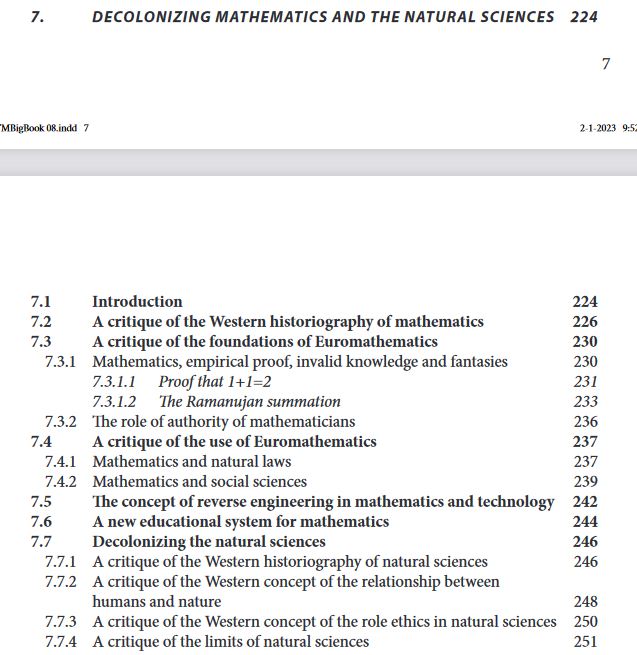

10 different causes for 1 phenomenon?
- No! That is BAD theory.
- BJP manifesto of 2009 stated that colonial education was a conspiracy specifically against India, by Macaulay.
- FALSE. Because same colonial education is found everywhere.
- Means: Even 75 years after the colonizer left, we failed to even know "WHO is the enemy".
Who is the enemy? NOT Macaulay
- Macaulay NOT the cause of colonial education
- only an instrument in bringing it to India.
- To cure a disease one must know its cause. Let us try to find it.
Let us set aside the STORY and start from FACTS.
- Fact 1. Colonial education was Western education. Undeniable.
- Fact 2. Who made Western education? Church.
- Mission schools of course: NO secular education in Britain until 1870 act of British parliament.
- But also higher education, Western universities, due to church.
- E.g. Pope's edict on University of Paris, 1231.
- Its Chancellor (not just Vice Chancellor)SUBORDINATE to the Bishop.
- Note that pope (Gregory 9) is issuing the order appointing chancellor.


Interim summary
- Western education was church education
- The church brought it to India.
- Contrary to story that church is at war with science paradoxically, the
- best science colleges in India (e.g. St. Stephen's, Madras Christian College, St Xavier's, Mumbai) are still church institutions)
The real aim of colonial education: controlling revolts
Macaulay version 2
- Anyway, to complete the story about colonialism, let us get back to Macaulay.
- Most people hear only of Macaulay's minute on education.
- But Macaulay also made a speech to the British Parliament (18 April 1847)
- In this speech he offered an entirely different reason for educating THE BRITISH. (Clearly, no conspiracy against India!)
- He feared further revolts in Britain after the French revolution, London riots etc.
- Macaulay's argument (in British parliament): education prevents revolts. Hence, educate the British poor for free.
- Note that, in India too higher education was introduced in a big way only after the Indian revolt of 1857. (To prevent further revolts.)
- However, nobody else in India ever talked of what all counter-revolutionary measures the British took to prevent further revolts after 1857.
The church magic
- Q. What is the magic in (Western) education that it gets into people's minds and prevents revolts?
- Q. WHY and HOW does church education make people obedient? (Like trained dogs: well-trained dogs need no leashes.)
- This the source of Western fear about decolonizaton (it affects their power).
Origins of church power and education
- Church power over Europeans is manifest.
- It ruled the Western mind for over a thousand years.
- But ruled mostly without weapons.
- What was the source of power?
- This "magic" power of church education is based on using control of education
- to systematically disseminate several factors such as
- 1. superstition (अन्धविश्वास)
- 2. faith (भक्ति, पश्चिम में भक्ति)
- 3. Ignorance (अज्ञान)
- 4. Myth (मिथ्या)
- 5. Prejudice (पूर्वाग्रह)
- 6. Cultural alienation from own cultural traditions (सांस्कृतिक अलगाव), e.g. calendar.
- 7. Peer pressure due to globalisation of church education during colonialism.
- (Macaulay first wanted to control the British poor.)
Teaching ignorance
- Ignorance is created by the examination system,
- which teaches that the objective is to pass the exam and avoid knowledge.
- Mathematics an excellent tool to teach ignorance (hence obedience).
- Let us see how ignorant the church made you.
Example of your ignorance: 1+1 = 2
- Everyone knows the kindergarten way to do 1+1 = 2
- But this is based on the empirically manifest (प्रत्यक्ष प्रमाण)

- Acceptable in ganita, but प्रत्यक्ष rejected in formal math
- as taught in school
- (same class IX text, p. 301,
- "However, each statement in the proof has to be established using only logic…. Beware of being deceived by what you see (remember Fig A1.3)"
- However, you probably left out this part since not asked in exam.😄
- Imp. Q. Without using प्रत्यक्ष how do you show 1+1=2?
- Bertrand Russell gave a proof in 378 pages.
- Do you understand any part of this proof?
- Do you understand anything on that p. 378?

- That is, though colonial education supposedly came for the sake of science it taught ignorance of mathematics even about such a basic thing as 1+1=2.
- The church power over your mind is based on myths and superstitions. Knowledge will bust superstitions, therefore the church deliberately teaches ignorance.
- But that's not the end of the story. Russell's proof applies only to cardinal numbers.
- For calculus, NCERT teaches one needs real numbers. These are taught in the first chapter of the same class IX school text.
- In formal mathematics there is no unique concept of the number 1. As such the natural number 1 is distinct from the real number 1. A completely different set of axioms (≠ Peano's axioms) is needed for real numbers.
- Very few people understand the axioms (of set theory)that are needed for real numbers. (But they will never admit it, especially not a PhD in math.)
JNU prize of Rs 10 lakhs for 1+1=2
- Accordingly, in JNU, I offered a prize of ₹10 lakhs to anyone who could prove 1+1=2 overnight. (Video, presentation)
- or a reduced prize of 1 lakh within a week.
- I can repeat that prize offer for my Cape Town Challenge here.
- Prove 1+1 = 2 in real number from first principles and without assuming any result of set theory, in the manner of the detailed proof from first principles given by Russell.
- From such ignorance how do you decolonize?
Trusting the West
- Ignorance teaches faith: Ignorance forces you to proceed on trust, not knowledge.
- Bhakti and prejudice guide that trust.
- You think Russell can be trusted since he got the Nobel Prize ("Western certificate of approval", Western bhakti)
- Where church education taught "trust the Christian priest", colonial education modified it to teach "trust the superior West".
- In school, I was taught that only Western ("phoren") texts are reliable.
Wikipedia system
- Today, most people Google for knowledge.
- Google directs them to Wikipedia.
- Wikipedia uses that same colonial standard: that only Western or Western-approved sources are reliable.
Mistrusting the non-West
- To escape from knowledge hegemony you need guidance to alternative knowledge.
- Colonial education alienated you from the "inferior" non-West.
- Wikipedia today rejects all non-Western sources as unreliable.
- This was the colonial teaching: "trust the West", "mistrust the non-West".
Cultural alienation
- e.g. teaching ONLY Christian calendar
- and child's birthday on it from an early age
The role of myth (false history of science)
- Greeks a proxy for the church.
- Talk of Greeks masks Church intervention in creating a false history of science.
- Church superstitions(e.g. axiomatic proof) also attributed to Greeks (e.g. Pythagoras) to mask church intervention.
- Though colonial education supposedly came for science
- you could not learn science without even 1+1=2.
- because the church teaches ignorance.
- But the church told you tonnes of stories about science.
- Your total faith in WEst it is clear from the fact that you
- never challenged any story or checked it.
- Stories nested within each other like Russian Matrioshka dolls.
- This allows the received story to be saved by technique of myth-jumping.
- E.g. X std school text used term "Pythagoras theorem" 32 times.
- If you point out no evidence for Pythagoras,
- Step 1. no one will believe you (mistrust the non-West)
- Step 2. Journalists will write against you (trust the West)

- (but no one will provide evidence or engage).
- Step 3. If finally admitted, no Pythagoras, they will jump to myth of Euclid.
- Step 4. No evidence for Euclid, repeat above steps for Euclid.
- Step 5.
- Claim of Western superiority a mutation of earlier claim of White superiority
- If it is challenged and asserted that Euclid was a black woman censor it.
- Step 6. Finally assert, "it does not matter there is the book"
- Step 7. But there is a false myth associated with the book, that it has axiomatic proofs. But it has none (requires knowledge of math).
- Step 8. Finally uncover the real myth that the story of Euclid promotes Crusading church theology (which the colonised never study).
- Step 9. Use of axiomatic proof allows West to dominate mathematical knowledge, hence all knowledge (e.g. science) based on math.
Net result: you have no possibility of escape or revolt:
- no knowledge of your own,
- cut off from traditional knowledge,
- trust the wrong people, and
- mistrust those who might offer you a chance to escape
- immersed in an ocean of interconnected myths which you mistake for truth.
Summary
- Decolonization requires fighting the colonizer, and critiquing Western knowledge.
- Colonial education = church education, NOT Macaulay's (a mere church propagandist).
- Church NOT about only about conversion to Christianity, but about ruling you, through soft power (mind control) (or genocide or slavery).
- Church education lays the foundation for several techniques for mind control of colonially educated by West.
- One key technique is ignorance: though colonial education came for science it taught ignorance of even why 1+1=2.
- Because church education spread widespread ignorance of math, that makes it difficult to decolonize math
- we failed to remove one false myth of Pythagoras from our school texts.
A solution?
Is escape impossible?
- from this combination of
- ignorance of colonial math (even 1+1=2)
- bhakti in the West
- and in global peer group (universities)
- mistrust of non-West
- + belief in Western myths and stories.
Actually VERY easy to make a change at Univ. level
- at least on a trial basis
- (Univ. has autonomy)
- e.g. teaching of Indian calculus without limits as a full or part course
- as demonstrated by SGT univ. Delhii NCR in 2017.
- But we have not the will to do it,
- hence has not been repeated in last 6 years.
Decolonisation of math
Basic theme
- Most present-day school math
- arithmetic, algebra, trigonometry and calculus, probability and statistics
- first went from India to Europe as गणित in pre-colonial times
- for its practical value.
- Europeans appropriated it in three different ways.
- Pre-crusade: attributed to Arabs
- Crusades: attributed to late Byzantine Greek texts copied from Arabs
- post-Crusade: using doctrine of Christian discovery (e.g. Newton "discovered" calculus.
Epistemic test
- But the giveaway is that they failed to fully understand it.
- My epistemic test: knowledge thieves,
- like students who cheat in an exam,
- fail to fully understand what they steal.
- Europeans converted ganita into formal math by adding their own superstitious understanding of math
- as mathesis and eternal truth
- and into church-method of faith-based reasoning and proof
- They added a false history (Greeks did it, Newton did it) etc.
- During colonialism they returned this math to us declaring it as "superior" and globalised its teaching.
E.g. arithmetic of Arabic numerals
- Indian arithmetic was efficient
- Hence Europeans abandoned their own inferior system ("Roman numerals")
- and repeatedly imported Indian arithmetic
- Gerbert 976 (from Arabs in Cordoba, Spain)
- Fibonacci 12th c. (from Arabs in Africa)
- Clavius 16th c. (Jesuits in Cochin)
European failure to understand Indian arithmetic
- Gerbert's apices (Roman arithmetic based on inefficient abacus, efficiency of Indian arithmetic based on algorithms, Gerbert foolishly made an abacus for Arabic numerals)
- Florence 13th c. passed a law against zero (=sifr=cipher=mysterious code) since Indian place-value system not additive like Roman numerals.
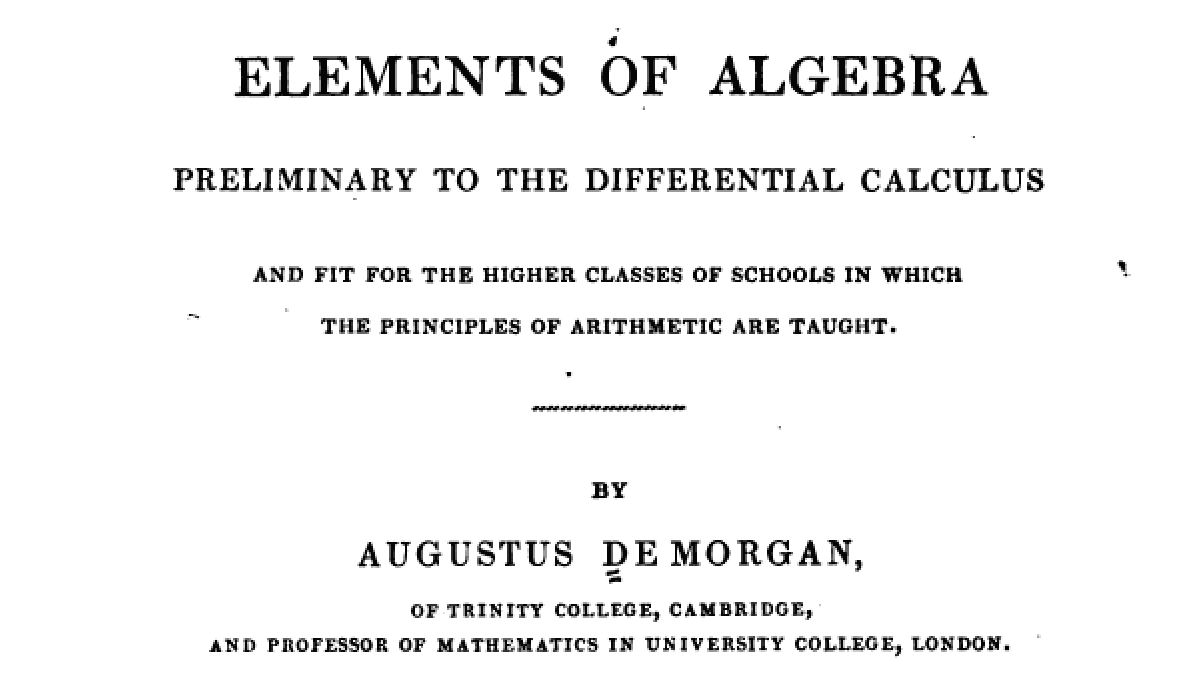
- However, zero relates to negative numbers and Augustus de Morgan, professor of math University College London, in his 19th c. textbook on Algebra, he FAILED to understand negative numbers and declared them evil.



The one aspect of math that Europe did NOT import from India was GEOMETRY
- Europe imported mystery (रहस्यवादी) geometry from Egypt (Plato's mathesis)
- and later converted it to suit church needs during Crusades
- Too long to explain in 2 minutes, in simple language, to the colonised who have been taught ignorance.
- If that were possible, you would have got decolonised long ago.


- Ideally decolonisation of math must from geometry (but difficult, since that is part of school syllabus controlled by govt.
- which does not allow alternatives to be taught).
- Indian (शुल्ब सूत्र) tradition of geometry was different, practical.
Rajju Ganita
- Why class IX?
- Because parents hyper about board exams in Xth,
- Nasik workshop, and its home assignment
- Very good response to teachers' workshop
- "How were we teaching this NCERT nonsense for so long? Were we hypnotized or what?"

- However, school syllabus for class IX controlled by government
- In actual teaching experiments with students the same teacher who taught the NCERT geometry
- also taught Rajju Ganita.
- But the two syllabi are contradictory, not complementary: e.g. invisible point vs dot, angle as two straight lines vs angle as capa, empirical vs axiomatic proof.
- This led to confusion
- since the teacher taught NCERT text in one class and in the next class taught that it was wrong!
Other Rajju Ganita workshops


Bengaluru workshop
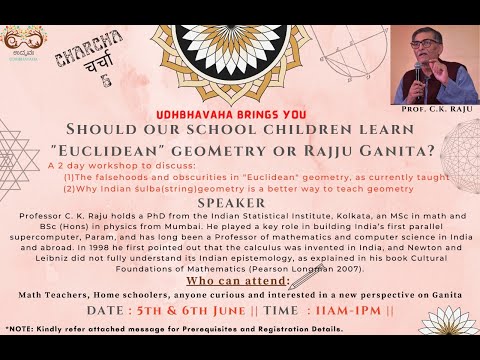
- Udhbhavaha workshop
- 2 videos (5 hours 42 mins), Part 1, and Part 2
- Some key highlights
- You have already seen NCERT class IX texts says Greek math was superior to all non-Western math
- NCERT class IX book also says "Non-Greek math had no proof"
- This false. Indian ganita had proof.

Proof (Indian methods of proof)
Lie No. 1: "Indian mathematics had no proof"
While mathematics was central to many ancient civilisations like Mesopotamia, Egypt, China and India,
there is no clear evidence that they used proofs
(p. 287, Class IX, Appendix 1)
Indian methods of proof
- Indians had a systematic theory of proof, which was used everywhere including mathematics.
- They had this theory of proof long before "Greeks", whether imaginary (like the mythical 12th c. Aristotle concocted after the Toledo translations of the 12th century),
- or the historical Aristotle of Stagira (-3rd c.).
- Indian notions of proof well documented.
Proof (प्रमाण)in the Nyaya Sutra of Gotama
- ONE Indian notion of proof: (Nyaya sutra 2)
- Not found in Indian math texts because proof not specific to math
- Same notion of proof applied to ALL knowledge (math, science, religion…)
- Examples of use in mathematics
Note use of anumana to REASON that earth is round
- But class IX school text (p. 79) lies:
In fact, Babylonians and Egyptians used geometry mostly for practical purposes and did very little to develop it as a systematic science. But in civilisations like Greece, the emphasis was on the reasoning behind why certain constructions work. [Emphasis original]
"Greeks" and reason (continued)
The Greeks were interested in establishing the truth of the statements they discovered using deductive reasoning (see Appendix 1)." (p. 79)
- "Greeks" only an acceptable proxy for "church".
- The text lies also because Indians did have a philosophical concept of proof, which let us understand better.
Disagreements about proof in Indian tradition
- Different schools of thought disagreed about what constituted acceptable proof
- Buddhists accepted only प्रत्यक्ष and अनुमान.
- Carvaka/Lokayata ("people's philosophers") accepted only प्रत्यक्ष.
- (Disagreement about proof shows, the Indian notion of proof existed from long before the beginnings of Buddhism, irrespective of the date assigned to the Nyaya sutra.)
Why did Carvaka reject anumana (inference)?
- Because anuman/deductive reasoning does NOT lead to truth or valid knowledge.
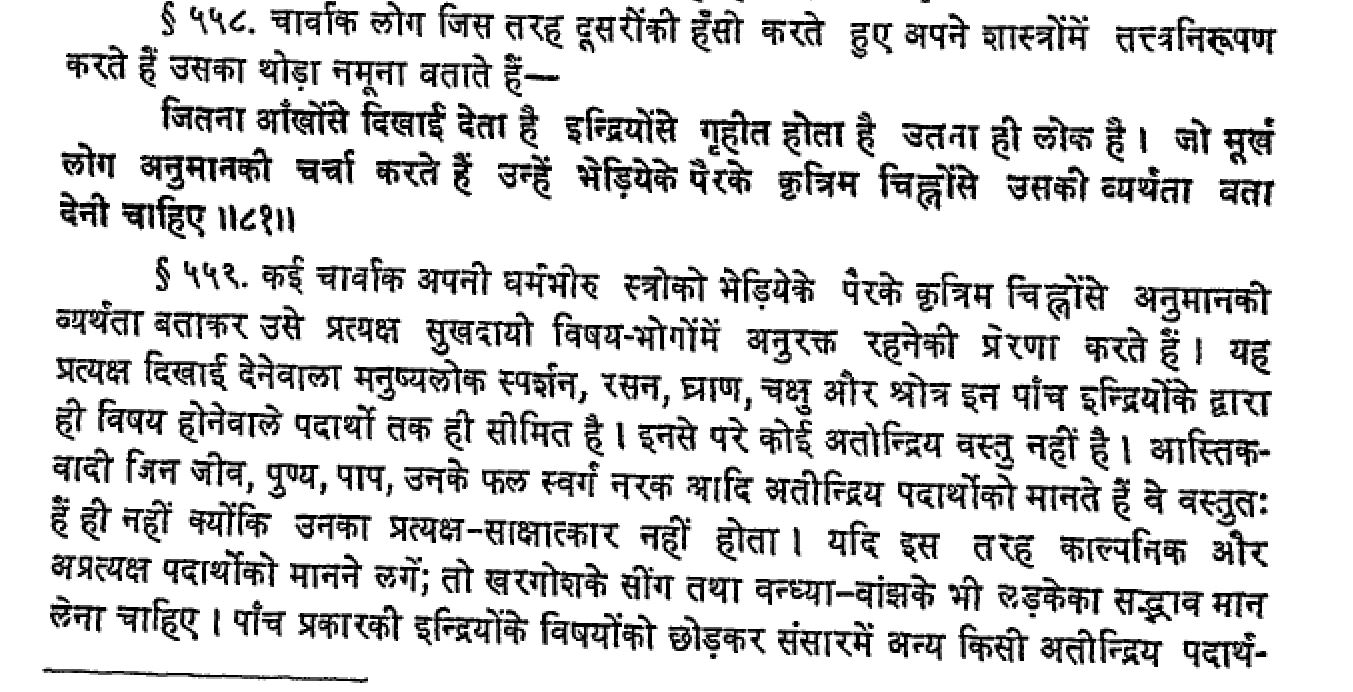
- Story of "seeing the wolf's artificial footprints" ("वृकपदं पश्यं", from षटदर्शन समुच्चय 81 and trans. Commentary 559–560, pp. 454–55. )
- leads to the false conclusion that a wolf was around.

Doctrine of relative truth
- Modern-day Western logicians do not deny the force of the Lokayat objection
- but try to hide this by saying the non-existent wolf is actually "relative truth"!
- My "rabbit theorem" illustrates the meaning of "relative truth": any nonsense whatsoever can be "relative truth".
Rabbit theorem (weakness of axiomatic proof)
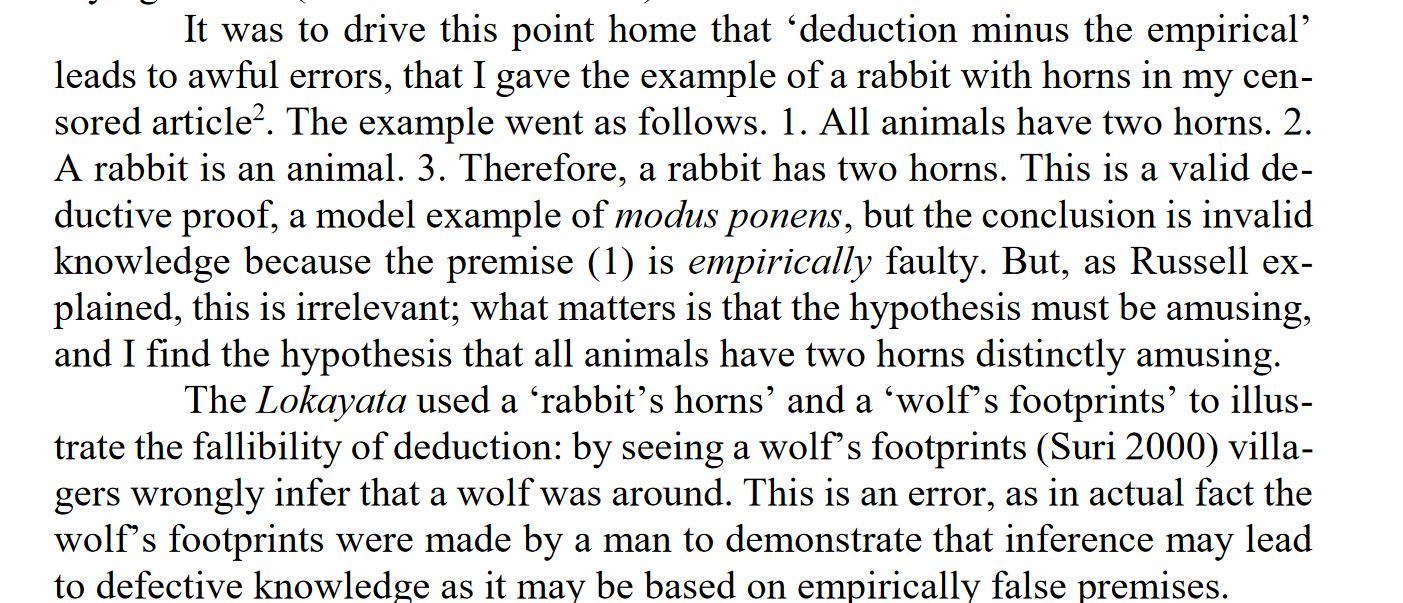
- All animals have two horns (postulate)
- a rabbit is an animal (postulate)
- \(\therefore\) a rabbit has two horns (relative truth).
- As we will see, ALL theorems of formal mathematics are such "relative truths".
- (Found in my censored article, and my article on Decolonising mathematics)
Buddhists accepted only pratyaksh (manifest) and anumana (inference)
- Rejected analogy (upamana) and testimony (shabda) as possibly misleading.
- Rejection of analogy: story of the elephant and the 9 men blind from birth,खुद्दक निकाय, उदान पालि (6.4), तित्थ सुत्त
- Bible ("gospel truth") says earth is flat (and tall trees CAN be seen from everywhere).
- So what some regard as "reliable testimony" ("Bible is the word of God", shabd) is NOT truth.

However, ALL Indian schools of thought accepted pratyaksh (empirically manifest)
- as does science (experimental method).
- Hence, first record of experiments is from India (in the Buddhist Digha Nikaya)
- Refutes common Western lie: "Francis Bacon discovered the experimental method"
- Francis Bacon was dishonest (sentenced for corruption), and a witch-torturer, who said "Gospel is the best cure for superstition".🤣🤣🤣
Section summary
- The class IX school text brazenly lies that Indians and others had no method of proof.
- (Why does teaching of formal math begin with lies?)
- This lie helps the school text to conflate "proof" with formal mathematical proof (= "proof as used by church")
- and avoid discussing the advantages or disadvantages of formal mathematical proof.
Proof (axiomatic proof)
Which proof is better?
- Let us discuss what the NCERT text avoids
- (by telling lies to make us believe there is only one notion of proof)
- But, first, we need to understand what is axiomatic proof,
- Let us understand it in terms of the Indian concepts of proof.
What is axiomatic proof?
- In terms of Indian concepts,
- formal/axiomatic mathematical proof accepts ONLY anuman (inference),
- (and, in a hidden way, shabda paramana [authority] for axioms),
- but rejects pratyaksh [empirically manifest]
Axiomatic proof rejects pratyaksh
- Have been writing about this for 20 years (Hawai'i abstract, paper, downloadable paper)
- but recently realized that
- (a) people are ignorant about the definition of formal mathematical proof
- (b) they don't trust my assertion (or check my definition quoted from the texts to which I refer)
- (Ignorance and trust deficit "trust the West and mistrust the non-West" is how superstitions are maintained.)
Axiomatic proof rejects pratyaksh
- This is clear from the difference between the proof of 1+1=2 in normal mathematics
- and the axiomatic proof of 1+1=2 by Russell.
- Because axiomatic proof rejects prtayksh it is different from ALL Indian systems of proof
- (since all Indian thought accepts pratyaksh)
Rejection of pratyaksh in formal proof is also stated in the school text
"However, each statement in the proof has to be established using only logic. … Beware of being deceived by what you see (remember Fig A1.3)!" [Appendix 1, p. 301, emphasis original]
That is why your school text lies
- that Indians etc. had no notion of proof.
- Easier to lie ("Indians had no proof")
- than to explain why you must use a strange method of faith-based reasoning for proof
- a method different from all Indian methods of proof.
- They KNOW no Indian asked questions about lies in school texts in 200 years.
- They believe colonised Indians won't be able change it in next 200 years,
- or even get math "experts" to publicly discuss that possibility.
- Non-mathematician made ignorant, taught to trust formal mathematician
- who won't admit since their entire career at stake once they acknowledge
- the fundamental difference between Indian ganita and formal math.
So, church superstition at base of Western/colonial math
- that faith-based reasoning (axiomatic reasoning) is superior
- makes math metaphysics (pure fantasy)
- it still "works" because much of this fantasy is built around Indian real-world ganita (imported from India)
- and in practice those fantasies are set aside (e.g. doing compass-geometry with real-world visible lines and dots)
But this has a subtle political angle
- dominating the world through metaphysical fantasies about infinity
- But fantasies are church weapons to control people's minds.
Politics of colonial mathematics
- Mathematical theorems are "relative truths"
- relative to axioms(=postulates, NOT self-evident truths).
- West controls the axioms
- Hence, West controls mathematical knowledge
- and all knowledge based on it.

The Western mathesis superstition
West tied math with religion from before church, since Plato
- E.g this tweet.
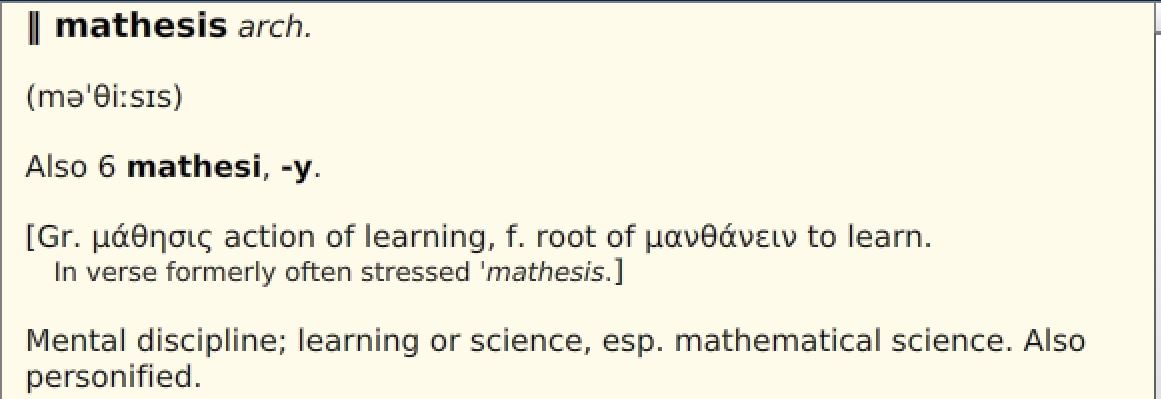
- word mathematics derives from mathesis meaning learning. (Oxford English Dictionary on mathesis)
- Plato on math and soul.
- According to Plato "all learning is recollection" of the knowledge acquired by the soul in previous lives.
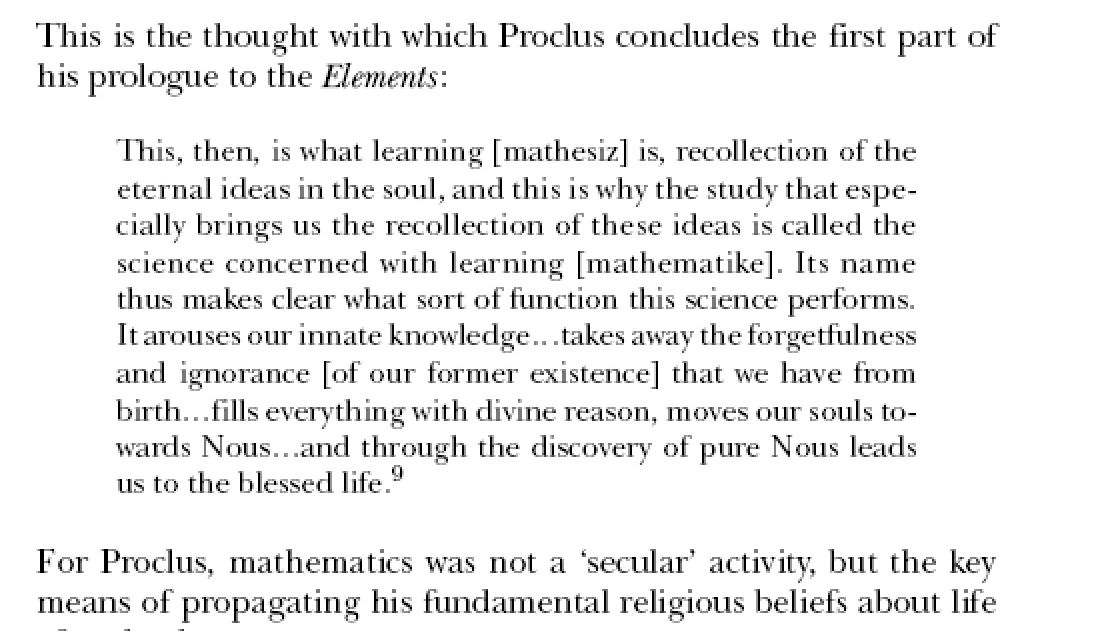
- Proclus on derivation of mathematics from mathesis

Mathesis and exactitude of math
- Though the church condemned math and related notion of soul
- and shut all schools of philosophy in Roman empire(532 CE)
- the superstition persisted in West that math is eternal knowledge since it arouses the eternal soul.
- Hence, the West believed that math is EXACT.
- But this belief is superstition.
Is the Pythagorean theorem true?
- Pythagorean theorem is surely a theorem: the class X NCERT text repeats "Pythagorean theorem" 32 times.
- But is it true in the real world. NO!
- For example, Pythagorean theorem is FALSE on the surface of the earth
- (with "straight" lines = shortest distance between two points = geodesics).

Pythagorean theorem is FALSE anywhere in the REAL world
- (because spacetime is also curved like the surface of the earth, but we won't go into that).
- The belief that Pythagorean theorem is true is a Western superstition (Indian did not have it)
- In fact it is a church superstition.
This church superstition (theorem = truth) caused the loss of thousands of lives.
- How? Long story, but let me cover it quickly.
- Greeks, Romans, Portuguese, British were bad at math, hence bad at navigation until the 18th c.
- Vasco da Gama learnt to determine latitude at sea from his Indian navigator
- who used the pole star altitude (Rajju Ganita text).
Western backwardness in math (elementary arithmetic) led to a bad calendar
- Hence bad European navigation
- until the Gregorian calendar reform of 1582
- (using calendrical info stolen from India)
Why is a good calendar needed for navigation?
- Calendar which correctly determine equinox needed to determine LATITUDE in daytime
- from observation of solar altitude at noon (covered in Rajju Ganita text)
- Not trivial (Protestant countries did not accept the calendar reform until 1752,
- long after Newton's death).
And serial plagiarists of my calculus transmission work,
- George Gheverghese Joseph and Dennis Almeida
- failed to understand this point of mine about the calendar reform,
- and made foolish mistakes proving they were plagiarists
- (e.g. confused solar altitude with solar declination speaking vaguely of "angle of the sun".)
Heaving the log to determine longitude
- Term "blog" comes from web-log. Where did the "log" come from?
- Europeans used a primitive technique of navigation: "heaving the log" to determine longitude at sea.
- A heavy log (tied to a knotted rope) was thrown into the sea,
- and the speed of the ship (in knots) measured by counting how many knots of the rope ran out in a given time.
- A continuous account of speed was maintained in a log book often just called "log".
From the speed, the distance travelled was calculated.
- From the distance, and the latitude difference, the longitude difference was calculated.
- Using the "Pythagorean theorem"
- applied to the "longitude" triangle
- (a right triangle, since lines of latitude and longitude meet at right angles).

Indians knew better even a thousand years earlier
- A similar method described by Bhaskar 1 (7th c.)
- to determine the longitude of a city
- if we know its distance from a city on the prime meridian (longitude through Ujjaini)
- BUT DECLARED TO BE A COARSE METHOD
Specifically, Bhaskar 1 says
- the disciples of the lower caste (Arya)bhata (भटस्य शिष्या:) learned in math (गणित विद)
- say the distance (or कर्ण = diagonal) is coarse (स्थूल)
- and the method too is coarse (i.e., THE PYTHAGOREAN THEOREM FAILS) BECAUSE THE CIRCUMFERENCE (परिधि) OF EARTH IS CURVED (वक्र).

Note: Bhaskar 1 is discussing the fact that spherical geometry is "non-Euclidean"
- long before either "Euclidean" or "non-Euclidean" geometry was known to the West!
- Wrong belief that Pythagorean theorem is true led to the drowning of thousands of European sailors
- British parliament in 1711 acknowledged British ignorance by a law setting up a Board of Longitude.
Section summary
- Pythagorean theorem is FALSE.
- Belief that "deductively proved" theorems are true is a SUPERSTITION,
- this false belief led to the death of thousands.
- To reiterate: theorems only "relative truth", hence often false in the real world.
Section summary (contd.)
- This false belief (theorem = truth) is actually a CHURCH superstition,
- supported by Aquinas and his schoolmen (Christian rational theology).
- This church superstition is peddled by the NCERT class IX school text.
- (Calendar not the sole superstition peddled by colonial education. )
Is the Pythagorean theorem true? (apologia)
- Some people say "Pythagorean theorem is approximately true".
- However, NO concept of "approximate truth" in formal mathematics.
- (Appendix 1, sec. A1.6 Summary) "1. In [formal] mathematics, a statement is only acceptable if it is either always true or always false." AND
- "2. To show that a mathematical statement is false, it is enough to find a single counterexample."
Approximate truth
- However, "approximate truth" found in sulba-sutra-s,
- e.g. "Pythagorean theorem" in Manava sulba sutra 10.10
- gaṇita about useful calculation NOT useless metaphysical proof.
- CALCULATING the diagonal requires square ROOTS.
- The simplest case of the unit square
- diagonal is \(\sqrt 2\) called सविशेष (with something remaining = approximation)
- source Baudhayana 2.12, trans.


- Better to speak of "inexactitude" since word "approxinate" wrongly assumes there is something exact.
- This inexactitude used in Rajju Ganita as "Zeroism".
So we have two superstitions in Western math
- A church claim that banning the pratyaksh results in infallibility.
- A Western belief that mathematics is eternal truth, hence exact, though this exactitude can be only attained through fantasy.
- Both superstitions come into play in the present-day teaching of calculus
- imported from India
- but by inventing the fantasy of real numbers
- to make it compatible with Western superstitions
- today declared as essential to calculus.
Calculus teaching
Basic story
- Calculus originated in India with 5th c. CE Āryabhaṭa
- as a method ("Euler's method") of solving differential equations.
- Note that Madhava of Sangamgram was a disciple of Āryabhaṭa school in Kerala from 900 years later.
- The origin of calculus is often wrongly attributed to the Kerala school
- whose work was first taken to the West by Whish in 1832.
- While the Aryabhata school in Kerala developed infinite series, our objective is to teach the calculus.
- For which Aryabhata's method (a general technique to numerically solve differential equations) is better suited.
- Note, further, that Aryabhata was a dalit
- whereas his disciples in the Kerala school were the highest caste Namboodiri Brahmins such as Nilkantha somasutvan
References
- Book
- Calculus articles in Springer encyclopedia
- Calculus articles in Boloji
- Arabahata dalit paper
Decolonised pedagogy of calculus without limits.
- Central University of Tibetan Studies, Sarnath (2009, school level)
- Universiti Sains Malaysia (2010)(4 groups, 4 groups, 3UG+ 1PG)
- Ambedkar University Delhi, (2012 PG, social science) also poster
- CISSC, Tehran, (2012 m,mixed) also poster


- SGT University Delhi (2017, UG science and engineering), poster
- Workshop and "Institute lecture" at IIT: BHU
- A difficulty at IIT: BHU. Must a differentiable function be continuous.


Content
- Technical lectures to faculty – USM, SGT,
My course is labelled as calculus without limits. Why?
Because no need for integrals and derivatives (defined as limits)
- calculus about solution of differential equations.
- Aryabhata (=Euler method) provides a general technique of solution
- derivatives replaced by finite differences (e.g. khandajy)
- integration = solving differential equation (no need for integral sign)
What about infinite series?
- No limits here either.
- Because Indian calculus developed with non-Archimedean arithmetic
- Brahmagupta (in Brahma sphuta siddhant) introduced अव्यक्त गणित of polyonomials
- regarded \(ax+b\) for given \(a\) and \(b\) as an "unexpressed number" which acquires a value only when the value of \(x\) is prescribed.
- Otherwise arithmetic was the same as that of integers or fractions.
Polynomials make a non-archimedean field
- Polynomials with rational coefficients \(∑ⁿ _{i=1} aᵢx^{i}\) constitute an integral domain (no zero divisors).
- This can be extended to a field of quotients in usual way.
- Order: \(P(x) > 0\) if it is +ve for large \(x\). (E.g. \[2x-3 > 0 \] \[-3x +5 < 0.\])
- This makes it an ordered field.
- But this field is non-Archimedean. For \(x\) one cannot find an \(n\) such that \(x< n\) or \(x-n < 0\) (i.e. x- n >0)
- In a non-Archimedean field there are no limits
- since there are infinities and infinitesimals.
- However, approximate limits hold on zeroism.
- This similar to limits by order-counting.
- No need for reals (= largest Archimedean ordered field).
Rejecting reals and limits greatly simplifies calculus AND
- All practical value is retained
- since practical value comes from numerical solution of differential equations (on a computer).
- Students can do harder practical problems no covered in usual calculus courses (e.g. elliptic integrals, see tutorial sheet).
- This is achieved by throwing out the two Western superstitions
- which the West added to ganita to turn it into math.
- (No loss even in useless skill of calculating derivatives and integrals, which can be done by open source software Maxima)
Summary and conclusions
- Colonial education involves church tricks (teaching ignorance, Western bhakti, bundles of stories, mistrusting the non-West etc) to capture the colonially educated mind,
- especially in math,
- Injected Western superstitions into ganita imported from India
- to turn it into formal math
- to make it compatible with Western religious beliefs.
- Math is difficult because of these historical Western difficulties with imported Indian ganita (played out in fast-forward mode in the classroom)
- and the superstitions that the West added
- which add nothing to practical applications of math
- but give West control over mathematical knowledge.
- Rejecting these superstitions makes math easy while preserving all practical value (from ganita).
- Decolonised math courses have been tried out in 3 countries.
- Can be easily taught in universities.
- Decolonisation of school math more difficult but ongoing.