Gaṇita (गणित) vs math

C. K. Raju

Indian Institute of Education
G. D. Parikh Centre, J. P. Naik Bhavan
University of Mumbai, Kalina Campus
Santacruz (E), Mumbai 400 098

Introduction

  • Most of you were taught gaṇita (गणित) is the Hindi translation of mathematics.
  • So my title may seem strange.
  • My first point: gaṇita (गणित) ≠ math

What is the difference?

  • Have been told to be very brief.
  • So will summarize in one line.
  • Gaṇita accepts empirical proof,
  • mathematics prohibits it.

Did you understand?

  • Let me repeat this in Hindi
  • गणित में प्रत्यक्ष प्रमाण मान्य है,
  • मैथमेटिक्स में वर्जित है

Did you understand now?

  • All those who understood please raise your hands!
  • If you understood, please give an example to explain.
  • Those who understood at least half of the statement, raise your hand!
  • Please explain your half-understanding with an example.

You have passed many exams

  • but passing exams ≠ acquiring knowledge!
  • As every student believes, passing exams about getting a job, not about acquiring knowledge.
  • A coaching class will say this brutally: your aim to pass exam, get job not acquire knowledge
  • (which takes too much time, a post-retirement pursuit )
  • I pity your trust in the system brought to you by the colonial invader.
  • It is a church education system: univs of Cambridge, Oxford, Paris, Harvard all set up by the church.
  • Church about power, not mere Christian propaganda.
  • To rule you, the system aims to make you mentally submissive
  • to stop revolts after 1857.
  • How?
  • Fear of exam makes you docile,

– it makes your mug, and blindly accept and repeat whatever is stated in the book

  • without examining it critically.
  • It teaches you trust Western books as the reliable source for passing exams.
  • Colonial education teaches IGNORANCE
  • so that even later in life you have no option but to "trust the West"
  • Thus, if you don't know something today what will you do?
  • You will Google!
  • Google will take you to Wikipedia
  • which has the principle that "trust the West" and "mistrust the non-West"
  • so it deems mostly Western sources as "reliable aources."
  • The whole point of this talk on ganita versus mathematics is to change that education system which keeps you enslaved.
  • Students in this college are not toppers.
  • That is not because you are inferior,
  • it is because the education system is bad.

Back to difference between ganita and math

  • To repeat: Gaṇita accepts empirical proof,
  • mathematics prohibits it.
  • गणित में प्रत्यक्ष प्रमाण मान्य है,
  • मैथमेटिक्स में वर्जित है

Example

Mathematics prohibits the प्रत्यक्ष

  • Also stated in class IX NCERT text(p. 301)
  • "each statement in a [mathematical] proof has to be established using only logic…Beware of being deceived by what you see …!"
  • i.e., math allows only अनुमान NOT प्रत्यक्ष.
  • Since you were taught to trust only the West, here is a Western source:
  • Mendelson, introduction to mathematical logic, page 34
  • i.e., A mathematical proof is a sequence of statements in which each statement is either an axiom, or is derived from preceding statements by some rule of reasoning
  • (e.g.,modus ponens 1. \(A \Rightarrow B\), 2. \(A\), ∴ 3. \(B\).)

Important point

  • In a mathematical proof your are NOT ALLOWED TO say
  • "I see this, therefore it is true"

So, how to do 1+1=2 in math (WITHOUT relying on प्रत्यक्ष)?

Any other answers?

No unique notion of number 1 in (axiomatic) math

  • Why?
  • प्रत्यक्ष prohibited in math, so
  • Number 1 NOT an "abstraction" for 1 dog, 1 crow etc. which you can SEE
  • Behavior of 1 decided SOLELY by axioms.
  • E.g. you must have learnt of OR gate
  • for which 1+1 = 1
  • and XOR gate (EXCLUSIVE OR) implemented millions of times in the circuits of your cell phone or computer
  • for which 1+1 = 0.
  • You were never taught!
  • The axioms for real numbers require (axiomatic) set theory
  • which most people (including professional mathematicians) do NOT study.
  • Why? Because the aim of colonial education is to teach you ignorance or half-knowledge.
  • Hence, the NCERT text gives a WRONG definition a set as "a collection of objects"
  • To pass the exam you may mug it and repeat it
  • But consider Russell's paradox.
  • This proved that Cantor's set theory/naive set theory leads to contradictory conclusions.
  • From such an internally inconsistent theory, any nonsense conclusion whatsoever may be drawn.
  • Therefore, Cantor's set theory was abandoned and replaced by axiomatic set theory in the 1930s.
  • But axiomatic set theory is not taught.
  • Does anybody know the axiomatic definition of a set? Please raise your hand!

JNU prize of ₹10 lakh

  • To make people take these issues more seriously, I offered a prize of ₹10 lakh in JNU for 1+1=2
  • (see this video chaired by the then JNU VC, and current chair of UGC)
  • The prize is to anyone who could meet my Cape Town challenge to prove 1+1 = 2 in REAL numbers straight from axioms of set theory
  • without assuming any theorem of axiomatic set theory and proving everything from axioms.
  • This is my point: that colonial education deliberately taught you half-knowledge
  • to force you to rely on the authority of others (you trust) namely the West.
  • And brought in an exam system to ensure that you never have time to acquire knowledge.
  • These are tricks of church/colonial education which you never understood
  • foolishly imagining that the invader brought church education for your benefit.

Interim summary

  • Ganita is very easy compared to (axiomatic) mathematics
  • which is very difficult even at the level of 1+1=2.
  • Since you get along without knowledge of 1+1=2 in math, of what use is it?

A common confusion: √2 in ganita vs math

  • People say √2 a real number, is useful.
  • They confuse the ganita notion of number with the math notion of real number.
  • Thus, √2 known to ganita since days of the sulba sutra
  • In terms of प्रत्त्यक्ष it is the diagonal of the unit square. (\(a=b=1 \therefore d=\sqrt 2\))
  • But this is possible only in ganita.
  • NOT in mathematics, where प्रत्त्यक्ष is prohibited.
  • As प्रत्त्यक्ष diagonal can be measured to various degrees of precision but NEVER exactly
  • (in terms of units an which \(a, b\) can be measured exactly).
  • Hence name for √2 in the Baudhayan śulba sūtra is सविशेष
  • meaning with a remainder (अवशेष)
  • Apastamba शुल्ब सूत्र calls it स अनित्य = impermanent).
  • Note: this is NOT the "Pythagorean theorem"
  • as so many of our netas keep wrongly repeating.

Why not?

  • Another way to see it is that we have an infinite sum \[\sqrt 2 = 1+ 0.4 + 0.01 + 0.004 + ...\] or \[\sqrt 2 = 1+ \frac{4}{10} + \frac{1}{100} + \frac{4}{1000}+ ...\]
  • That is, $\sqrt 2 = 1.4142135…$
  • where the three dots indicate that the process goes on indefinitely.
  • That is these early Indian ganita texts adopted a pragmatic attitude
  • In an infinite series, simply sum a finite number of terms to the required precision.
  • That is exactly what we still do in practice, for ALL applications of mathematics to science and engineering.
  • Indian ganita texts were the first to sum infinite geometric series in 15th c. (but won't go into that).
  • But real numbers incorporate a different attitude
  • namely that the infinite series for √2 has an exact sum
  • this is incorporated in the theorem that every real number has a unique (=exact) n th root.
  • Though we can never write down what that exact sum is in the case of √2
  • and can never *see it, since प्रत्त्यक्ष is NOT allowed.
  • i.e., exact value of √2 "exists" only in a metaphysical ( = UNREAL) sense.

The inability to write down the exact value

  • shows it can never be used in practice
  • This meets a common objection: people say of Western mathematics that "it works"
  • "they have sent a man to the moon"
  • But sending a man to the moon does NOT involve exact real numbers which can never be written down.
  • Thus, rocket trajectories are today calculated on computers (by both NASA and ISRO)
  • computers CANNOT use real numbers
  • because storing even a single real number requires infinite memory not available on the computer
  • Instead computers use what are called floating point numbers.
  • if you have not studied floating point numbers
  • (mantissa-exponent representation with 32 bits)
  • see my lecture notes on floating point numbers from 25 years ago.

Floats ≠ reals

  • Associative law for addition HOLDS for reals
  • but FAILS for floats:
  • (-1+1)+ε = ε ≠ 0 = -1 + (1+ ε)
  • if ε < 1E-8 (or 1E-16 on 64 bit systems).

Interim summary

  • Math of "EXACT but अप्रत्यक्ष" UNREAL "real" numbers NEVER used in practice
  • All practical value from inexact calculation.

Arithmetic

  • Well known that Europeans themselves abandoned their INFERIOR system of arithmetic ("Roman numerals")
  • and replaced it with what they called "Arabic numerals"
  • or algorismus, since based on the 9th c. text "Hisab al Hind" or Indian arithmetic of al Khwarizmi (of Baghdad, Beyt al Hikma).
  • Algorismus or Algorithmus the Latinized name of al Khwarizmi.

Key question: WHY did Europeans abandon their native arithmetic?

  • From here to Manoj Kumar (in Purab aur Paschim) Indians keep singing praises of zero.
  • But zero, then, was a problem for Europeans not a solution
  • so it is NOT the answer to "why?"
  • A question which our historians NEVER asked.

Efficient Indian गणित gave a comparative advantage in commerce

  • over inefficient native European abacus.
  • Hence, Fibonacci wrote Liber Abaci (1203) a Latin translation of Hisab al Hind.
  • He was a Florentine merchant, who traded with Arabs in Africa from whom he got this knowledge
  • and understood its value for commerce.

Efficient Algorismus vs inefficient Greek/Roman abacus

Inferiority of European arithmetic

Inefficiency of Greek/Roman pebble arithmetic (coin-counter system)

  • 89+79 requires 18 operations.
  • \(89 × 79\) requires 1422 operations
  • compared to 10 operations (4 single digit "multiplies", 4 single digit "adds" and 2 "carries" in गणित
  • More details in my book on Refutation of Aryan Race Conjecture

The problem with zero

  • Key point: backward Europeans lacked full comprehension of elementary arithmetic
  • clear from the very term zero from cipher (from Arabic sifr),
  • cipher means mysterious code. Why mysterious?
  • Roman numerals additive: xxii = 10+10+1+1
  • but in place-value system 10 ≠ 1+0=1.

Suspicion of zero

  • Adding zero at the end can inflate a contract
  • (not possible with Roman numerals: only III can be added at the end)
  • Hence Florence passed a law against zero in 1299.

Roman arithmetic lacked FRACTIONS

  • Julian calendar hence used leap years
  • instead of saying the duration of the (tropical) year is \(365 \frac{1}{4}\) day.
  • Since Roman arithmetic lacked large numbers, it also lacked precise fractions.
  • Hence, Gregorian reform of 1582 still used leap years instead of saying year = 365.241 days.
  • Hence, reformed calendar still defective: equinox does not come on the same day every year.

Gregorian reform used inputs from India

  • Matteo Ricci was the favourite student of
  • Clavius who headed the reform committee
  • and wrote a book on practical arithmetic.

De Morgan's folly

"Algebra" from "al Jabr waal muqabala" of al Khwarizmi

  • who partly translated 7th c. Brahmagupta's unexpressed arithmetic (अव्यक्त गणित)of polynomials
  • and linear and quadratic equations.
  • Primitive Greek/Roman arithmetic lacked √.
  • Term for √2 is SURD from Latin surdus = DEAF from Arabic asumu
    • Why is √2 DEAF?

Deaf roots

  • In Indian शुल्ब सूत्र √2 = DIAGONAL (कर्ण) of unit square.
  • But word कर्ण also means ear (=कान),
  • hence bad कर्ण mistranslated as bad ear = deaf! 😊

Pocket trigonometry

Toledo translations ca. 1125

  • Written as consonantal skeleton "jb" (without nukta-s) like "pls" in SMS.
  • Misread by Mozharab/Jew 12th c. Toledo mass translators as common word "jaib" = जेब = pocket.😊
  • Word "trigonometry" involves a conceptual error: it is about circles not triangles.
  • Hence my pre-test question what is \(\sin 92^∘\)? (In a right-angled triangle there cannot be any angle of \(92^∘\).)

Key point: ALL these cases

  • of arithmetic, algebra, trigonometry
  • involved various degrees of incomprehension
  • by Europeans while copying from Indians
  • but we have declared the duffer as "superior"
  • and are playing "follow the leader".

Arithmetic

Deaf roots

  • In Indian शुल्ब सूत्र √2 = DIAGONAL (कर्ण) of unit square.
  • But word कर्ण also means ear (=कान),
  • hence bad कर्ण mistranslated as bad ear = deaf! 😊
  • So, Europeans copied 3rd hand from the Arabs who copied from Indians
  • and colonized Indians are today copying fourth hand from Europeans
  • Including their silly translation mistakes such as surd
  • who is the bigger fool?

In fact Europeans learnt arithmetic from Indian ganita

In contrast, Indian ganita had very large numbers

  • Parardha or trillion in Yajurveda 17.2
  • तल्ल्क्षण (=\(10^{53}\) etc. in ललित विस्तर: (chp. 12)
  • So, according to me, Indian ganita was superior from the very beginning
  • but you are taught that West is superior and you must ape it!

Inferior European arithmetic

  • Well known that Europeans themselves abandoned their INFERIOR system of arithmetic ("Roman numerals")
  • and replaced it with what they called "Arabic numerals"
  • or algorismus, since based on the 9th c. text "Hisab al Hind" or Indian arithmetic of al Khwarizmi (of Baghdad, Beyt al Hikma).
  • Algorismus or Algorithmus the Latinized name of al Khwarizmi.

WHY did Europeans abandon their native arithmetic?

  • From here to Manoj Kumar (in Purab aur Paschim) Indians keep singing praises of zero.
  • NOT because of zero which was a problem for Europeans not a solution
  • so it is NOT the answer to "why?"

Efficient Indian गणित gave a comparative advantage in commerce

  • E.g. native Greek-Roman numerals need 12 symbols (instead of 4) for the 4-digit number 1788=MDCCLXXXVIII
  • Hence, European pebble arithmetic had difficulties even to represent large numbers

Inefficiency of Greek/Roman pebble arithmetic (coin-counter system)

  • 89+79 requires 18 operations.
  • \(89 × 79\) requires 1422 operations
  • compared to 10 operations (4 single digit "multiplies", 4 single digit "adds" and 2 "carries" in गणित
  • More details in my book on Refutation of Aryan Race Conjecture

Europeans failed to understand zero

Suspicion of zero

  • Adding zero at the end can inflate a contract
  • (not possible with Roman numerals: only III can be added at the end)
  • Hence Florence passed a law against zero in 1299.

How many of you would like to study in University college London?

  • Please raise your hands.

De Morgan's folly

  • E.g. De Morgan a very influential professor from University College London
  • foolishly declared negative numbers impossible. (Morgan, Augustus de. Elements of Algebra: Preliminary to the Differential Calculus, 2nd ed. London: Taylor and Walton, 1837, p. xi.
  • and went on to say (1898) belief in witches 10000 times more possible than \(- 9 < 0\). 🤣🤣🤣
  • Did not deserve to pass high school, but you think UCL superior!

Trigonometry and calculus

Europeans copied and failed to fully understand

  • Similar situation in trigonometry and calculus
  • West learnt it from us as ganita.
  • Failed to fully understand, hence learnt badly.
  • but we are convinced we must imitate the "superior" West in calculus

Pocket trigonometry

Toledo translations ca. 1125

  • Written as consonantal skeleton "jb" (without nukta-s) like "pls" in SMS.
  • Misread by Mozharab/Jew 12th c. Toledo mass translators as common word "jaib" = जेब = pocket.😊
  • but we are convinced that we must ape the superior West
  • Hence, you still use that translation mistake "sine"
  • Word "trigonometry" involves a conceptual error: it is about circles not triangles.
  • Hence my pre-test question what is \(\sin 92^∘\)? (In a right-angled triangle there cannot be any angle of \(92^∘\).)

The other question the task is

  • what is \(\sin 1^∘\)?
  • Any answers?
  • So, you are 1600 years behind the times
  • because you do Western math, not ganita.

Aryabhata's sine table

Europeans stole the calculus from India

  • like the earlier cases of arithmetic algebra, and trigonometry
  • They failed to understand the ganita of the Indian calculus.
  • Why did they steal?

Motivation: Navigational problem

  • Europe was very poor, all dreams of wealth (whether piracy or conquest) were overseas.
  • Accurate navigation was needed to bring that wealth home.
  • Europeans had 3 key navigational problems.
  • Latitude, loxodromes, longitude at sea.
  • Today I will consider only the case of longitude

Longitude

  • Longitude calculation in Indian tradition requires,
  • as Brahmagupta says, knowledge of the radius of the earth \(R_E\)
  • is essential to calculate your longitude
  • and value of earth radius (in योजन) found in many Indian texts.
  • Do you know how to do it?
  • Perhaps not, because you ape the West who could not do it for a long time
  • Bible wrongly says earth is flat
  • unlike word भूगोल which has गोल.

Easily calculated from elementary trigonometry,

  • Calculate the height of a hill h
  • climb the hill and measure the angle of dip of the horizon from it θ.
  • My students in Malaysia did it, can you?
  • But you learn WRONG definition of angle
  • Learn to measure angle only with a protractor, on paper, not in space.

Europeans could not get right size of earth

  • Columbus underestimated it by 40%
  • let to navigational disasters
  • hence in 1600, Portugal banned the carrying of globes aboard ships
  • Hence, European navigational problem persisted till at least 18th-century.
  • Various European governments offered huge prizes for its solution.
  • In 1712, the British Parliament passed a law setting up a board of longitude
  • to offer a prize of UKP 20,000 to anyone
  • Who developed a method to determine longitude at sea
  • Plus point for West, they valued scientific knowledge. We never offered a prize to solve a problem.
  • The prize was half given in 1762. Read details in my book.

Trigonometric values needed to solve navigational problem

  • As we saw, Indian texts in Kerala had very accurate values.
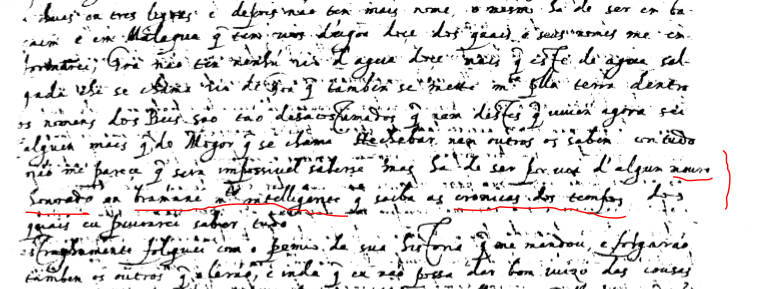
  • Jesuits had a school/college in Cochin since 1500 to teach local (Syrian) Christians on Malayalam
  • They translated and sent Indian texts back to Europe.
  • Key point: Europeans FAILED to UNDERSTAND how Indian trigonometric values were calculated

By 15th century Indians calculated sine values using infinite series

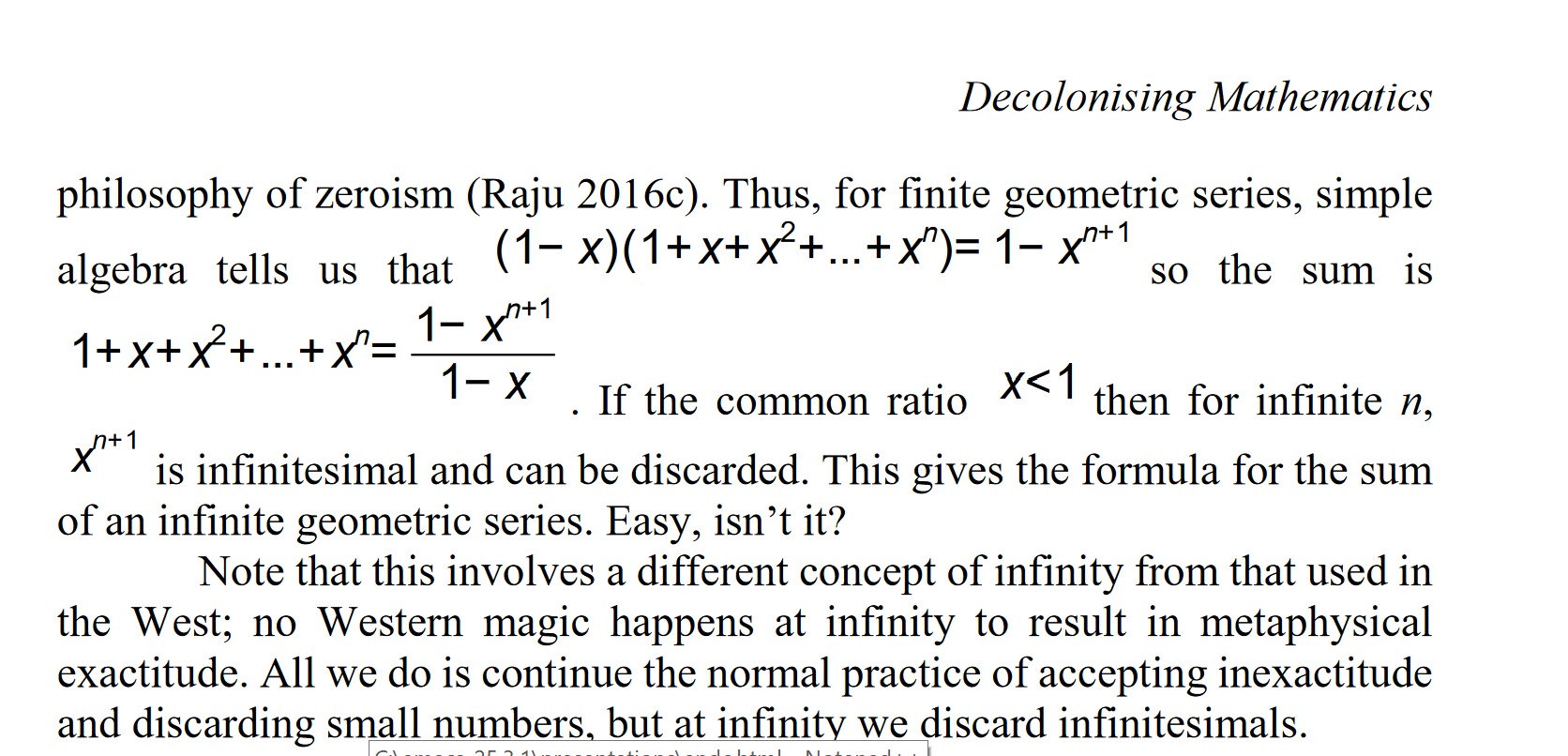
Nilakanth (15th c.) was the first to sum INFINITE geometric series

  • but he used Brahmagupta's अव्यक्त गणित (of polynomials)
  • which involves what is today called non-Archimedean arithmetic
  • involving infinities and infinitesimals
  • absent in so-called "real" numbers which obey Archimedean arithmetic.

And the philosophy of zeroism

Full explanation

  • needs a full course on calculus without limits
  • (no limits possible with non-Archimedean arithmetic)
  • But it needs autonomy to change the syllabus
  • which autonomy a college does not have.
  • So, entertainment over for the day!

For answers to deeper questions