Table of Contents
- Practical gaṇita vs religious mathematics
- Summary
- Key difference
- Pūrva paksha (पूर्व पक्ष)
- KG method of 1+1=2 is gaṇita method
- But KG/gaṇita method NOT allowed in math
- Empirical PROHIBITED in math
- Also stated in class IX NCERT text(p. 301)
- This proves my first preposition: gaṇita is different from math
- A consequence: prohibiting the empirical makes 1+1=2 VERY difficult in math
- This already proves my second proposition: ganita makes math easy
- In axiomatic math no unique concept of number 1
- JNU prize of ₹10 lakh
- The case of "real" numbers is important since
- Teaching experiments and reports (contd)
- Important point
- There is NO loss of practical value
- Computers CAN'T use real numbers
- Interim summary
- GREAT COLONIAL SUPERSTITION
- The myth of superiority (a quick detour)
- This claim of White/Western origin of science is blatantly false
- Arithmetic
- Key question: WHY did Europeans abandon their native arithmetic?
- Efficient Indian गणित gave a comparative advantage in commerce
- Efficient Algorismus vs inefficient Greek/Roman abacus
- Inferiority of European arithmetic
- Inefficiency of Greek/Roman pebble arithmetic (coin-counter system)
- The problem with zero
- Suspicion of zero
- Roman arithmetic lacked FRACTIONS
- Gregorian reform used inputs from India
- De Morgan's folly
- "Algebra" from "al Jabr waal muqabala" of al Khwarizmi
- Deaf roots
- Pocket trigonometry
- Toledo translations ca. 1125
- Key point: ALL these cases
- Indian origins of probability and statistics as ganita
- अक्ष सूक्त (ऋग्वेद 10.34)
- Key point: probability NOT understood with axiomatic math
- Calculus
- Why was calculus stolen?
- Reading list
- Interim summary
- So what difference does Western theft of calculus make to calculus TEACHING today?
- Let us understand the problem
- Mathematics and religion
- Conclusions
Summary
- 1. Gaṇita (गणित) differs from math,
- 2. it makes math easy, and
- 3. makes science better.
Key difference
- Gaṇita is practical
- math is religious
- hence unfit to be taught as a compulsory subject in schools.
Pūrva paksha (पूर्व पक्ष)
- Many people sarcastically ask:
- "Where is the religion in 1+1 = 2?"
- They are thinking of the KG method of 1+1 = 2.
- That is an empirical proof; nothing religious in it.

KG method of 1+1=2 is gaṇita method
- since gaṇita accepts empirical proof= प्रत्यक्ष प्रमाण
- accepted by all schools of Indian thought,
- as stated e.g. in the Nyaya sutra 2,
- and elucidated here or in this video.
- So, gaṇita method is practical NOT religious.
But KG/gaṇita method NOT allowed in math
- Why not?
- Because empirical proofs prohibited in present-day math
- =formal math = axiomatic math = Western ethnomathematics
Empirical PROHIBITED in math
- People find this hard to believe.
- But stated in any stock text on mathematical logic (e.g. Mendelson, introduction to mathematical logic, page 34)
- i.e., A mathematical proof is a sequence of statements in which each statement is either an axiom, or is derived from preceding statements by some rule of reasoning
- (e.g.,modus ponens 1. \(A \Rightarrow B\), 2. \(A\), ∴ 3. \(B\).)

Also stated in class IX NCERT text(p. 301)

- "each statement in a [mathematical] proof has to be established using only logic…Beware of being deceived by what you see …!"
- i.e., math allows only अनुमान NOT प्रत्यक्ष.
- This text is compulsory reading for all (math compulsory up to class X),
- if you didn't read it, it is your problem!
This proves my first preposition: gaṇita is different from math
- gaṇita accepts empirical proof
- math (as currently taught) rejects it
A consequence: prohibiting the empirical makes 1+1=2 VERY difficult in math
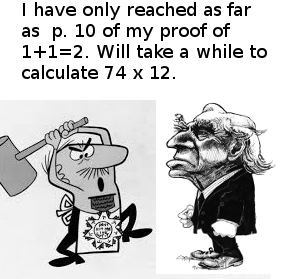
- e.g. Russell needed 378 pages in his Principia to prove 1+1=2,
- and few people understand a single sentence on that page 378.
- This extraordinary difficulty of math adds NO practical value in a grocery shop.

This already proves my second proposition: ganita makes math easy
- (without loss of practical value).
- But that is not the end of the story…
In axiomatic math no unique concept of number 1
- 1+1=2 for natural numbers proved using Peano's axioms, but
- 1+1=2 for "real" numbers requires axioms of set theory.
- Very few people (even among professional mathematicians) understand axiomatic set theory
- (different from naïve set theory taught in schools to indoctrinate children)
- E.g., wrong to define a set as a "collection of objects"
- Results in Russell's paradox:
- that there is a set R for which the statement R ∈ R is BOTH true and false.
- If there is a statement which is both true AND false, \(A ∧ ¬ A\)
- then any NONSENSE conclusion \(B\) whatsoever can be MATHEMATICALLY PROVED from it
- using the rule of reasoning called modus ponens
- since \(A ∧ ¬ A \Rightarrow B\) is a tautology whatever be \(B\) (a contradiction implies any statement).
- However, since colonial education (DELIBERATELY) taught students to study only for exam,
- most students think it is fine to repeat any statement made in the NCERT school text,
- e.g., "a set is a collection of objects"!
JNU prize of ₹10 lakh
- To make people take these issues more seriously, I offered a prize of ₹10 lakh in JNU for 1+1=2
- (see this video chaired by the then JNU VC, and current chair of UGC)
- The prize is to anyone who could meet my Cape Town challenge to prove 1+1 = 2 in REAL numbers from first principles (in the manner of Russell's proof of 1+1=2)
- without assuming any theorem of axiomatic set theory and proving everything from axioms.

The case of "real" numbers is important since
- real numbers purportedly needed for calculus on current teaching
- and calculus needed for all science.
- Hence, real numbers taught in class IX and class X to indoctrinate children
- without ANY comprehension of the difficulties involved.
- Hence, math of calculus so difficult that
- California (US technology hub) recently cancelled calculus teaching in schools.
- Their aim: to replace it with data science.
- Risky strategy: data science needs statistics which needs calculus.
- Half understood statistics may create bugs in AI programs
- on which the world may depend in future for decision-making.
- So, correct strategy is to make calculus easy.
- This can be done by teaching calculus as ganita
- the way it originated in India
- with the 5th c. Aryabhata
- as the numerical solution of differential equations
- That gaṇita makes calculus easy has been DEMONSTRATED
- by teaching experiments over the last 14 years with 8 groups in 5 universities in 3 countries (India, Malaysia, Iran).
- Central University of Tibetan Studies, Sarnath (2009)
- Universiti Sains Malaysia (2010, 4 groups, see report part 1, and part 2), news report

Teaching experiments and reports (contd)
- Ambedkar University Delhi (2013, PG, social sciences), also poster
- CISSC, Tehran, 2013, also poster
- SGT University Delhi (UG, Science and engineering), 2017, poster.
- After my recent talk in IIT Kanpur (or see abstract) this course on calculus as gaṇita will also be taught there from next semester (Feb 2024)


Important point
- Teaching calculus as gaṇita enables students to solve HARDER problems
- not covered in usual calculus courses
- but needed for a correct explanation of the first science experiment in schools
- The simple pendulum
- so, calculus as ganita leads to better science teaching.
There is NO loss of practical value
- since "real" numbers never used in practice.
- Why? Because most practical applications of calculus to technology
- such as sending a rocket to the moon
- done today on COMPUTERS
- by numerically solving differential equations, the Aryabhata way
- as I learned in C-DAC where my job was
- to implement applications of national importance (space, oil etc.) on the target computer.
Computers CAN'T use real numbers
- since they have finite memory.
- Hence they use what are called floating point numbers
- which are so different that they do not even obey the associative law for addition (see Hawai'i talk/paper)
- used in ALL axiomatic mathematics, including that of real numbers.
- This applies also to all AI programs done on computers.
Interim summary
- Ganita makes math easy
- enables students to solve harder problems not covered in stock calculus courses
- involves no loss of practical value, for applications to advanced technology.
- So, why not teach ganita?
GREAT COLONIAL SUPERSTITION
- Because of SUPERSTITIOUS FEAR
- due to the KEY superstition instilled by colonial/CHURCH education
- APE the West or risk catastrophe.
- Simple trick: say the West is superior, hence ape it to begone superior.
E.g. class IX school text math (chp. 5) says

- we should APE the "Greeks"
- who did a math "SUPERIOR" to what ALL others did (Indians, Egyptians, Babylonians, Maya).
- Since I am taking a critical view, I asked NCERT
- what is the primary evidence for Euclid?

NCERT answers
- 1. [2007, Hukam Singh, then math head NCERT] "why do you need evidence? We go by a committee!"
- 2. [2019] "Euclid mentioned in 3 Western math texts. Believe it!"
- BUT, sir, history needs PRIMARY sources for which I asked, you are quoting TERTIARY sources.
- 3. [2019] "Euclid mentioned in 6 Western math texts. Now believe it!"

- i.e., "West is superior, hence trust it (as Wikipedia does"
- ape it because it says it is superior!
- Let us set aside Euclid for whom there is no evidence, and much counter evidence.

"Euclid" book has no axiomatic proofs
- Prop. 1 and prop. 4 of "primary source" from 19th c. has empirical proofs.
- Proof of prop. 47 ("Pythagorean theorem" depends on this, hence empirical, not axiomatic.
- This fact was finally publicly admitted in the 20th century
- when Hilbert (1899) rewrote the "Euclid" book to provide the axiomatic proofs missing in it.
- so, unlike the Jains who reject claims about intentions which can be easily professed
- we are asked to believe in the professed "intentions" of a nonexistent person
- which supposed intentions are NOT reflected in the book which he supposedly wrote,
- to which Hilbert's rewrite does great violence because the author of the "Euclid" book never had those intentions
- as explicitly stated by Proclus etc.
- If you can believe the rubbish in the NCERT text about "Euclid", you can believe anything at all.
What is "superior" about "Greek" (=axiomatic) math?
- The NCERT textbook tries to establish this claim of "superiority"
- by telling a stream of lies in typical church fashion.
Key lie: "Greeks alone used reason".
- This is a brazen lie, as we saw (Nyaya sutra 2), gaṇita also uses reason as in inference or anumana
- as used e.g. by Aryabhata to infer that the earth is round (like a kadamba flower)]
- because, as Lalla explains (20.36), far-off trees cannot be seen.
- But there are other tricks.


Our class IX school text misleading uses
- one word "reason" which has two very different meanings. (Common church trick.)
- (1) scientific reason or reason PLUS facts, as in ganita (inference from observation)
- (2) the religious reason or reason MINUS facts as in current mathematics.
- Most of you probably did not know until today that axiomatic reasoning prohibits facts or anything empirical.
- So, most people ARE fooled,
- they wrongly assume that by the word "reason", our school text is referring to scientific reason (reason PLUS facts)
- whereas it is actually referring to religious reason (reason MINUS facts).
- So this deception successfully fools children/people by allowing them to conflate the two meanings of reason.
- This is class IX mathematics that we are talking about.
- Can't just blame the NCERT.
- If, in a nation of 1.4 billion people, in 2 centuries, no one else cross-checked or objected to this way of deluding our children
- we are collectively responsible, and our independence is forfeit.
The myth of superiority (a quick detour)
- Right from the 4th c. when the church first married the Roman state
- asserting Christian superiority became a key part of church dogma
- and its revised doctrine of the soul
- against the earlier belief in equity.
- By the 5th c.the church was already using a secular argument from false history (Orosius) to buttress this claim of superiority.
- During the Crusades this technique of using false history false history went viral
- with all knowledge from Arabic texts from the Muslim enemy being attributed to early Greeks
- regarded as the sole friends of Christians.

- This false history made that knowledge in Arabic texts theologically correct,
- so it would be used as texts in the first Christian universities
- such as Oxford Cambridge, Paris all set up by the church during the Crusades
- (to encourage knowledge absorption needed to win the Crusades).

Christian supremacy
- In the 14th and 15th centuries this claim of Christian supremacy
- was used as the moral justification and imperative for genocide (of 100 million native inhabitants) in the American continent (Bull Inter Caetera)
- AND for the slavery of Africans and other non-Christians (Bull Romanus Pontifex)
From Christian to White supremacy
- After 2 centuries of the organized and brutal slave trade by Christians,
- many Africans converted to Christianity.
- Therefore, this "moral" directive ("enslave non-Christians") failed.
- Christian superiority was replaced by superstition of White superiority using the superstitious curse of Ham/Kam

From White to Western supremacy
- When colonialism replaced slavery as the major means of Western wealth
- The Aryan race conjecture was invented as critically useful to rule Indians by dividing then into North (Aryans) and South (Dravidians)
- as we are witnessing today.
- On this fantasy Whites had earlier conquered and populated India.
Since White supremacy could no longer be used,
- it mutated to Western supremacy, as e.g. used by Macaulay.
Same false history of science reused
- The SAME false history of science, erected during the Crusades, continued to be used as a secular argument for these assertions of Christian/White/Western superiority.
- There was only a change of labels, the early Greeks instead of being called friends of Christians were later called Whites or Western,
- But the same chauvinistic false history continued: that all science was the work of "Christians and friends", or Whites, or West.

- The colonised fanatically trust the church/West (and mistrust the non-West)
- hence never crosscheck the false history used to change our education system and mentally enslave us.
- At any rate that is the NCERT's stated policy: that students must trust any false history of science stated by Westerners.
This claim of White/Western origin of science is blatantly false
- science needs mathematics
- And the fact is that the West was far behind India in mathematics for millennia.
- THEREFORE, the West imported ALMOST all aspects of school mathematics from India
- arithmetic, algebra, trigonometry, calculus, probability and statistics
- (The sole exception is geometry to which I will return later.)
- Let us start with the case of arithmetic.
Arithmetic
- Well known that Europeans themselves abandoned their INFERIOR system of arithmetic ("Roman numerals")
- and replaced it with what they called "Arabic numerals"
- or algorismus, since based on the 9th c. text "Hisab al Hind" or Indian arithmetic of al Khwarizmi (of Baghdad, Beyt al Hikma).
- Algorismus or Algorithmus the Latinized name of al Khwarizmi.
Key question: WHY did Europeans abandon their native arithmetic?
- From here to Manoj Kumar (in Purab aur Paschim) Indians keep singing praises of zero.
- But zero, then, was a problem for Europeans not a solution
- so it is NOT the answer to "why?"
- A question which our historians NEVER asked.
Efficient Indian गणित gave a comparative advantage in commerce
- over inefficient native European abacus.
- Hence, Fibonacci wrote Liber Abaci (1203) a Latin translation of Hisab al Hind.
- He was a Florentine merchant, who traded with Arabs in Africa from whom he got this knowledge
- and understood its value for commerce.
Efficient Algorismus vs inefficient Greek/Roman abacus
- E.g. native Greek-Roman numerals need 12 symbols (instead of 4) for the 4-digit number 1788=MDCCLXXXVIII
- Hence, European pebble arithmetic had difficulties even to represent large numbers
- largest Greek-Roman number is a myriad (10k)
- connotes infinite in English
- compared to parardha (= trillion) in Yajurveda 17.2 and तल्ल्क्षण (=\(10^{53}\) etc. in ललित विस्तर: (chp. 12)


Inferiority of European arithmetic
- and their copying from India
- stretches back to antiquity
- The very NAMES of (small) Greek and Roman numerals copied from Sanskrit from India
- Direction of transfer follows knowledge gradient: those who knew only myriad copied from parardha.
- But after some 2000 years, by 13th c. they understood that was not enough.

Inefficiency of Greek/Roman pebble arithmetic (coin-counter system)
- 89+79 requires 18 operations.
- \(89 × 79\) requires 1422 operations
- compared to 10 operations (4 single digit "multiplies", 4 single digit "adds" and 2 "carries" in गणित
- More details in my book on Refutation of Aryan Race Conjecture
The problem with zero
- Key point: backward Europeans lacked full comprehension of elementary arithmetic
- clear from the very term zero from cipher (from Arabic sifr),
- cipher means mysterious code. Why mysterious?
- Roman numerals additive: xxii = 10+10+1+1
- but in place-value system 10 ≠ 1+0=1.

Suspicion of zero
- Adding zero at the end can inflate a contract
- (not possible with Roman numerals: only III can be added at the end)
- Hence Florence passed a law against zero in 1299.
Roman arithmetic lacked FRACTIONS
- Julian calendar hence used leap years
- instead of saying the duration of the (tropical) year is \(365 \frac{1}{4}\) day.
- Since Roman arithmetic lacked large numbers, it also lacked precise fractions.
- Hence, Gregorian reform of 1582 still used leap years instead of saying year = 365.241 days.
- Hence, reformed calendar still defective: equinox does not come on the same day every year.
Gregorian reform used inputs from India
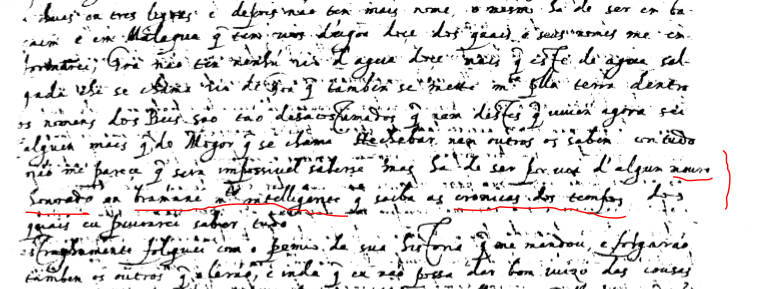
- Matteo Ricci was the favourite student of
- Clavius who headed the reform committee
- and wrote a book on practical arithmetic.
De Morgan's folly
- E.g. De Morgan a very influential professor from University College London
- foolishly declared negative numbers impossible. (Morgan, Augustus de. Elements of Algebra: Preliminary to the Differential Calculus, 2nd ed. London: Taylor and Walton, 1837, p. xi.
- and went on to say (1898) belief in witches 10000 times more possible than \(- 9 < 0\). 🤣🤣🤣


"Algebra" from "al Jabr waal muqabala" of al Khwarizmi
- who partly translated 7th c. Brahmagupta's unexpressed arithmetic (अव्यक्त गणित)of polynomials
- and linear and quadratic equations.
- Primitive Greek/Roman arithmetic lacked √.
- Term for √2 is SURD from Latin surdus = DEAF from Arabic asumu
- Why is √2 DEAF?

Deaf roots
- In Indian शुल्ब सूत्र √2 = DIAGONAL (कर्ण) of unit square.
- But word कर्ण also means ear (=कान),
- hence bad कर्ण mistranslated as bad ear = deaf! 😊
Pocket trigonometry
- Word "Sine" from sinus=fold from Arabic jaib (जेब) = pocket (OED).
- What has trigonometry to do with POCKETS?
- From Sanskrit term for it ardh-jyā
- (half-chord) or जीवा
- rendered in Arabic as jībā (no v sound in Arabic).

Toledo translations ca. 1125
- Written as consonantal skeleton "jb" (without nukta-s) like "pls" in SMS.
- Misread by Mozharab/Jew 12th c. Toledo mass translators as common word "jaib" = जेब = pocket.😊
- Word "trigonometry" involves a conceptual error: it is about circles not triangles.
- Hence my pre-test question what is \(\sin 92^∘\)? (In a right-angled triangle there cannot be any angle of \(92^∘\).)
Key point: ALL these cases
- of arithmetic, algebra, trigonometry
- involved various degrees of incomprehension
- by Europeans while copying from Indians
- but we have declared the duffer as "superior"
- and are playing "follow the leader".
Indian origins of probability and statistics as ganita
- "Probability in Ancient India", Handbook of Philosophy of Statistics, Elsevier, 2012, pp. 1175-96.
- "Probability", Encyclopedia of Non-Western science…, Springer, 2016, pp. 3585–3589.
- Probability relates to game of dice.
- The first account of the game of dice is in the RgVeda.
अक्ष सूक्त (ऋग्वेद 10.34)
- Translation
- Mahabharata (Sabha parva)
- Shakuni wins the game by deceit
- Hence, there was an idea of a "fair (or unbiased) game".
- Mahabharata (Van parva 72)
- Counting the fruits on a tree by sampling
- Permutations and combinations, Binomial theorem etc. part of Indian ganita.
Key point: probability NOT understood with axiomatic math
- Frequentist interpretation fails: relative frequency converges to probability only in a probabilistic sense
- Subjectivist interpretation fails: quantum probabilities are objective
- Measure-theoretic axioms fail: quantum probabilities not defined on boolean logic.
Calculus
- Calculus too originated in India in 5th c.
- and was stolen by Europeans (Jesuits in Kochi)
- in the 16th c.
- Why?
Why was calculus stolen?
- Indians used calculus to derive precise trigonometric values
- In 16th c. Jesuits based in Kochi(Cochin) in Kerala, translated and sent Indian ganita math texts back to Europe.
- Why? Hoping to solve the European navigational problem
- then the biggest scientific challenge facing Europe.

- Which involved the problem of determining latitude, longitude, and loxodromes at sea
- all of which required precise trigonometric values
- as explained in my school text on Rajju ganita.

Reading list
- E.g. my 2000 invited plenary at Univ. of Hawai'i and related article)
- and my 2007 book of 500+ pages.
- MIT talk, articles in the Springer Encyclopedia, on calculus, calculus transmission
- Durban keynote, popular-level articles on California and calculus etc.
Interim summary
- Newton and Leibniz did NOT "discover" the calculus, as our school text states:

tḥat is false history
- based on the Doctrine of Christian discovery that any piece of land/knowledge belongs to the first Christian to sight it (Bull Inter-Caetera)
- as in Vasco "discovered" India.
So what difference does Western theft of calculus make to calculus TEACHING today?
- (Today's talk not about history but about teaching ganita vs math.)
- Europeans stole calculus because they had an INFERIOR knowledge of it.
- Should we ape it?
- Unlike other cases of arithmetic, algebra
- in the case of calculus, the West admitted its failure to understand it
- hence Dedekind invented "real" numbers in late 19th c., 250 years after Newton's death.
- Today "real" number are regarded as essential to understand calculus
- (but, as we saw, almost no one in the country really understands 1+1=2 in real numbers
- and no one has accepted the challenge to prove it)
- and no university mathematician is willing to publicly debate why real numbers are needed for calculus
- when they are never used in practice
- but make calculus so very difficult.
Let us understand the problem
- Consider the number \(\sqrt 2\)
- The number is a surd.
- That means if we apply Aryabhata's 5th c. algorithm (the algorithm you learnt in school) to extract the square root
- the process never terminates.
- That is, $\sqrt 2 = 1.4142135…$
- where the three dots indicate that the process goes on indefinitely.
- Another way to see it is that we have an infinite sum \[\sqrt 2 = 1+ 0.4 + 0.01 + 0.004 + ...\] or \[\sqrt 2 = 1+ \frac{4}{10} + \frac{1}{100} + \frac{4}{1000}+ ...\]
- This fact about \(\sqrt 2\) was known from the earliest times, in India and
- the name for it in the Baudhayan śulba sūtra is सविशेष
- meaning with a remainder (अवशेष)
- (Apastamba calls it sa anitya = impermanent).
- Similar understanding applies to \(π\) for which Āryabhaṭa (Ganita 10) gives an आसन्न (near) value.

- That is these early Indian texts adopted a pragmatic attitude
- In an infinite series, simply sum a finite number of terms to the required precision.
- That is exactly what we still do in practice, for ALL applications of mathematics to science and engineering.
- But the Western attitude was different,
- Westerners wanted to sum an infinite series exactly, let us understand why.
Mathematics and religion
- Plato tells the story of how Socrates visits his friend Meno.
- Since Meno is not convinced of Socrates' theory of the soul
- Socrates offers to demonstrate it by calling Meno's slave boy
- to demonstrate the slave boy's innate knowledge of geometry
Math first connected to religion through mathesis = learning
- According to Plato/Socrates all learning is recollection
- as in the PRIMARY source, I just showed you.
- And Proclus explains that "mathematics" etymologically derives from mathesis.
- Proclus further cites Plato's Phaedo to explain that it is ONLY mathematics (and figures) which especially arouses the eternal soul.


- Plato/Socrates in Republic VII.527 reasserts this
- hence says math must be compulsory part of education in the Republic
- because it arouses the soul and that makes people virtuous.

- Note the superstitious belief that mathematics contains eternal truths
- and the belief in sympathetic magic: "like arouses like".
- i.e., the eternal truths of math arouse the eternal soul.
- Because of this superstitious belief ("math contains eternal truths"
- math had to be exact
- infinite series for \(\sqrt 2\) had to be summed exactly
- an anitya (=non-eternal) or inexact value as in the Apastamba śulba sūtra would NOT do
- though it works fine for ALL practical purposes.
Diagrams/figures
- Recall that your school geometry text had numerous diagrams
- as also used by Socrates in Meno (because figures aid learning, i.e., arouse the soul.
- But figures have NO CONNECTION to axiomatic proof,
- as pointed out by Bertrand Russell ("Teaching of Euclid")
- To the contrary, Propositions 1, 4 of Euclid give empirical proof using figures, which proofs are hence rejected today.

Russell's superstition
- As a student of Cambridge (a church institution)
- Russell subscribed to the Cambridge superstition
- as we do
- that the non-existent "Euclid" INTENDED axiomatic proofs.
- When there was no such intention.
The church and its notion of soul
- But the Crusading church said so (that the "Euclid" book was about axiomatic proofs). Why?
- Because Plato used a "pagan" notion of soul
- (Very, very similar to the Hindu notion of ātman.)
- This was an equitable notion
- Cursed by the state-church (4th c. onward) which was committed to the dogma of Christian supremacy.

- Therefore, the church was opposed to the Egyptian/"pagan"/Platonic connection of geometry to the soul.
- This idea of equality was expressed through geometry in many ways.
- For example, through the idea that souls are like spheres (and all spheres are equal)
- Indeed, Justinian's fifth anathema (= great curse) of 532 CE was against this notion of the soul as a sphere

- Again, e.g., all prepositions of the original "Euclid" book are about equality of apparently dissimilar objects.
- But we are blind followers of the West (as NCERT teaches)
- and the West was hegemonised by the church especially during the Crusades, the Inquisition, etc.
- Therefore, Hilbert replaced the term equality by the term "congruence" not found anywhere in the original book
- but we blindly ape it today for that is the dharma of the colonised.
Church rational theology
- Therefore, the church rejected any connection of mathematics to the notion of soul it cursed
- Instead it connected the Euclid book to axiomatic proof (= reason MINUS facts)
- Because it wanted to compete with the Islamic theology of reason (aql-i-kalam). Why?
- Because the church failed to convert Muslims by force the way pagans in Europe had been converted earlier
- And Muslims rejected the Bible as corrupted (as did Isaac Newton).
- unable to convert either by force or by scripture, the church was forced to accept "universal" reason which Muslims accepted.
- But the church made the great innovation of reason MINUS facts
- as first used by Aquinas to prove his angel theorem (Summa Theologica, First Part, Q. 52, article 3) .
- All university mathematicians today are committed to this church method of reasoning and proof.

- Axiomatic mathematics adds no practical value, as we saw
- But it has superior POLITICAL value for the West
- because the axioms of mathematics are laid down by the West,
- And that enables the West to control mathematical knowledge
- the way the church controlled its rational theology.
- Also, axiomatic method makes simplest things very difficult
- and widespread ignorance of math reinforces Western control
- on the colonial teaching "trust the West, distrust the non-West".
- So that frauds like Stephen Hawking can easily claim that "science has proved the truth of Christianity".
- Such creep pf religious beliefs into science through mathematics is impossible with gaṇita which starts from प्रत्यक्ष.
- But that is another story. I will stop at this point

Conclusions
- We made the strategic BLUNDER of not studying the colonial enemy
- And the church-state nexus during colonialism
- which looted us for 2 centuries
- by telling us lies which we REFUSE to check even 75 years after the British left.
- That has made us (and our children) mental slaves.
- Macaulay argued that colonial education was needed for science.
- And decolonisation must begin from gaṇita/math needed for science,
- and from a critical re-examination of its related history AND philosophy.
- The PHILOSOPHY of gaṇita vs math is critical to correct present-day math teaching.